Buck’s Horn Plantain
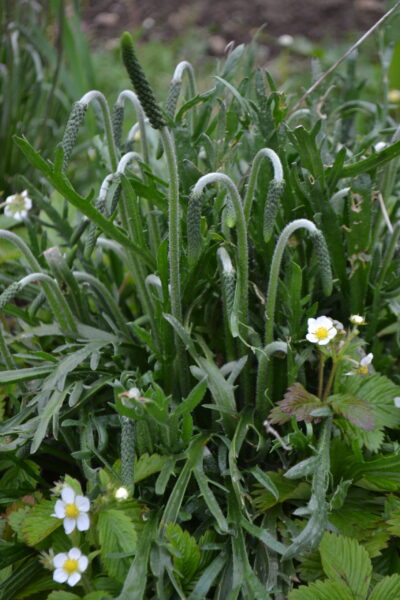
Buck’s horn plantain (Plantago coronopus) is a herbaceous plant, native to the British Isles and also to the rest of Eurasia and northern Africa and introduced widely elsewhere. Although more frequent near the coast (it is quite salt-tolerant) it is also found inland in the southeast of the British Isles and elsewhere along the edge of salt-treated roads. Within a population there are usually annual, biennial and perennial individuals. It self-seeds freely in, and nearby, the area where it is planted which is useful for replacement of plants which die out after a year. (Buck’s horn plantain has an unusual reproductive strategy in that it produces both large seeds which are released as the seed capsule dries out and smaller seeds which are shed by the plant at a later stage.)
It is a pleasant salad vegetable with a nutty flavour and can also be cooked.
Larger and more succulent-leaved plants have been found on Grassholm Island and other islands off the Pembrokeshire coast. This website about the wild plants of Malta includes a photo which appears to be a succulent example of Plantago coronopus.
Hardiness
Hardy to about -28°C.
Soil conditions and location and cultivation
Best grown in a sunny or only slightly shady position. Tolerant of a wide range of soil types but grows particularly well in lighter soils. It can be convenient to allow it to grow in a self-seeding patch. Also worth trying in richer soil and/or in the shelter of a greenhouse or polytunnel for especially tender leaves.
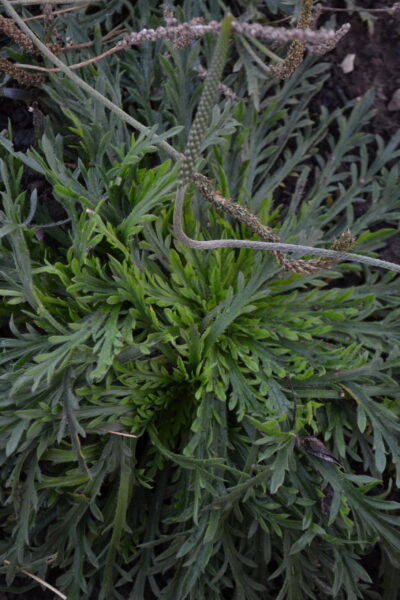
Height
1ft. 30cm.
Spacing
Plants grow to about 1ft (30cm) wide but can be grown more closely, say 6″ (15cm) apart for plentiful leaves from a small area.
Pests and diseases
Not significantly troubled by pests or diseases.
Harvesting and yield
A patch of about a square metre will give plenty of leaves for salads.
How to propagate
Easily grown from seed.
Wildlife value
The Database of Insects and their Food Plants lists buck’s horn plantain as a food plant for many beetles, for the Granville fritillary butterfly (a rare species within the UK confined to the Channel Islands and the Isle of Wight and a few other sites where it has been introduced) and for some flies and moths.
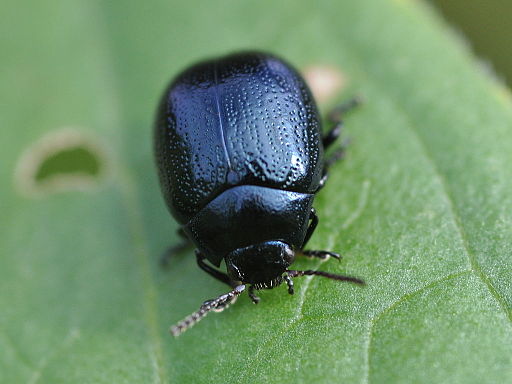
Plantain leaf beetle. Aiwok, CC BY-SA 3.0, Wikimedia Commons
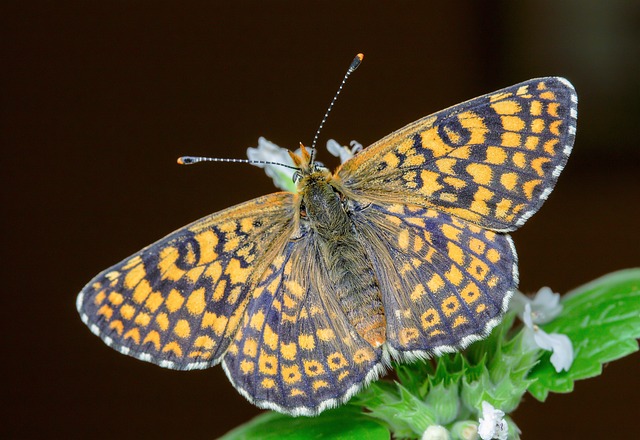
Granville fritillary. Image by Ian Lindsay from Pixabay
Botanical name
Plantago coronopus Linnaeus 1753.
Common names
Buck’s horn plantain, minutina, erba stella, stag’s horn plantain, star of the earth, star grass.
History

Wood cut from Mattioli 1571, A Compendium of All Plants together with their Icons.
It is not unlikely that buck’s horn plantain has been known as a vegetable and medicinal plant since antiquity. In ‘De Materia Medica’ (Of Medical Substances), the five volume medical manual written between 50 and 70 CE by Pedanius Dioscorides, a Greek doctor, the use of a plant called Coronopus which may be Plantago coronopus is described:
Coronopus is a little herb that is somewhat long, with
indented leaves, spread on the ground. It is eaten
(boiled) as a vegetable. It has a thin astringent root that is
eaten for coeliac [intestinal complaints]. It grows in
untilled places, on hillocks and by highways. It is also
called ammonos, or astrion, the Africans call it atirsipte, the
Latins caciatrix, some, stilago, or sanguinaria.
The plant (presumably the same as Dioscorides’) is also mentioned in Pliny the Elder’s Naturalis Historia (C.E. 77). Book 22, Chapter 22 (19) CHAP. 22. (19.) is headed ‘The Coronopus’ and Pliny writes, ‘The coronopus is an elongated plant, with fissures in the leaves. It is sometimes cultivated, as the root, roasted in hot ashes, is found to be an excellent remedy for cœliac complaints.’
Medieval herbalists argued at length about the identity of coronopus in the classical texts but many agree that it was the plant now called buck’s horn plantain. Here is the illustrated entry for Coronopus by Italian doctor, Pietro Andrea Gregorio Mattioli in his 1571 edition of his Compendium de Plantis Omnibus una cum Earum Iconibus (1971).
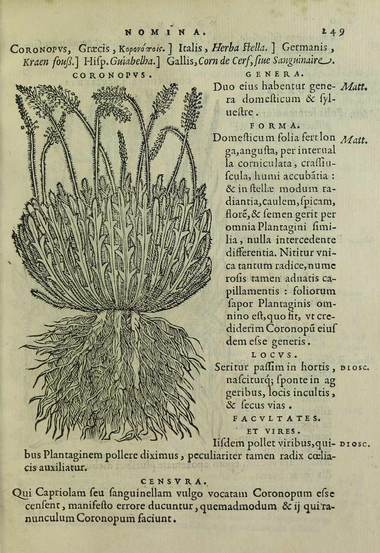
In his commentaries on Dioscorides Mattioli writes that ‘it is a herb that is commonly called Herba Stella, popular and very frequent in all Italian gardens, which is often used in salads……..‘
Since Mattioli’s time, the use of the plant as a salad vegetable has continued in Italy (an ingredient, for example, in misticanza from Rome). Although mentioned by food writers elsewhere (for instance in John Evelyn’s Acetaria: A Discourse of Sallets (1699) it is only in recent years that it has begun to be taken up by farmers in more northern climates as a cold-hardy winter salad leaf.