Tree Onion

H. Zell, CC BY 3.0, via Wikimedia Commons
The tree onion is an unusual onion which form bulbils or ‘topsets’ at the top of its flower stalk but not true flowers.

For this reason it is also called a top-setting onion and, because the bulbils will gravitate towards the ground there rooting anew at a slight distance from the original plant, walking onion.

Its botanical name is Allium x proliferum. Although its origins are obscure, genetic analysis has shown that it is a hybrid between Allium cepa (common onion) and Allium fistulosum (Welsh onion). There are selections of the tree onion made in North America such as the Catawissa onion and others.
Hardiness
Hardy to about -40°C.
Soil conditions and location and cultivation
Sun or semi-shade. Not too fussy about soil type so long as organic matter is quite high. Good drainage and reasonable spacing between plants helps to avoid fungal problems.
Height
90-120cm
Spacing
Plant about 20cm apart. They can be allowed to form a colony of plants as the top setting bulbs naturally root into the ground but thin out the colony from time to time to allow air to easily reach individual plants.
Pests and diseases
Slugs are fond of grazing the leaves in spring. Tree onions are probably susceptible to all pests and diseases found in the onion family. I have certainly read reports of allium leaf miner on tree onions. I haven’t yet heard of them getting white rot.

Harvesting and yield
These onions complement rather than replace common onion crops as the bulbils at the top of the stem are very small (rarely more than 2cm across) and the underground bulbs are also only about shallot size. Each plant will give one underground bulb (or one bulb and a few offset bulbs in older plants) and a small handful of bulbils (say five to eight). Harvest the bulbils as needed in the summer and early autumn and the bulbs after the foliage has died away in the autumn. The bulbs can be left to grow – they will resprout. Some bulbils can be replanted at harvest time to give new plants. Alternatively they can be planted in spring and used for an annual crop of white shank and attached leaves like spring onions.
The hollow leaves are long and plumper than spring onions and Welsh onions and can be harvested sparingly but repeatedly from a growing plant.
Wildlife value
Low wildlife value as flowers are very rare (although perhaps not altogether unknown)
Botanical name
Allium x proliferum (sometimes Allium cepa var. proliferum)

Common names
Tree onion, top onion, top-setting onion, walking onion. Egyptian onion, Egyptian walking onion, winter onion.
History
The earliest reference to the tree onion in the botanical literature appears to be in 1406 in Jiuhuang Bencao (Famine Relief Herbal) written by Ming dynasty prince Zhu Su. Tradition tells that Zhu Su commissioned the collection, planting and study of wild plants in order to recommend suitable plants for eating and medication during times of famine, which was common in the area of China where he lived. It sounds though that the onion described was already a garden plant in the area. He writes,
‘Louzicong is widely planted in people’s gardens. The seedlings, leaves, roots and stems are all similar to onions. At the top of the leaves, there are four or five small onions, which grow in three or four layers, so it is called Louzicong (onion that grows in storeys). It does not produce seeds, but if you pinch off the small onions, they will survive when planted. It tastes sweet, spicy and warm in nature. To relieve hunger – Pick the seedlings and stems with the roots, remove the fine hairs, simmer until cooked, and season with oil and salt. It can also be eaten raw. To treat diseases – Use it together with onions in the herbal medicine category.’
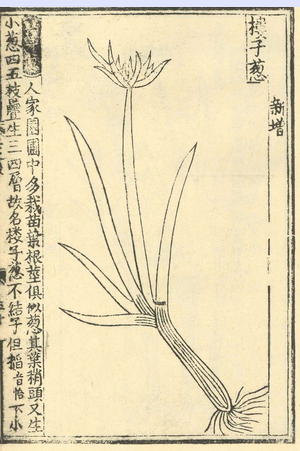
Woodcut of the onion from Jiuhuang Bencao.
In recent time genetic research has indicated that the tree onion is a hybrid between common onion (Allium cepa) and Welsh onion (Allium fistulosum) and H.D. Rabinowitch notes in Onions and Allied Crops that the ranges of these two onions overlap in north-western China, reinforcing the contention that China is its place of origin. (The term Egyptian walking onions is often used but there is no evidence that the plant originated in Egypt. Whilst several alternative explanations are given for this term, none have been verified.)
Further evidence for the Chinese origin comes from Jesuit priest Louis le Comte who reports in 1696 in his Nouveaux mémoires sur l’état présent de la Chine (New memoirs on the present state of China):
I could not refrain from telling you about a type of onion that I have there seen ; it does not come from seed like those of Europe; but at the end of the season we see small filaments growing at the tips or stems of the leaves, in the middle of which a white onion forms, similar to that which germinates in the earth. This little onion grows over time with leaves like those which surround it, which in turn bear a third onion at their tip; in such a way, however, that their size and height decrease as they extend from the earth.
Curiously the first record of the tree onion in Europe may be in a book of philosophy by Benjamin Martin, a London lexicographer, rather than in a herbal. In 1782 he wrote The Young Gentleman and Lady’s Philosophy, in a Continued Survey of the Works of Nature and Art; By Way of Dialogue in which teacher and student, Cleonicus and Euphrosyne, discuss a plant which fits the description of the tree onion (but could possibly be another sort of bulbil-bearing allium).
John Abercrombie lists ‘tree onion’ under Articles for Pickling in The Complete Kitchen Gardener, and Hot-Bed Forcer (1789) but makes no other mention of it.
At some point the tree onion reaches North America. There seem to be no records of this but it must have been fairly early in its history as it was re-introduced to France from Canada before 1875 (possibly as early as 1820) in the form of the Catawissa onion by Monsieur Alfred de Lentilhac and sold by Monsieur Gagnaire, a horticulturist in Bergerac (recounted in Bulletin de la Société nationale d’acclimatation de France). The Catawissa onion is generally believed to have originated in Catawissa, Pennsylvania, developed by one F.F. Merceron according to William Woys Weaver. It is one of several selections of the tree onion now to be found in North America: amongst them Moritz Egyptian, McCullar’s White Topset, Heritage Sweet White, Amish walking onions and others.
The Egyptian onion and Catawissa onion are distinguished in The Vegetable Garden, Illustrations, Descriptions, and Culture of the Garden Vegetables of Cold and Temperate Climates by Vilmorin-Andrieux et cie 1885 (English version, the French can be found here.)

Interestingly the distinction seems to be made on the basis of the Catawissa onion having several tiers of stems and bulbils, but the Egyptian onion having only one. But Zhu Su’s ‘louzicong’ was described as having three or fours tiers. Perhaps multiple layers had become rare in the tree onions circulating in gardens and had to be re-selected for in Catawissa.
I enjoyed this description from mjc of the Catawissa onion….
I grew up less than twenty miles from Catawissa, Pennsylvania, the supposed origin for the Catawissa onion. Next time I get up to my mom’s house, I’ll see if I can find any ‘originals’…lots of people used to grow them and as far as I know, there wasn’t a variety name tagged on to them, but nobody ever called them Egyptian or anything else…just walking or tree onions. I used to grow them as a kid and the one I grew was what everyone else in town grew…which most closely matches the description of the Catawissa., including the fact that they would get rather tall (I had them up to 4’ tall…the little old lady I got my starts from grew them next to a chain link fence…48 inches tall and they would always be about as tall as the fence). I know that fence is gone, but I don’t know if the onions are still there (her granddaughter is living there, last I heard).