Purple Tree Collard
 The purple tree collard is a long-lived tall perennial brassica most commonly grown in the southern states of the USA. It has purple-green leaves which turn more purple in cold weather.

Hardiness
Hardy to about -6°C (i.e. may need protection in cold UK winters)
Soil conditions and location and cultivation
Tolerant of a wide range of soil conditions but will thrive best in a moist, rich soil with a pH of about 6.5. Full sun is preferable but it will tolerate some shade. Avoid a position with poor air-flow because mildew is then more likely to grow on the leaves.
Apply a thick mulch of garden compost once or twice a year to feed the plant.
A strong stake is recommended to support the plant especially on exposed sites. It is common for side branches to break. They usually remain partially attached and continue to grow well with the end of the branch bending up towards the sun again. Unless a less untidy appearance is desired it isn’t necessary to try to prevent this habit with extra stakes or ties.

Broken branches turning up towards the light again
Height
6 – 8ft. 1.80 – 2.4m
Spacing
1 – 2 ft. 30 – 60cm

Pests and diseases
May be vulnerable to any pest or disease that attacks garden cabbage. Especially look out for and protect from slug, snail and sparrow attacks on young plants and mealy cabbage aphid, cabbage white caterpillar and pigeon attacks on plants of any age. The use of bird and insect netting is a reliable method of protecting plants. Mildew may occur due to prolonged damp conditions in autumn or poor ventilation.
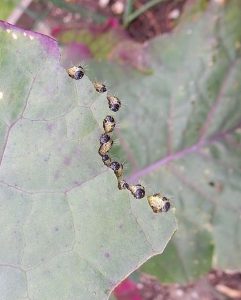
Caterpillars having lunch

Winter damage by pigeons
Harvesting and yield
Allow at least one plant per person.
Pick the youngest, freshest looking leaves throughout the year. They are usually enjoyed boiled or steamed until just tender and served alone as a green vegetable or added to stews etc.

purple tree collard crisps
How to propagate
Flowers and seed pods rarely appear on purple tree collards so propagation is usually done by taking cuttings. Stem cuttings will root easily. Gently pull a side stem downwards from a main stem leaving a small ‘heel’ of woodier material still attached. Insert into moist ground, or into a pot of potting compost planting out when roots start to emerge from the base of the pot.

A cutting stuck in the ground roots easily
Wildlife value
Purple tree collard does not seem to be of high wildlife value (partly because it rarely flowers) and the wildlife it does attract (aphids, whitefly and cabbage white butterflies and their progeny) may detract from its food value for humans. However planting an extra large crop can serve to feed both wildlife and people.
Botanical name
Purple tree collards are a cultivated form of wild cabbage (described in 1753 by Carl Linnaeus as Brassica oleracea). They are placed in the cultivar group ‘Acephela’ (without a head).
Common names
Tree kale, walking stick kale.
History
Purple tree collards are common in the southern states of the USA. (In 2010 the purple tree collard became the ‘official green’ of the City of Richmond in California. The council members proclaimed that the purple tree collard was what the city aspired to be: tough, healthy and productive.) The wild plant that purple tree collard derives from, Brassica oleracea, grew around the shores of the Mediterranean. Many cultivated forms have been developed in many countries throughout human agricultural history.
There seem to be two theories about the history of collards in America (the word ‘collard’ is probably derived from cole-wort, a middle English word for cabbage, now generally referring to a brassica which does not form a head); that they came to America from Africa during the early years of slavery or that they were already on the continent, having been brought there by the first English settlers, but that collard cooking traditions owe a heavy debt to African culinary culture. The first mention in the literature is of ‘colworts’ in a list made by Nathaniel Shrigley in his, ‘A True Relation of Virginia and Mary-land ; with the Commodities therein, which in part the Author saw ; the rest he had from knowing and Credible persons in the Months of February, March, April and May‘, published in 1669.
Very little historical information is available for the origin of the purple tree collard specifically. The idea that they may have originated from the ‘cow cabbages’ or ‘walking stick kales’ of Jersey reaching California in the late eighteenth century is doubtful to me as Jersey kale flowers reliably and looks very different. Genetic studies may have thrown light on their most likely path across the globe – I will update this page as I learn more.