Babington’s Leek
Babington’s leek (Allium ampeloprasum babingtonii) is found in the wild only in Britain, Ireland and the Channel Islands. The whole plant is edible with a garlicky leek flavour.

It grows mainly in sandy and stony places near the sea perennating by means of an underground bulb and its offsets (bulblets). Along with Allium ampeloprasum bulbiferum it is a top-setting variety of Allium ampeloprasum. Tiny bulbs known as ‘bulbils’ develop in its flower-head. Seed is not generally formed. A. ampeloprasum (which is rarer in the Britain and Ireland than the Babington variant) does not have bulbils and reproduces by seed. It has several cultivated forms including elephant garlic, kurrat, pearl onion, Persian leek and A. ampeloprasum porrum, the garden leek.

Hardiness
Hardy to about -20°C
Soil conditions and location and cultivation
Will grow well in a wide range of garden soils including clay ones – but does less well in especially gravelly soils. Will grow in semi-shade or full sun. Tolerant of wind.
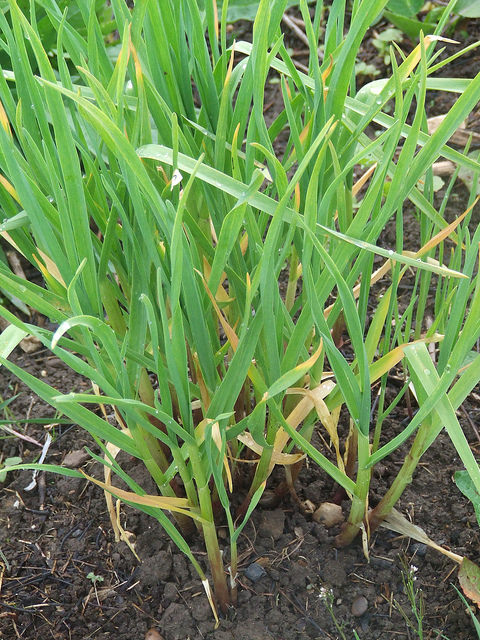
Plant the bulbs or bulbils at any time of year about 20cm apart about 5-7.5cm deep. Shoots will emerge in late winter or early spring. Flower stalks do not usually emerge in the first year after planting but in subsequent years they appear in late spring/early summer and produce a head of bulbils (tiny bulbs) with a few sterile flowers.
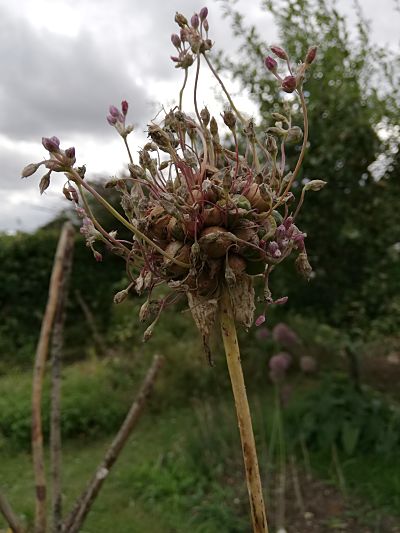
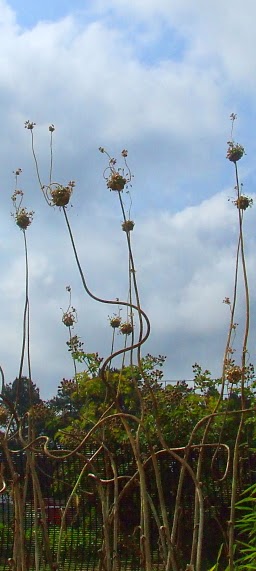
This dies in late summer and the leek is then dormant until the following year. The bulbils on the dead flower stalk may break out of the head and fall to the ground or the stalk may bend over and deposit the bulbils on the soil surface. At some time over the autumn or winter the bulbils put out contractile roots which pull them underground before they then sprout and form a new leek plant.
Height
5 – 6 ft. 1.5 – 1.8m
Spacing
8 inches. 20cm.
Pests and diseases
Leek rust can occur on the plants (and also overwinter on the plants and be transmitted from them to annual leeks).
Harvesting and yield
Do not harvest in the first year of growth. In subsequent years the leeks can be cut off at the base, just above the underground bulb, in spring.

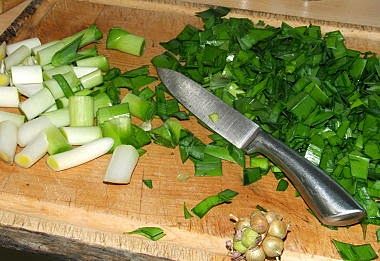
They can be used just as for annual leeks. This should be done before the bulb throws up a flower stalk in late spring/early summer.
In later years when a clump of leeks has developed where each one was planted, the whole clump can be dug and the fattest leeks used in the kitchen with the more slender ones being replanted about 20cm apart.
In summer unripe bulbils from the flower head can be used in salads and casseroles etc. In late summer the bulbs in the ground can be harvested. They may have bulblets attached which can be replanted as replacements (as can the dried bulbils from the flower head).
How to propagate
See details above. Seed is not known to be produced by this variety. Video here on collecting the bulbils.
Wildlife value
Few insects visit Babington leeks, probably due to a lack of pollen in the sterile flowers.
Botanical name
Allium ampeloprasum v. babingtonii (Borrer) Syme
Common names
Babington leek, Babington’s leek, Babington’s garlic, wild garlic, gairleog fidín and oinniun fidín.
History
Babington’s leek appears to have been first ‘discovered’ on the south Isles of Aran (Ireland) by William MacCalla, a naturalist from Roundstone, Galway. in 1834. He sent it to Charles Cardale Babington who described it as Allium halleri in the first edition of his Manual of British Botany. This was changed to Allium babingtonii by William Borrer, halleri having been ascribed to a different species. Babington considered it a distinct species to Allium ampeloprasum, but it was later renamed Allium ampeloprasum babingtonii by John Boswell-Syme. Babington records visiting MacCalla in Galway and finding the leek on Illan Glas in Roundstone Bay, and also later finding it in Cornwall.
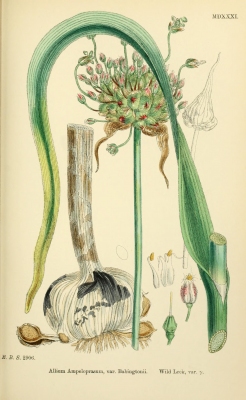
(Alternatively some sources suggest that it was Robert Ball and William Thompson, who discovered it on Aran. This is not the account given in the Supplement to the English Botany of J. E. Smith and Sowerby which was co-authored by Charles Babington.)
Babington’s leek is sometimes considered to have been introduced in ancient times by settlers who used it in cooking as it is often found in association with settlements (i.e. near the ruins of cottages and enclosures). Other authors think it is native at least in Ireland. Babington discussed the matter with a correspondent who suggested it was introduced in Ireland. He responded saying that he thought it was native in Ireland otherwise it would be more widespread in the country.
Whether native or introduced in ancient times, it probably predates the garden leek in Britain, which is believed to have been brought there during the Romano-British era or possibly previously by Phoenician traders and to have spread from there to Ireland. It is conceivable that old recipes such as brotchán foltchep (the Irish leek and oatmeal soup) were originally made with wild Babington leeks.