Garlic Cress
Garlic cress (Peltaria alliacea) is a herbaceous perennial plant native to Austria, Hungary and the Balkan States. It has naturalised in parts of the Czech Republic, Germany and the United Kingdom (at Rubha Phòile on Skye and also near Bath). It is a brassica which provides spicy leaves which make a tasty addition to salads through winter and into spring. At this time of the year it grows fairly close to the ground and has deep green shield-shaped leaves. The extending flowering stems have long oblong leaves which usually have a purple hue. The flower stems can grow tall in good soil and in May the stems erupt into a frothy mass of white blossom which smells of honey. The leaves can be too bitter to eat in summer.
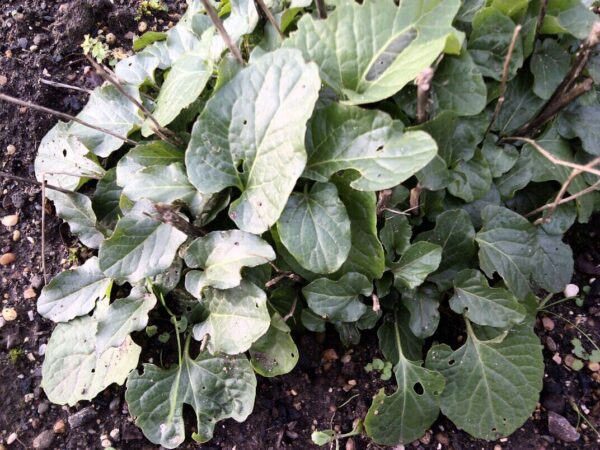

Peltaria alliacea 1, from www.Saxifraga.nl – by Jasenka Topic
Hardiness
Hardy to about -18°C.
Soil conditions and location and cultivation
Garlic cress will grow in a wild range of soils including clay, sandy and stony ones and also in soils of varying pH values. It will grow in both semi-shade and sun. It spreads easily on runners from the main plant and also self-seeds a little and will require annual weeding if this is not desired.
Height
3ft. 90cm. Shorter in poorer soils.
Spacing
3ft. 90cm. If grown in good soil. Otherwise a closer spacing.
Pests and diseases
Not significantly troubled by pests or diseases.
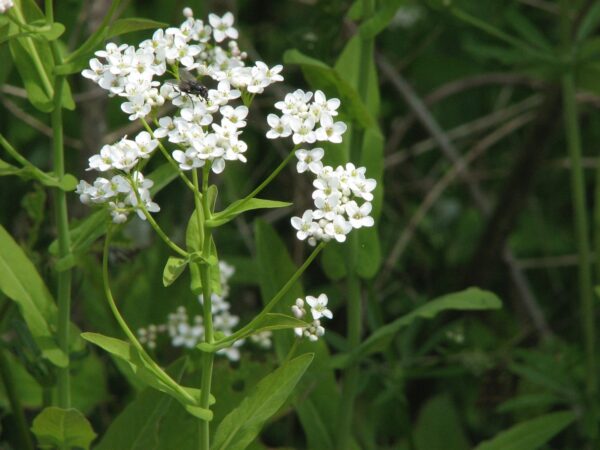
Peltaria alliacea 2, from www.Saxifraga.nl – by Jasenka Topic.
Harvesting and yield
One or two plants will be ample for up to four people.
How to propagate
Dig up the small plants which grow on runners around the main plant in spring and replant. Collect seed and sow in spring. Seed is sparce on the plant but it germinates well.
Wildlife value
Details of insects attracted to the plant are lacking. Observations need to be made. The Database of Insects and their Food Plants records Peltaria alliacea as a food plant for the swede midge (Contarinia nasturti).
Botanical name
Peltaria alliacea. First published and described by Nikolaus Joseph von Jacquin in ‘Enum. Stirp. Vindob.’ on page 260 in May 1762
Common names
Garlic cress, shieldwort.
History
To be completed at a later date.