Garden Sorrel

Garden sorrel (Rumex acetosa) is a hardy, evergreen, herbaceous perennial vegetable/herb plant that originates from grassland habitats, woodland edges and roadside verges throughout Europe, parts of central Asia and North Africa. It is usually considered to have been introduced to North America and Greenland. It is a very useful strong-growing vegetable providing leaves with a pleasantly sharp, sour taste throughout the year. There are superior French cultivars such as ‘Belleville’ and ‘Blond de Lyon’ which have especially large juicy leaves and are less prone to run to seed, as well as completely non-flowering types such as Profusion, and even rarer varieties with wine coloured leaves. (Rumex acetosa is sometimes called French sorrel but this name more commonly refers to Rumex scutatus, buckler-leaved sorrel, a species with smaller leaves but often considered to have a finer flavour and particularly popular in French cooking.)
Hardiness
Hardy to about -40°C
Soil conditions and location and cultivation
Sorrel is tolerant of a wide range of soil conditions, including very acid soils. It needs a fairly moist spoil to do well, and a moist, rich soil to do very well. A sunny location is ideal but it will also grow in semi-shade.

Height
8 – 12 inches. 20 – 30cm. Flowers stems will grow to 24 – 36 inches, 60 – 90 cm.
Spacing
12 – 18 inches. 30 – 45cm.
Pests and diseases
Slugs and snails may eat holes in the leaves which can be a problem for plentiful winter harvests.

Slug-nibbled sorrel leaves
Surrounding the plants with sheep’s wool or sharp grit may reduce nibbling. In other seasons growth tends to outstrip the rate at which molluscs eat the leaves and plenty of untouched leaves can usually be found. Whilst sorrel is a food plant for many insects, generally only a few leaves will be affected on each plant, especially in a garden situation.
Harvesting and yield
Sorrel isn’t usually eaten very frequently in quantity as it is quite sour. (This is due to high levels of oxalic acid in the leaves – so eating sorrel is not recommended for those who suffer from kidney stones or are advised to stick to a low-oxalate diet for other reasons). One plant per person will supply plenty of leaves in summer but it is worth growing at least double that number of plants if harvests are wanted through the winter months. If the weather turns very cold only a few small leaves will be found on each plant. Growing a non-flowering variety such as ‘Profusion’ gives better year-round use.
How to propagate
Seed germinates easily in spring and can be sown where it is to grow. (Male and female plants are needed in order to harvest one’s own seed.) A clump of sorrel can be dug up and divided into sections each bearing roots and a bud. These will establish well (and most quickly in late spring) either in the ground or in pots for planting out later.
Wildlife value
Rumex acetosa is a food plant for a very large range of invertebrates including beetles, flies, butterflies, and moths. (Database of Insects and their Food Plants)

Mines made by the pygmy sorrel moth, one of the world’s smallest moths – the wingspan is 3-4 mm. Photo by Janet Graham, CC BY 2.0.
Botanical name
Rumex acetosa Linnaeus 1753
Common names
Common sorrel, garden sorrel, spinach dock, sour dock, cuckoo sorrel, cuckoo sorrow, cuckoo’s meate, gowke meate, green sauce, sour sabs, sour grabs, sour suds, sour sauce, English sorrel, French sorrel (this name is also frequently applied to Rumex scutatus), red sorrel, broadleaf sorrel, Sauerampfer (German), aveluk (Armenian), oseille (French), acedera (Spanish), túnsúra (Icelandic), almindelig syre (Danish), niittysuolaheinä (Finnish), angssyra (Swedish), engsyre (Norwegian).
History
The oldest reference to sorrel may be in the Fên Chü Ju from the Shih-ching (Book of Odes) an ancient Chinese collection of poetry dating from the 11th to 7th centuries BC.
‘Where near the Fên damp is the ground,
The sorrel gatherers are found,
To eke their scanty food.’

Book of Odes commentary fragment
A plant called lapathon which occurs in the writings of Theothrastus has been identified as sorrel although it is hard to tell which sorrel species is being described. And likewise Pliny speaks at length of lapathum:
‘It is only the lapathum that is better in a wild state than cultivated: in its cultivated state it is the same plant that is known to us as the “rumix,” being the most vigorous by far of all the plants that are grown; so much so, indeed, that it is said that when it has once taken root, it will last for ever, and can never be extirpated from the soil, more particularly if water happens to be near at hand. Its juices, which are employed only in ptisans, as an article of food, have the effect of imparting to them a softer and more exquisite flavour. The wild variety is employed for many medicinal purposes.’
The subsequent history of the use of the plant in Europe is hard to outline briefly as being a native plant it has clearly been in traditional use for centuries in many European cultures. It is mentioned frequently in the literature. Sorrel (of some description) is one of a list of herbs in a cure for the ‘sweating sickness’, a virulent viral disease of the time, recorded amongst the papers of the court of King Henry VIII. It is mentioned in 1699 by John Evelyn in ‘Acetaria, A Discourse of Sallets‘ and in 1728 in Richard Bradley’s ‘Dictionarium botanicum : or, a botanical dictionary for the use of the curious in husbandry and gardening’. Amongst sorrel varieties suitable for garden use Bradley lists a long-leaved sorrel which never runs to seed, ‘This a Rarity and I have only seen it at Mr Chapman’s, a very curious gardiner, near Pitfield-Street, Hoxton.’ (He also talks of Acetosa Maxima Germanica, the Great Sorrel of Germany, with larger leaves than garden sorrel, sometimes curled at the edges and tuberous joints that will root when placed in the ground. Perhaps a wild dock of some sort.)
Sorrel is used extensively in France to make potage d’oseille (sorrel soup) or potage santé (health soup) but sorrel soup is also found in cultures all over Eastern Europe, often called shchavel borscht, ‘shchavel’ or a version of this name deriving from various Slavic languages of the region, and in turn giving schav, the Ashkenazi Jewish name for the soup.
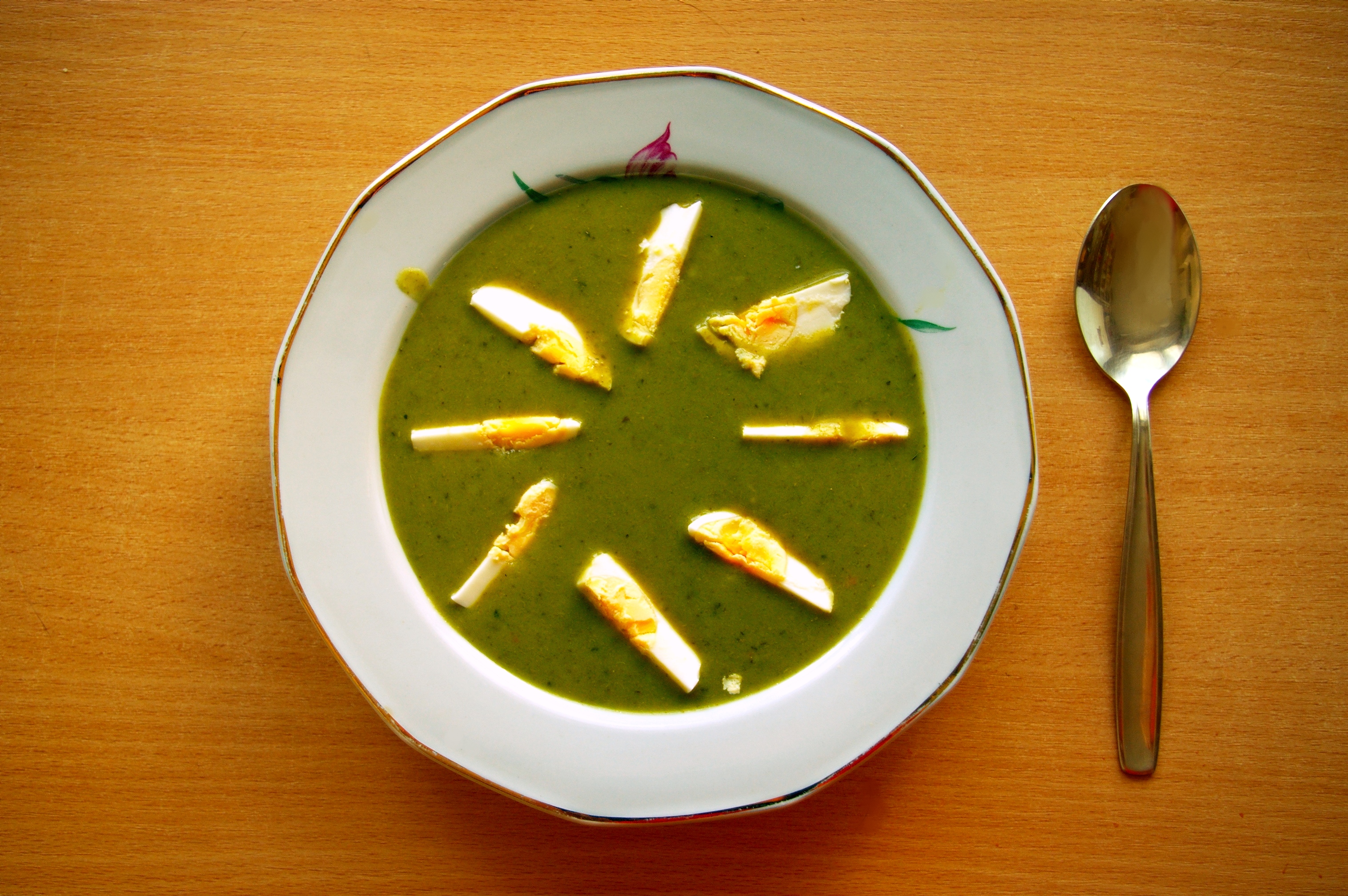
Sorrel Soup with Egg by Michal Sulik CC BY 3.0
In Armenia sorrel is traditionally dried and braided and then rehydrated in winter and stewed with onions, potatoes, walnuts, garlic, bulgur wheat or lentils, and sour plums to make aveluk soup. Sorrel is also used to make a green sauce to accompany oily fish and meat, and cooked with eggs, added to stews and used in fillings for pastries such as byrek in Albania or spanakopita in Greece.