Nine Star Perennial Broccoli
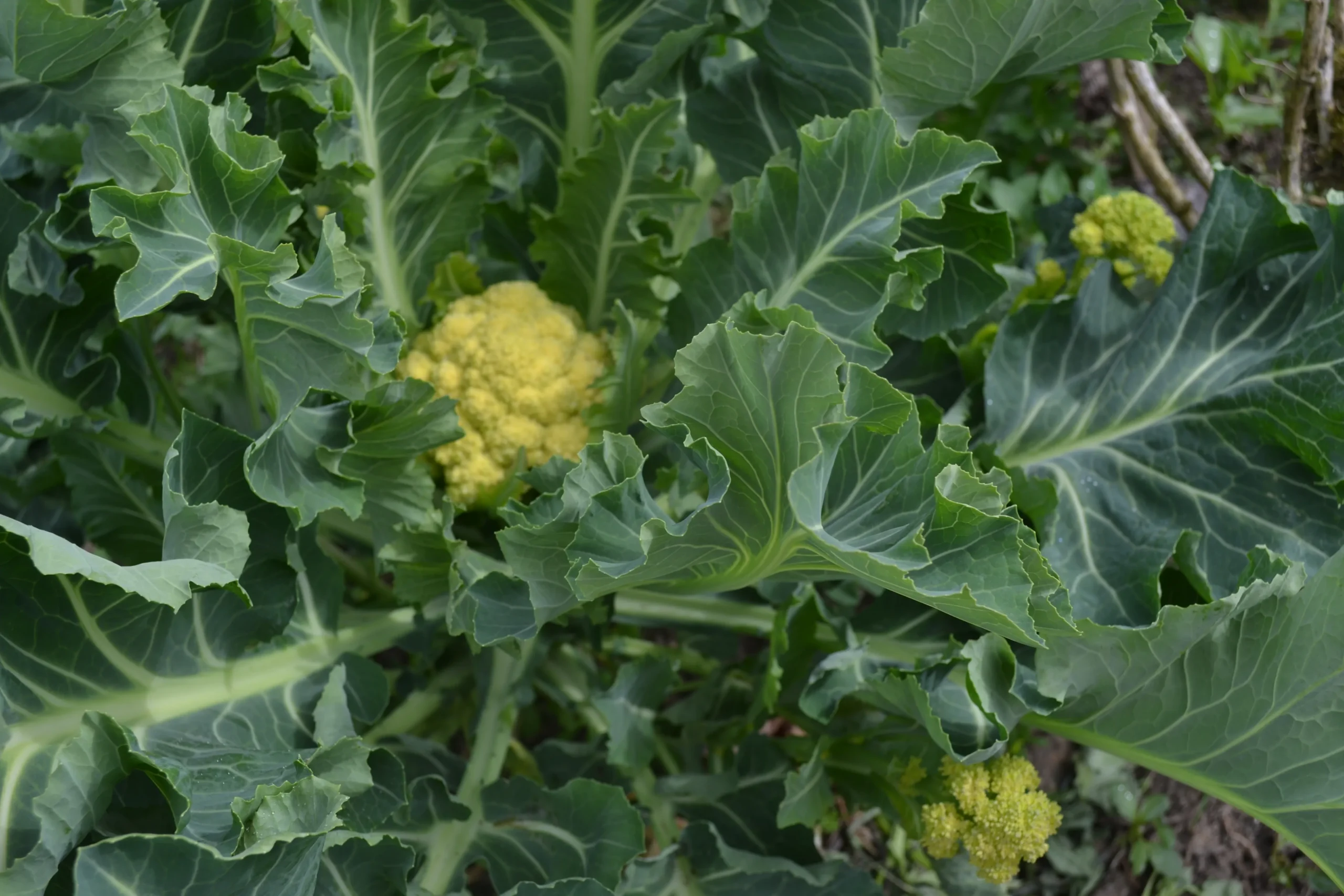
Nine star perennial broccoli is a brassica which produces multiple white broccoli sprouts, some of which can be large, for several years in a row. To maintain production it is important to feed the plant well and to remove all the sprouts before they flower. It is a form of broccoli and not a cauliflower as is sometimes said – if left to flower it will develop normal flowers, unlike the cauliflower, which can only rarely do this due to a genetic mutation which causes the formation of the typical cauliflower head.
Hardiness
Hardy to about -10°C.
Soil conditions and location and cultivation
Ideal conditions are fertile, well-drained, alkaline soil in full sun. It will grow in most garden soils but high fertility is important.
Height
3ft. 0.9m.
Spacing
3-4ft. 0.9-1.2m.

Pests and diseases
Slugs and snails and birds may eat the seedlings. Pigeons may eat the foliage especially when the weather is cold – nets are often required. Cabbage white butterflies lay eggs on the leaves in spring and the hatching caterpillars eat the leaves (make sure any protective nets are raised well above the plants to prevent the butterflies laying eggs through the net.) Mealy cabbage aphid can be a serious problem and it is worthwhile removing small colonies before they multiply. Growing plants nearby which attract parasitic wasps can reduce insect pest populations.
Harvesting and yield
Well grown plants will produce a large central cauliflower-like flower sprout and several good-sized smaller ones from side shoots. About 4-11 heads in total. Yield rather depends on getting a good seed strain. The leaves have good flavour too.

How to propagate
Grow from seed in spring. Can be propagated from non-flowering side shoot cuttings if the plant has some of these. Push the cuttings into a pot of compost, preventing too much moisture loss with a clear ventilated plastic cover. They should take just a few weeks to root during spring to autumn.
Wildlife value
As detailed under pests and diseases the leaves are attractive to a range of creatures but this can detract heavily from their food value for the gardener. However leaving a plant to flower at the end of its useful life will benefit ladybirds, hoverflies, bees, wasps and many other insects.
Botanical name
Brassica oleracea botrytis asparagoides
Common names
Nine Star perennial broccoli.
History
The earliest reference to Nine Star broccoli is The Gardeners’ Magazine 1907 (previously Gardener’s Weekly Magazine and Gardener’s Magazine) where its development is credited to Mr W. Crisp of Heathfields, Fordham Heath, near Colchester. It is reported to be a cross between one of the single headed varieties and a sprouting kind. The writer describes a specimen in its fourth year giving nine heads with three of the largest measuring 11, 10 and 8½ inches across.

(1914, November 6). Reporter (Box Hill, Vic. : 1889 – 1918), p. 5. Retrieved April 19, 2017, from https://nla.gov.au/nla.news-p7319611/
Later journals also mention Crisp’s Nine Star Perennial Broccoli, which agree that the plant ‘yields from five to nine good heads each year’ and ‘they are not weaklings by any means’ (Garden Life 1920). The need of the plant for plenty of feeding is usually emphasised and also sometimes the practice of thinning out developing shoots if too many are produced, to encourage fewer larger ones to grow. One writer says that William Crisp wrote to him, in reply to his enquiry, to say that the broccoli came up in a row of ordinary broccoli – no mention of it being a cross, not a deliberate one in any case. There are also references to Nine Star Perennial Broccoli being developed by a Mr Charles Curtis in 1927 but clearly a plant by that name was already in existence.