Patience dock
Patience dock (Rumex patientia) is a herbaceous perennial plant, native to southern and eastern Europe but introduced and often naturalised in other regions of Europe, and in North America and Asia. It has a mildly acid flavour and a soft texture when cooked.
Hardiness
Hardy to about -20°C
Soil conditions and location and cultivation
Will grow well in a wide range of garden soils including heavy clay ones. Will grow in semi-shade or full sun. Will tolerate weed growth, but keep weeded and mulch with compost annually to maximise leaf production.
Height
5 – 7ft. 1.5 – 2.1m (when in flower) Leaf clump grows to about 60cm.

Spacing
Space plants about 30cm apart. (They can be thinned to about 50cm apart when they grow big, or divided.
Pests and diseases
Slugs and snails will eat the new leaves in spring. Mature plants with a well-developed root stock will grow through the damage but young plants may need some protection. Dock rust may occur (although I’ve only seen some slight spotting of what might be dock rust on my plants and only on older leaves, not the younger ones which I harvest).
Harvesting and yield
Harvest fresh looking young leaves. Older leaves can be bitter so it can be useful to cut the plant down to the ground (from their second year on) in late spring to give new flush of young leaves. For fairly frequent use of this plant grow about three plants per person.

How to propagate
Sow seed in spring, prick out seedlings into pots and plant out when well grown.
Wildlife value
Rumex patientia is a food plant for various weevils, including Hypera rumicis, which spins a ‘golden net ball’ cocoon. Also food plant for dark-coloured dock aphids and the dock sawfly Ametastegia glabrata (Source: BRC Database of Insects and their Food Plants)

Weevil (Hypera rumicis) larva, Otmoor, Oxfordshire
By Charles J. Sharp CC BY-SA 4.0
Botanical name
Rumex patientia Linnaeus 1753
Common names
Patience dock, garden patience, herb patience, monk’s rhubarb, passions. (Note that patience dock is also a name used for bistort (Bistorta officinalis) and monk’s rhubarb is also used for Rumex alpinus and Rumex pseudoalpinus and Rheum rhaponticum.)
History
It is hard to pin-point the botanical identity of the different docks and sorrel mentioned by Greek and Roman writers. Cultivated ‘lapathon‘ (Dioscorides) and ‘garden lapathum‘ (Pliny) may be Rumex patientia. Lapathum remained the name given to the dock genus until Linnaeus classified them under the name Rumex. But it may also be the origin of the name of ‘patience’ for R. patientia, the theory being that, when the plant was introduced to Britain from Italy, it was called ‘lapazio’ (from Lapathum in Latin), and this became corrupted in English to ‘patience’ (and sometimes also to ‘passions’ from similarity of sound to La Passio, the Passion of our Lord).
The name of monk’s rhubarb appears in 16th century herbals such as those of Tragus (Hieronymus Bock) and Fuchs. Bock wrote in his herbal book that monk’s rhubarb was first discovered near Simonswald in the Black Forest and was then grown in monasteries in the area and used as a substitute for rhubarb root (a highly prized medicinal at the time). The references to monk’s rhubarb from this era are sometimes said to refer to Rumex alpinus but the illustrations in the herbals usually show the longer pointed leaves of R. patientia rather than the rounder ones of R. alpinus.
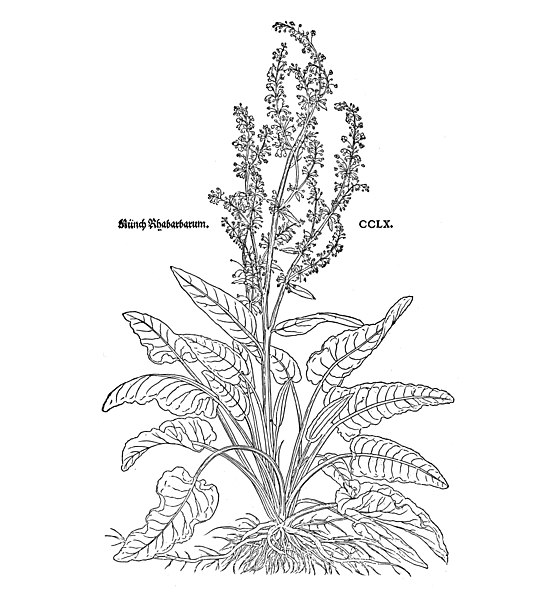
Illustration of herb patience from Leonhart Fuchs, New Kreuterbuch, 1543
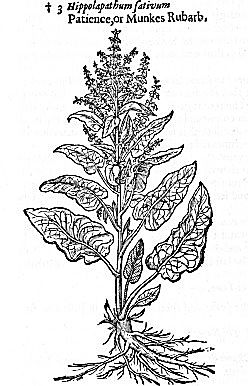
Illustration of herb patience from Gerard’s Herbal 1597
Louden gives the date of introduction of R. patientia to Britain as 1573 but it appears in an alphabetical list of herbs ‘necessary for a garden’ which was compiled for a Surrey landowner, Thomas Fromond, soon after 1525, and ‘Pacience’ is also mentioned by Turner in The Names of Herbes (1548) in a description of different kinds of dock.
Although it is still commonly eaten as a vegetable in countries of Southern Europe, its use in Britain was already dying out by 1817 when Patrick Neill wrote in An Account of British Horticulture, ‘In old times , garden-patience was much cultivated as a spinage. It is now very much neglected, partly perhaps on account of the proper mode of using it not being generally known. The leaves rise early in the spring; they are to be cut while tender, and about a fourth part of common sorrel is to be mixed with them. In this way patience-dock is much used in Sweden, as we have been informed by the late Sir Alexander Seton of Preston, who had an estate in Sweden, and frequently resided there. This mixture may be safely recommended as forming an excellent spinage dish.’
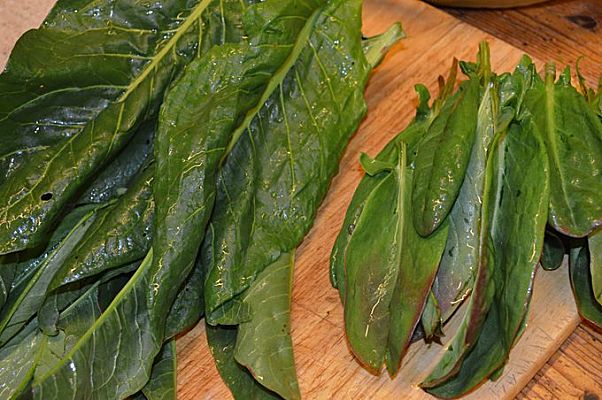
Garden patience and garden sorrel leaves