Welsh Onion

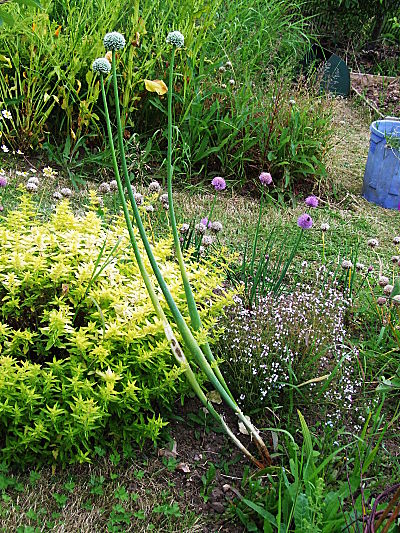
Welsh onion (Allium fistulosum) is an edible, perennial member of the onion family. It gives green onion-flavoured leaves to harvest through the year until late in the autumn and fresh regrowth appears early in the spring. It does not form plump bulbs but the leaves arise from a slightly thickened base, which produces tillers in time to form a medium-sized clump. Round white flower-heads arise in summer.

Farm, CC BY-SA 3.0 via Wikimedia Commons
Allium fistulosum also includes Japanese bunching onions, grown in quantity in China, Japan and in Korea. They are often single stemmed and most varieties divide less freely at the base than Welsh onions (but are sold in bunches – hence the name). They are grown for their thickened ‘pseudostems’ (false stem like that of a leek made of tightly rolled leaf bases). There are many varieties grown in Japan and they have been classified into four cultivar groups by Shigenori Kumazawa:
- Kaga. Grown for their pseudostems. Dark green thick leaves, little tillerin. Become dormant in winter.
- Kujyo. Tender, green leaves to eat, Profuse tillering. Stay green over winter but have low cold tolerance.
- Senju. Intermediate between the former two. Grown mainly for their pseudostems. Growth continues during winter, but at a reduced rate.
- Yagura negi ( A. fistulosum var. viviparum Makino). Produces numerous tillers in spring and summer. Growth stops in winter. It produces no flowers but only bulbils.
The notes below refer in the main to Welsh onions. I haven’t grow many of the Japanese varieties yet and their culture may differ.
Hardiness
Hardy to about -17°C
Soil conditions and location and cultivation
Best grown in a sunny location in a fertile, well-drained soil with a pH 6.5 to 7.5 but will grow adequately in more acidic soils and in damp, heavier ones.
 Height
50 – 60cm
Spacing
30cm
Pests and diseases
Generally trouble-free but can be affected by onion white rot and downy mildews. Allium leaf miner (Phytomyza gymnostoma) can occur on the plant.
Harvesting and yield
Harvest green leaves at any time by cutting them close to the base but take just a few from each plant or allow the plants to regrow well between pickings. Whole onions can also be pulled from the clump.
How to propagate
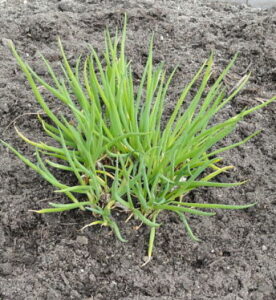
Dig a clump, divide and replant. Can also be grown from seed which is best sown in spring.
Wildlife value
Very attractive to bees.
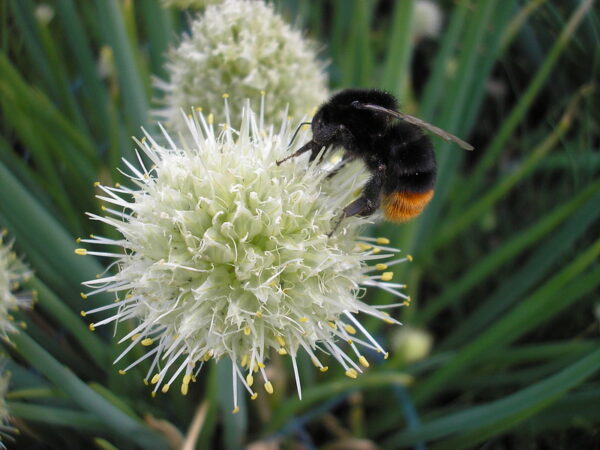
Gerwin Sturm CC BY-SA 2.0
Botanical name
Allium fistulosum Linnaeus 1753
Common names
Bunching onion, Japanese bunching onion, spring onion, escallion, scallions, sibies, ciboules, negi, silpa, cebolinha, chibbles. (Scallions and spring onions can refer to various species of Allium, eaten at a young, green leafy stage.)
History
Allium fistulosum is not known in the wild. DNA studies by Friesen et al. (1999) indicate that it originated from the wild species, Allium altaicum, that is native to rocky slopes and plains in southern Siberia, Kazakhstan, Mongolia and China.
Allium fistulosum has been cultivated in China, Japan and Korea for centuries and is the primary onion used there. First references in China may be found in ancient Chinese scripts, for instance in the Shi Jing. However the symbol for onion or ts’ung found there may also represent other types of onions in China at the time such as Allium tuberosum. BK Singh and Y. Ramakrishna (2017) note that details of how to grow the bunching onion were described in a Chinese book of 100 BCE (possibly quoted in the later 6th century Qimin Yaoshu) and that the plant was first mentioned in Japanese literature in 720 ACE.
The species is believed to have been brought into western Europe during the Middle Ages, and from there into Russia. Attempts to trace this latter history can be made by searching for mentions of the onion in the herbals and gardening journals of the time. This illustration of Cepa oblonga in Rembert Dodoens’ ‘Stirpium historiae pemptades sex‘ of 1583 (his Cruydeboek in Latin) is considered to be Allium fistulosum (although the bulb looks rather fatter than A. fistulosum today). It is fatter also in the illustration of Cepa longa – (4 below – also identified by writers as fistulosum) published in the following century in England in John Parkinson’s ‘Paradisi in Sole Paradisus Terrestris’.

Allium fistulosum came to be known as Welsh onion during this European phase when the word ‘welsche‘ was applied to them, derived from pre-German walhaz, used by ancient Northern Europeans to denote things coming from the Romanised regions to the south (sometimes considered to have the more general sense of ‘foreign’).