Forager’s Meadow or Forest Garden?
Several things are coming together in my mind at the moment regarding one of our allotments. The one we call ‘Old’ as it is the first one I rented (twenty-four years ago now – yikes!) It is the most established plot and the one which is most like a garden. It is about 10m wide and 25m long and houses the 12′ x 8′ greenhouse, a shed and lean-to greenhouse, thirteen trees and twenty vegetable beds.
After creating the Experimental Perennial Vegetable Garden, and feeling quite satisfied with how it turned out, I’m rather wanting something similar on a larger scale at Old.
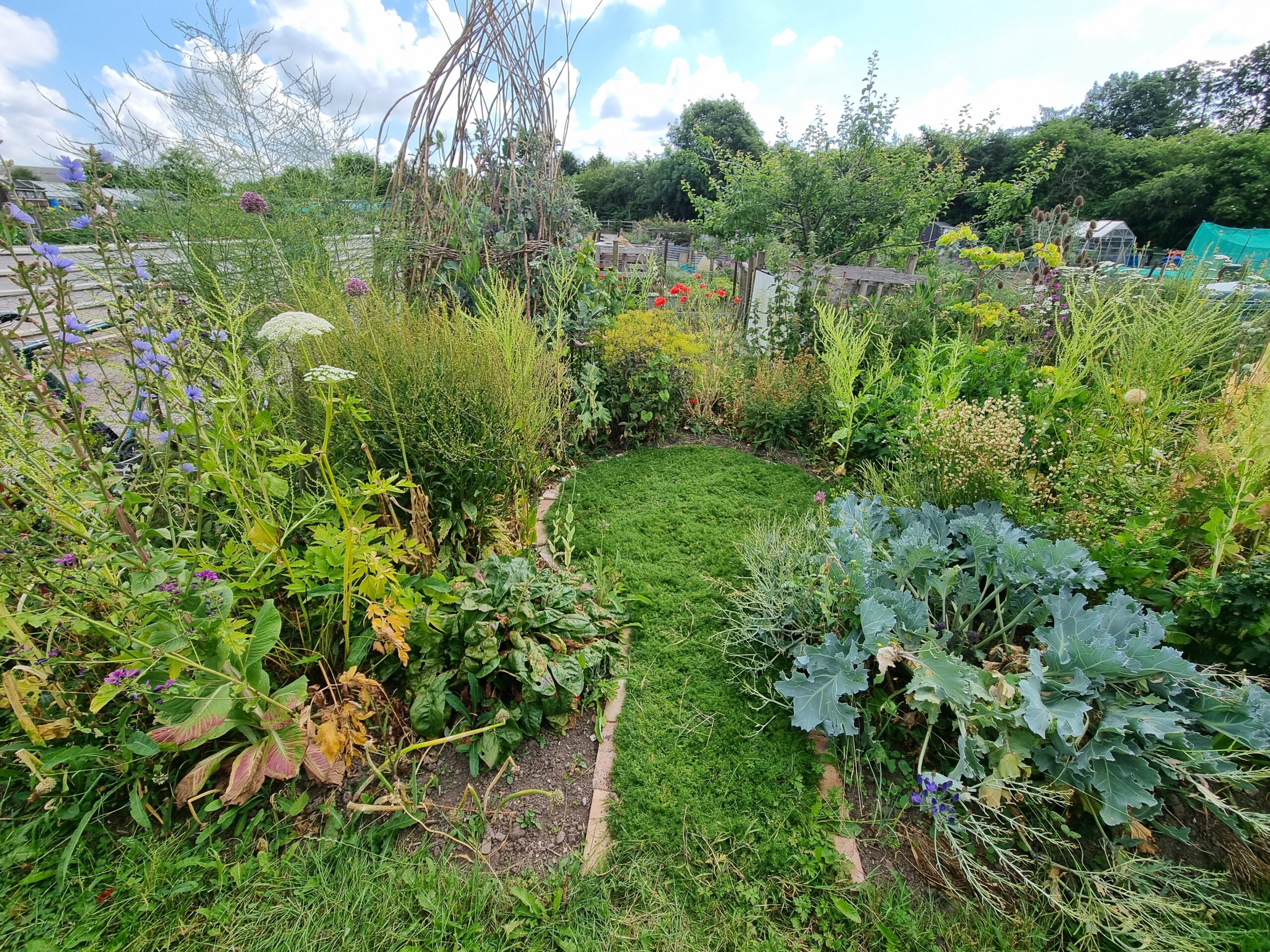
An expanse of all our favourite perennial vegetables interspersed with wild flowers for colour and to bring in the insects, surrounding a camomile lawn.
I have also come across the concept of a ‘foragers’ meadow’, containing both wild flowers and perennial vegetables, through a seed mix sold by Northwest Meadowscapes in America. And I am inspired by the work of Joshua Sparkes on natural farming, syntropic agriculture and fertility management.
These thoughts were in my mind when I saw a very beautiful meadow, also containing perennial vegetables, which Mandy Barber has sown and which brought the idea vividly to life for me.
I’m imagining just one central broad path running through the plot leading both to a camomile lawn for relaxing in the sun, and to the greenhouse, shed, cold-frames, compost heaps, workbench, mucky area etcetera, at the back of the plot, with some dedicated island beds accessed by narrower side paths or stepping stones for plantings of, say, asparagus, skirret and oca. A tentative sketch of the new layout is shown below, basically a curved path, camomile lawn, and island beds shown in red drawn over the present layout of beds which will disappear.
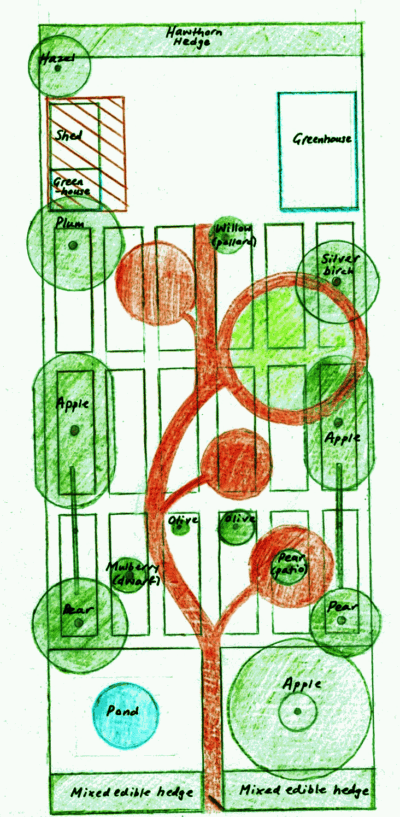
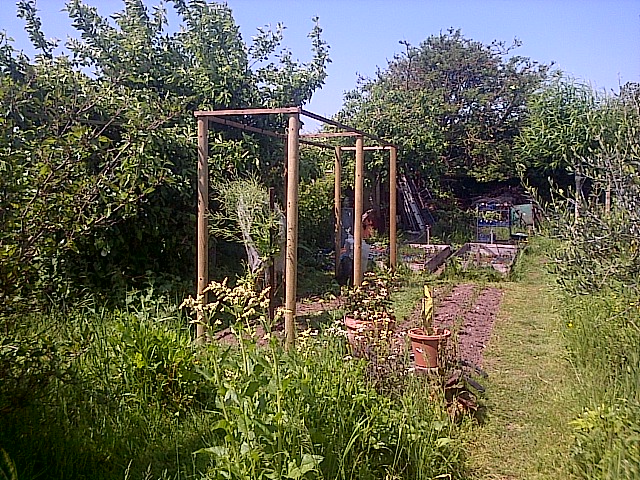
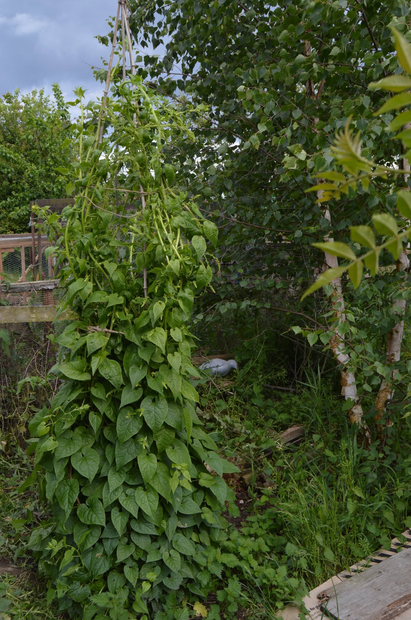
I think I will have narrow margins along the path and around the lawn for the smaller annual and perennial vegetables and herbs, such as everlasting and potato onions, wild rocket, carrots, peas, sage and thyme, and squeeze in a squash arbour spanning the path at the back. I’ll incorporate the perennial kale cage I’ve started to build (visible in the top photograph) and put in more supports at the sides of the plot for climbers like Caucasian climbing spinach, hopniss (Apios americana) and Chinese yam. (There are two of these supports on the plot already which are for grapes – they are drawn on the plan but I forgot to label them.)
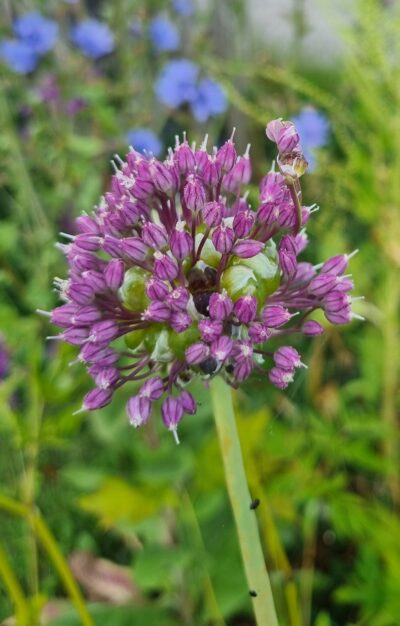
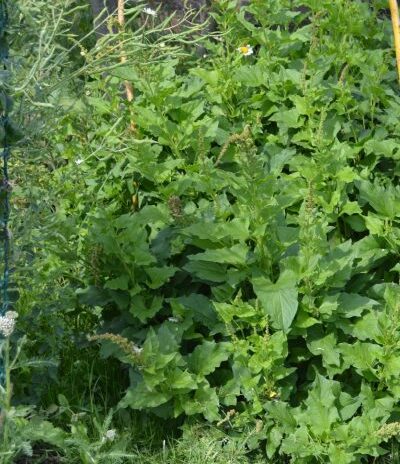
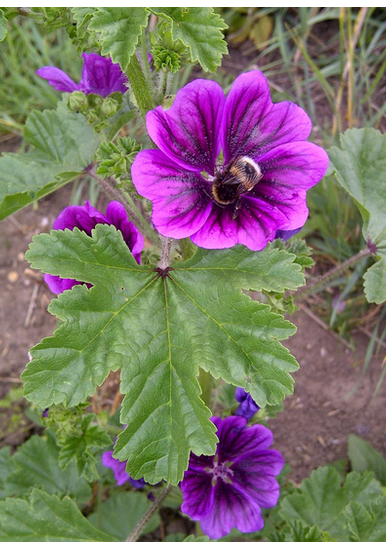
The rest of the area will be riot of colourful wildflowers, tall herbs, some ornamental flowers. Many sturdy perennial vegetables such as Good King Henry, ashitaba, sea kale, and perennial alliums can grow amongst them, quite able to hold their own in this natural setting.
I’ll keep all the trees, the mushroom bed and the pond of course and make some log piles and other wildlife refuges. I also have a bit of a desire for a bigger shed/summer house – hence the red hatched area at the back of the plot.
This will optimise the plot for feeding invertebrates and birds and small mammals whilst also providing a good lot of easy-to-grow food for us. And it would simplify its upkeep for when we are older. At present we need the space as it is for the sales and stock plants, so it is a plan for some unspecified future time rather than now. When it comes to it, I don’t think it will be great deal of work if I mulch out the grass paths and plant the new areas that then become available with the desired perennial vegetables, ground-cover plants and wild flowers. In places I might need to sow some yellow rattle or do some top soil stripping to reduce the fertility for the wildflowers. Then there will just be the job of making the curved path, camomile lawn, and island beds.
In the context of a pretty standard 10 pole (250 square metres) allotment plot, with the trees necessarily fairly close together, this could be thought of either as a forager’s meadow or equally as a forest garden. (Trees aren’t necessary for a forager’s meadow, but I sincerely commiserate, by the way, if you would love to plant trees but your allotment rules disallow it. Short-sighted surely in view of climate change.)
So there you go, that’s the plan. I do hope I actually get around to carrying it out!