How to Ferment Jerusalem Artichokes
Fermenting Jerusalem artichokes is the one thing that has worked for me to significantly reduce the unwelcome farting effect they have!

(Adding herbs and spices or pre-soaking in lemon juice hasn’t helped and neither has using different cooking methods or late harvesting. I haven’t yet managed to properly put to the test the idea of eating them frequently in very small quantities until one’s system becomes used to them – which may well work but takes dedication.)
I have posted about fermenting the tubers before but haven’t until now written a step-by-step explanation of how to do it.
So this is what I do (with thanks to Cissy Budra who taught me how simple it is to do it).
- Scrub the tubers and chop them into pieces. As the pieces stay quite crisp I’ve found that cutting them up quite small works best if I want to eat the results in their raw state. Pack them into a glass jar leaving a space of a few centimetres at the top, as the fermenting liquor will rise as it bubbles.
- Add other ingredients for additional flavour. Today I added small pieces of garlic, ginger root and chilli and some turmeric powder. I meant to add a bay leaf or two but forgot (will pop them in later this evening). Cissy told me that onions work well and other root vegetables like turnip and radish and she likes chunks of cabbage too.
- Cover the contents with a brine solution (salt dissolved in water: 2tblsp salt per litre of water). Today I made up 2 litres of solution which was enough for two 2-litre jars of artichokes (these are quite large jars – 1 litre jars were the ideal size for my first attempts.)
- Cover loosely with a lid so that dust is kept out but bubbles of gas can escape. I use the glass lid that fits the preserving jars I use – with no clips. A cloth or large jam jar lid would do. Place the jar on a dish to catch any overflow of liquid as the fermentation proceeds. Leave on the kitchen side at room temperature for about two weeks. White scum that develops is harmless kahm yeast and can be ignored or skimmed off.
- Taste at intervals and, when it tastes good, eat it! Keep the uneaten portion in its jar in the refrigerator.
That’s it!

I will eat and enjoy these but nobody else in the family is keen (yet!). I had the idea the other day that I could use the fermented tuber pieces in cooked dishes. So that I can try this I did another jar of larger pieces, just in brine and with no additional ingredients.
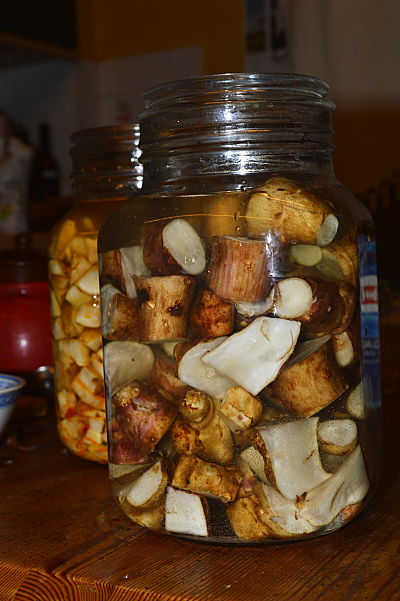
I’ll update this post in a couple of weeks or so with the results of my brews.
Update 13/01/21 Had a taste today. The small pieces of artichoke with garlic, ginger, chilli and turmeric are so scrummy – really looking forward to having some more for lunch. The big pieces in the other jar are less exciting of course, just a bit tangy compared to raw artichoke – but these are intended for cooking. I will make some artichoke soup with them soon and then give a wind update!!
Update 26/07/21 Unfortunately I left the large pieces to ferment just too long! Some nasty looking moulds developed at the top of the jar and I stuck the jar on a shelf in the garden out of the rain. When the jar got knocked on its side a week or so later and a pong arose, I attempted to rinse any mould off the now very soft fermented artichoke. Pieces I dared to taste were not unpleasant but very sour. I made some soup just now with the washed artichoke (along with onion, garlic, and stock) but it too tastes just too sour. I’m also not sure the bad smell is entirely gone and I can’t eat it!
Conclusions: Fermenting small pieces of Jersualem artichoke with spices makes a delicious non-flatulence-producing condiment. Fermenting large pieces (for using in cooked dishes) clearly also breaks down all those wind-producing complex sugars – but don’t leave them for too long. I would guess at about four weeks for the right degree of tanginess and crispness.
lieven david
I fermented sunchokes the same way, two weeks ago. I shredded them, added cabbage, beetroot, onion + brine + spices.
Great taste, and most of all: my tummy digests them well, for the first time ever.
Alison Tindale
Brilliant! Pleased to hear it has worked for you too.
mr naughty
all very good but i love farting
Alison Tindale
Fair enough!
Anni Kelsey
Hi Alison, Happy New Year!
I am planning to give this a go in the next couple of weeks – does it matter what kind of salt you use? I am guessing that as it is NaCl – whether it is cheap supermarket table salt or more expensive sea salt – that it probably doesn’t affect the outcome.
Have you ever tried fermentation with other tubers like mashua or oca?
I have just looked table salt and found that it is mined and needs more processing than sea salt so I guess it costs more in energy.
Perhaps I am answering my own question here!
Alison Tindale
Happy New Year to you too Anni! Well I have always used sea salt as that is what we have in the cupboard but I don’t think it would make a difference really. I think the only other root veg I have done are Chinese artichokes, skirret and scorzonera. They all worked but the scorzonera surprised me by coming out with a soft texture.
Anni Kelsey
Great, thanks, I will follow your example.
Claire Lindow
I am trying fermented jerusalem artichokes for the first time. This is the first year I’ve grown them and I was delighted by the yield. How long would you say they typically take to ferment?
Alison Tindale
Hi Claire, I do them for three to four weeks.
Linda
I have a bumper crop! I have grown these previously in sandy soil and had no noticeable gas, but in a rocky more alkaline soil they are terribly gassy. I felt bad for my neighbors I shared with!
Now I have lemons, but if that doesn’t work out. Guess I will ferment them, thanks
Alison Tindale
Good luck with the acid hydrolysis Linda!
Holly Hope
I tried a version of this pickling before making our soup for last night. Because I have histamine intolerance and have issues with almost everything fermented (even tea), I peeled the tubers and let the sit in water with a splash of lemon juice until they were all peeled. I transferred them to the jar, added the brine, and added a capsule of histamine-reducing probiotics, and put it in a dark box. It only sat overnight, but it was bubbly in the morning. Then I added a few more tubers in the morning. The soup was delicious and no pre-flatulence cramps.
Alison Tindale
Good result Holly! I hope it continues to work for you.
Paul
Hi I’ve grown a crop to last all Winter. Naturally they’d be valuable lasting all year. So, how long do they keep once fermented, out of a fridge?
Alison Tindale
I usually have them eaten up in a month or two so this is a little hard to answer from experience. One jar I had made from larger pieces went mouldy after about six months. I suspect this could have been avoided if I had topped the jar up with brine and I have heard the suggestion to use a stronger brine for long-term storage. One thing to bear in mind is that the artichokes will become more sour with time so taste from time to time to make sure they are still to your liking.
Philip Lister
I grated the artichokes, added turmeric chilli garlic and ginger and the results are lovely, very sweet.
I made an accidental discovery as the brine overflowed from the jar, collected into a saucer I placed below it and naturally condensed being in a warm place (on top of boiler.) The resulting salty syrup is not dissimilar to soy sauce!
Alison Tindale
Going to have to try that!
Bill Lutz
A quick thank you! Grew then for the first times this past year but a quick freeze (Colorado, USA) killed off the tops before the flowers formed. Since my doc had suggested the active ingredient of the chokes, I decided to check on them once the ground thawed a bit: result was TONS of small round chokes! Will be trying the fermentation soon. Again, thank you for your great article and thank the commenters!
Pauline
Hello from Melbourne Australia where it is autumn. I had one Jerusalem Artichoke/sun choke plant which has just yielded a 10 (Aussie) litre – your 10 quart I think- bucketful. when cleaned, scrubbed, trimmed and sliced, I have 11 x 2lb jars fermenting. This is a typical crop from one plant in our Temperate climate.