Chinese Lantern Salsa

The fruits of Chinese lantern, Physalis alkekengi, are often described as poisonous but are actually edible if fully ripe. The rest of the plant including the calyx (the lantern) is toxic. The usual advice is to wait until the calyx is skeletonised (there is a skeletonised calyx to the left in the photo below).

The first fruit I ever ate was in a skeletonised calyx and in fact was amongst the leaf litter in autumn beneath the bare stems of the plants. It was surprisingly sweet for a fruit I had expected to be bitter and it piqued my interest in Physalis alkekengi as a hardy perennial tomato-like vegetable. (There other Physalis species often grown for their fruit in this country such a P. peruviana, the Cape gooseberry, an annual, and P. ixocarpa, the tomatillo, a non-hardy perennial. There are also several edible hardy perennial Physalis species from North America – usually known collectively as ground cherries – which are not well known in the UK but are worth investigating.)

Hardy perennial ‘tomatoes’?
Even when accounts of Chinese lanterns acknowledge that the fruits are edible they are still reported as bitter. It may be that on most plants they only sweeten much later in the season but are rarely gathered quite so late. But perhaps they never sweeten up on some plants. I have discovered that there is a wide variability in alkaloid levels between populations of plants – and, rather wonderfully, sometimes in the direction of greater sweetness than is generally found …..

In 2019 lupinaster on Ebay was advertising seeds for a ‘rare form of Chinese Lantern with delicious non-bitter fruits,’ and I bought some. Wojciech Szymanski, the Polish botanist seller, had gathered the seeds on the slopes of a mountain in Sichuan province in China. Having grown out the plants I can detect no bitterness in the ripe fruit.

The fruit is also ripe and juicy on these plants whilst the calyx is still red. I sent some fruits to another grower and he found them to have a slight bitter aftertaste but not nearly as bitter as fruits he had tried before. The fruits are definitely acid, more acid than a tomato but less than a lemon. I can eat a handful raw quite happily but felt I would want them cooked up into a sauce or mixed raw with other ingredients to enjoy them in any quantity.
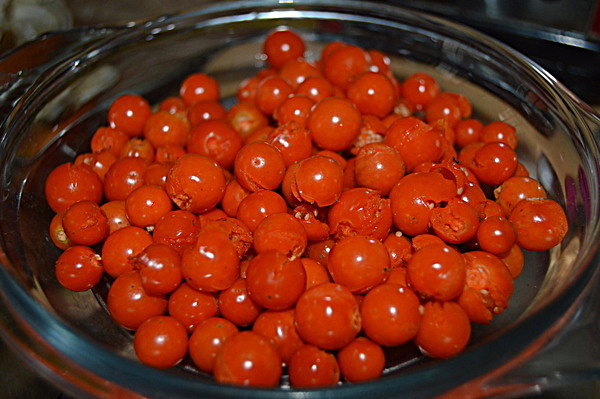
So yesterday I made Chinese lantern salsa! I mixed the washed fruits with some red chilli pepper, red onion, coriander leaves, chopped garlic, salt and black pepper and lime juice and put them in the blender for less than a minute. The result was really quite sour and I kicked myself for adding the lime juice! So I added a little dried Stevia leaf (very sweet) and when that didn’t seem quite enough (and not wanting to risk a Stevia leaf aftertaste) I also added a little brown sugar.
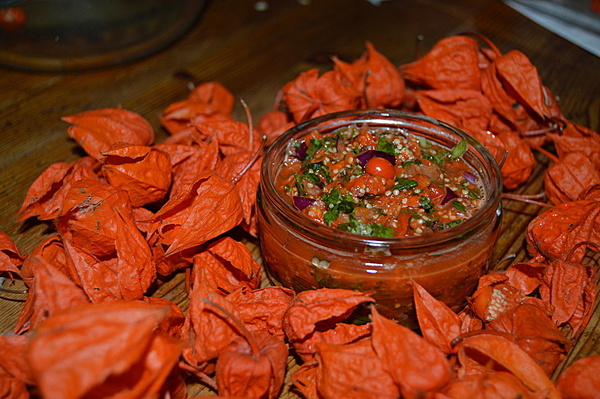
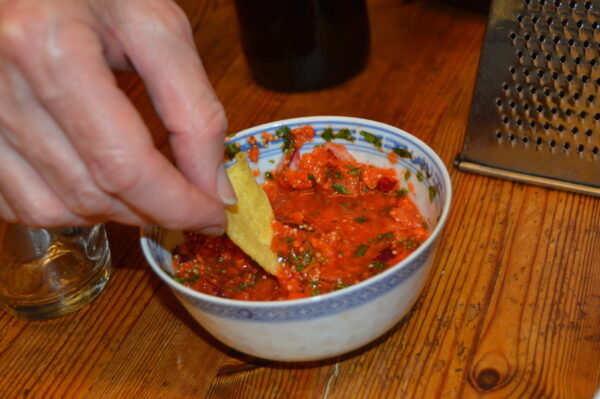
The result was now quite acceptable. I wasn’t massively keen (but then I’ve never been especially drawn to buying salsa from the shops) and I want to try them cooked next time, in a ‘marinara’ style sauce with red onion, garlic, marjoram and olive oil. But Stew liked the salsa when he came in – here is his hand dipping in with a tortilla chip!
Helen Butt
Very exciting!
Which aspect do the Chinese lanterns need to grow in?
Alison Tindale
Hi Helen,
Sun or partial shade will suit them fine.
Pat Collins
I had the same seeds from Poland but he did not collect them from China, though I understand the confusion as he said they were collected from China but did not say who did it. The seeds were collected by Bleddyn and Sue Wynn-Jones of Crûg Farm Plants in Wales. Wojciech helpfully included the collector code BWJ8093 (Bleddyn Wynn-Jones) and their pictures matched when my plants grew. They misidentified them as a sort-of-non-existent species called Leucophysalis sinense but they are clearly a wild form of Alkakengi officinarum (as Physalis alkakengi is now called – it is quite different from the American Physalis species). I love the fruits though I usually juice them with extra water to make the juice less acidic and avoid the seeds. I call it alkakengade. That mountain (Emei Shan) is one of the four sacred mountains of China and was the home of White Snake and Green Snake, one of the best-known of Chinese tales. Some really nice movies and series based on it, too. It would have cost a lot more to buy it from the Wynne-Joneses, as they only sell plants, not seeds. (I don’t allow comments on my blog, I don’t have the patience to clean up all the nonsense.)
Alison Tindale
Hi Pat, Thank you so much for this detailed comment and for correcting me on the collection aspect. I made an assumption there but these details do matter! And I hadn’t caught up with the Physalis alkakengi name change either. You have given me lots of points of interest for follow up there – including your blog.
Pat Collins
I didn’t mention that I also have the other low-bitterness alkekengi (spelling mistake in my last comment, shouldn’t write at 2am) from Lupinaster, which he found in a Polish market. I call that one “Polish Market”. It is taller and bigger in all parts, except the berries are variable, some bigger and some the same. The lanterns are the classic Chinese Lantern shape rather than squashed like the Emei Mountain one. It is Alkekengi officinarum ssp. franchetii. The Emei Mountain one is Alkekengi officinarum ssp. officinarum. It is difficult to say how domesticated the Polish one is but all feral European plants were brought from Asia starting about 6 or 7,000 years ago. So they were presumably originally selected for eating or medicine. I imagine the migrating peoples would stay in an area for a few years or decades or centuries and they could plant the seeds or bits of plant and have fruit rich in vitamin C in their first year in the new area. However, many alkakengi plants have been introduced from Asia in more recent times, for medicine and ornament. Some sources say that ssp. franchetii is only found wild in Asia but I am not sure. If you haven’t got and want a piece of the ‘Polish Market’, drop me an email.
Alison Tindale
Thanks Pat but I do have that one also. I am also growing a plant from fruit I found in a franchetti I found near the coast in Bridlington in which I could detect no bitterness. I think it will fruit this year for further taste trials. These plants hold promise as well as being charming as they are.
Pat Collins
OK.
I made hybrids between the two that I am going to let interbreed this year.
Alison Tindale
Oh excellent! I’d love to know how those turn out.