Review 2025
The Backyard Larder’s twelfth annual review!
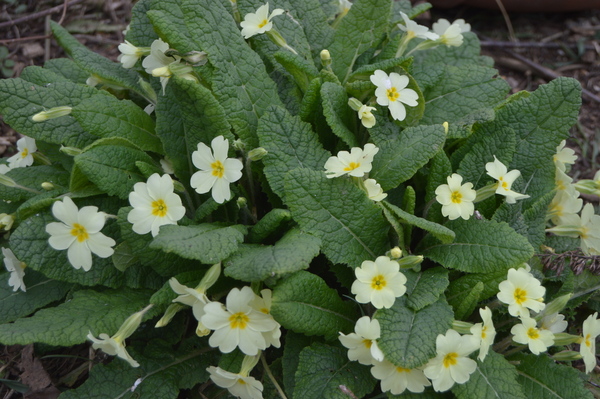
The big news this year is that I now garden on three allotments! I was surprised last May to receive an email saying that my name had come to the top of the waiting list – I had been thinking that I would be forever shunted down the list because I already had a plot on the site.
This was the plot (Plot 71) I was offered last May…
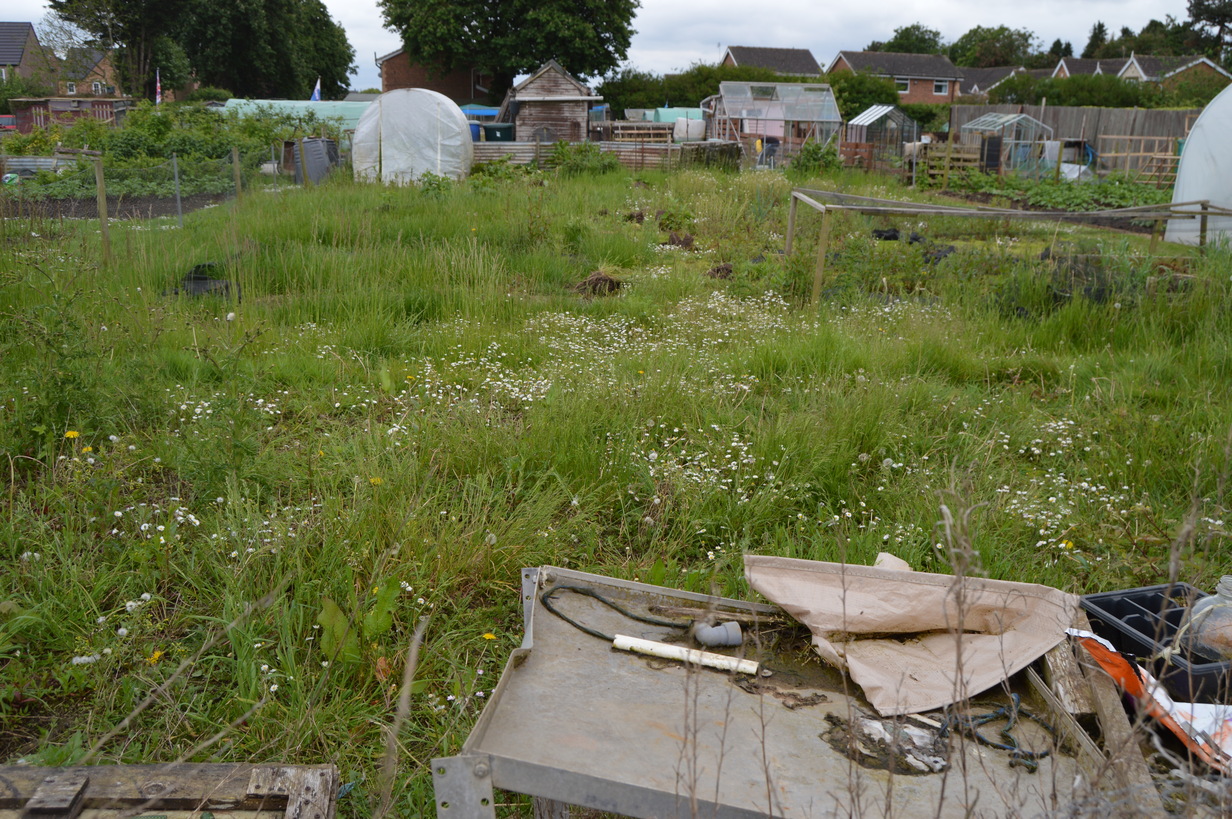
I tidied it up a bit but didn’t manage to do much with it last year as I was struggling with unexplained fatigue. This turned out to be due to having what is hilariously called a ‘deranged liver’, most probably a side effect to some otherwise, for me, excellent medication. (I’d discovered in 2O23 that I had a mild but still very problematic form of the genetic condition, cystic fibrosis. The good news that followed was that I have a genotype that could be treated with ‘genetic modulators’, the drugs in question.) Well, if it was the drugs causing the problem, my body must have got used to them as I seem to have recovered now and have managed to do quite a lot to the new plot so far this year.
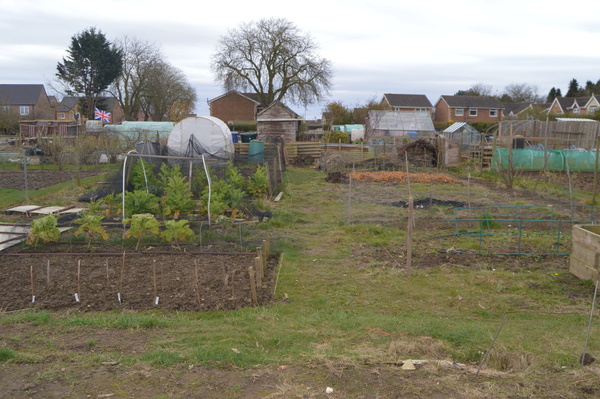
My plan is to have a wildflower strip down the far left hand side and a hedge of edible leaf and fruit shrubs/trees down the far right hand side and, within those two strips, perennial vegetables, especially those I am trying to breed and trial, to the left of the central path and annual vegetables to the right of it. Hidden from view in the foreground there is an area I’m planting up as a small hazel coppice with a carpet of woodland wildflowers and spring bulbs, and a shed that will give shelter to the fig tree I was struggling to find a spot for on my main plot last year. And at the far end there is space for a pile of rotting wood and nettles for wildlife, as well as compost and leaf mould heaps, a comfrey patch and an apple tree. The polytunnel cover is beginning to fall apart but it was so warm and humid in there last summer that I’m hoping it will hold together long enough to grow sweet potatoes in there this year.
Back on the main plot the ‘Dwarf’ Jerusalem artichokes did fairly well last year but the aardaker (Lathyrus tuberosus) I’d planted to climb up a support down the centre of the same bed didn’t do so well. But I’m trying again this year, encouraged by finding what seems like a very productive aardaker plant elsewhere on the plot. This was the 240g harvest from a square foot of soil around the plant (which is a good amount for this vegetable)….
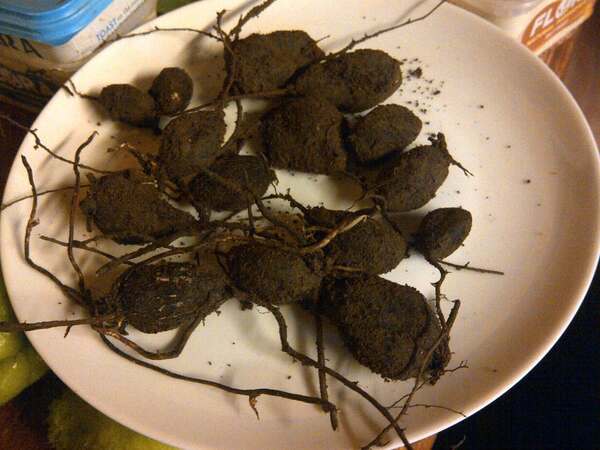
I’ve planted some of these very tubers by the support this year. I’m growing oca on the bed next to this one and planning to run a centre support down the middle of that one too. This is hopefully going to support another climbing legume, talet (Amphicarpea bracteata) which bears edible underground tuber-like beans. An annual vegetable which self-seeds.
I believe I have true earth chestnut Bunium bulbocastanum coming up in one of the other beds on the main plot. Last year they appeared to disappear when I planted them out, but it seems they lived on out of sight! That is progress I am very pleased to see.
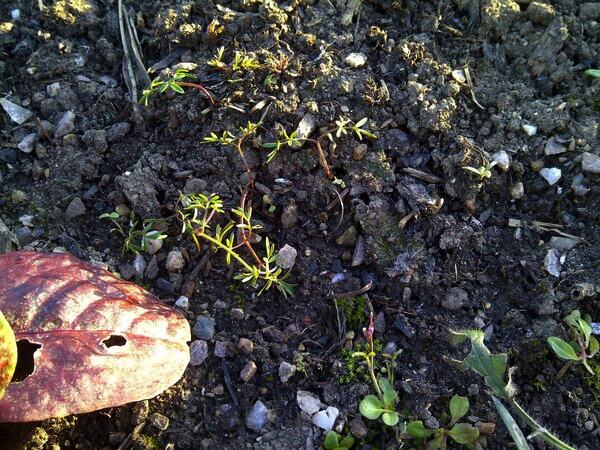
Lactuca perennis, perennial lettuce, is a new plant growing in another bed. It is said, by some, to be mild in flavour. I have yet to eat it.
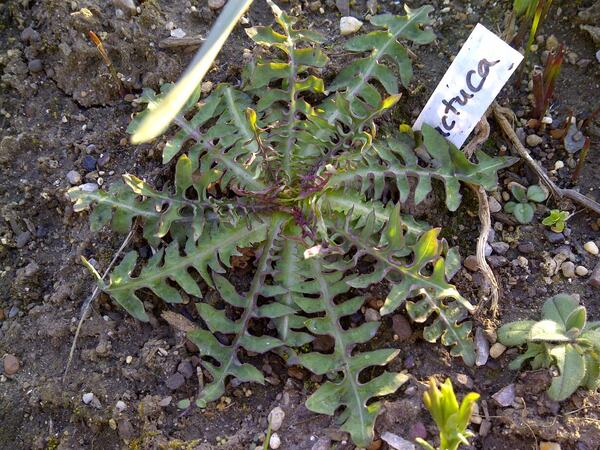
The Jaltomato tlaxacala, bearing its curious little fruits that taste like apple and banana to me, which I reported on last year, did indeed survive in the greenhouse. I’m just not sure if it has managed to do so outside. Possibly one to try again with.
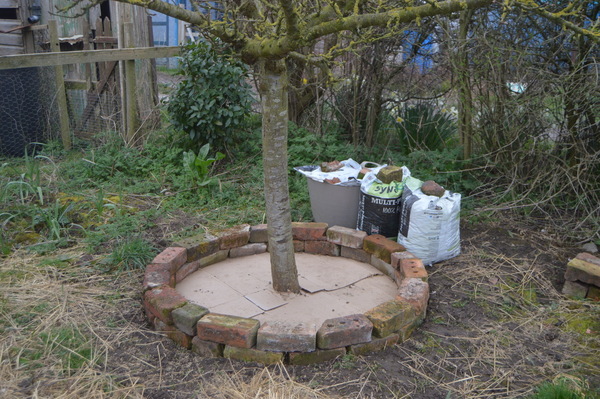
Under one of the apple trees I have created a bed for King Stropharia (Stropharia rugosoannulata) mushrooms, inspired by a delivery of very fresh wood chip to the allotments (some of it now in the bags by the bed). I’m awaiting to receive the spawn from Gourmet Woodland Mushrooms.
I had more plans for my third plot than I ended up having the energy for last year. Fortunately the experimental perennial vegetable garden (latest review here) mostly took care of itself. This is how it is looking this week (the area in front of the low wicker fence)….
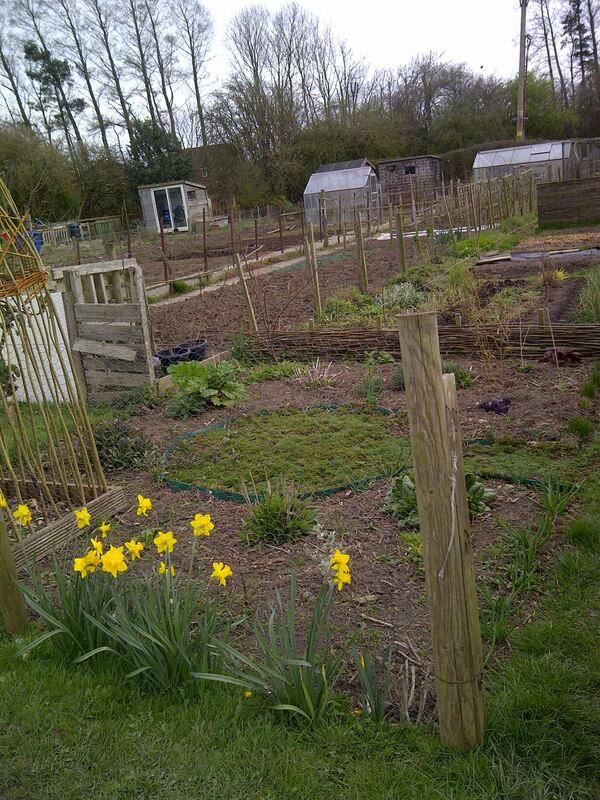
To the left of the top of the post in the foreground, a new-to-me perennial vegetable Rumex alpinus, Monk’s rhubarb, can be seen. Its leaves, although small at the moment, grow quite large and look a bit like rhubarb leaves in shape.
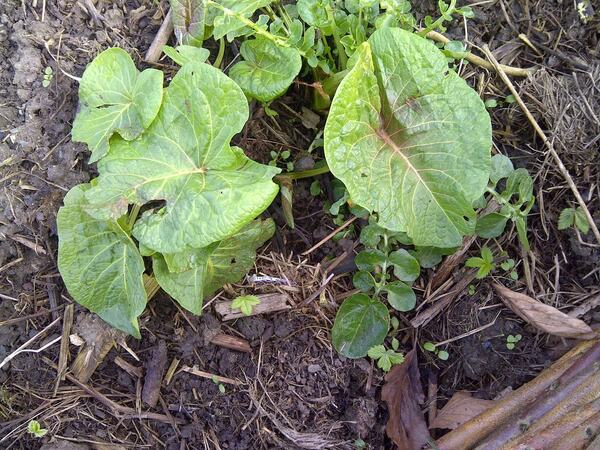
The patch I had designated for popcorn, squash, beans, peas, talet, lupins, yacon, oca, sunflowers and my sunflower/Jerusalem artichoke hybrids, grew only sunflowers last year! The sunflower/Jerusalem artichokes tubers mysteriously failed to grow despite the tubers showing signs of sprouting. Later in the year I dug them up and managed to grow some of them in pots and I planted out the resulting tubers on Plot 71 last autumn. The popcorn plants failed to give popcorn and the lupins produced no beans, the talet was overcome with weeds, the runner beans disappeared and the squash was never planted. The peas and yacon were planted elsewhere and gave a poor to moderate harvest. Never mind! I hope to plant this patch with popcorn again this year and maybe squash and beans too.
But at the end of this patch there was success. I was chuffed to successfully grow some chayotes (Sicyos edulis) outside in Yorkshire.
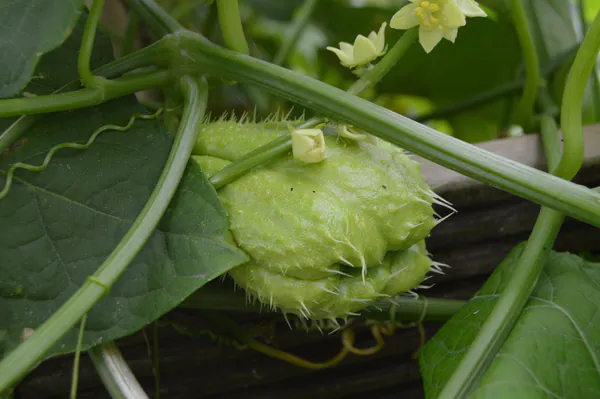
It is a perennial plant but I haven’t yet managed to overwinter it, either outside or in the greenhouse (although it should be definitely be possible in the greenhouse I feel, even in Yorkshire). Join this Facebook group for more on UK chayote growing and breeding.
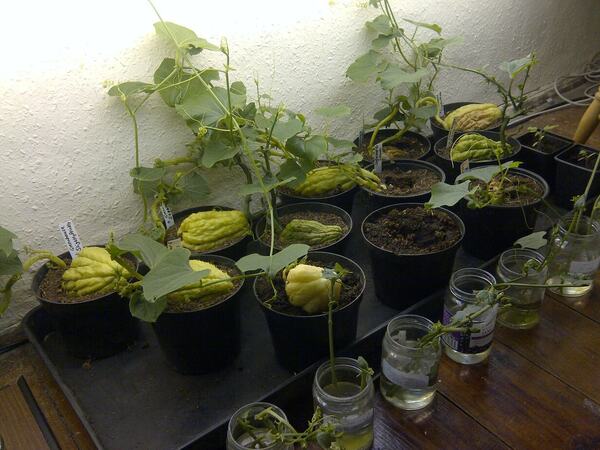
Here are the potential chayote plants for this year…
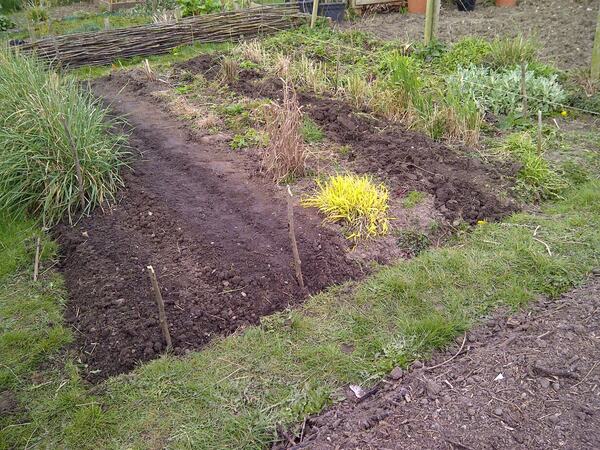
I did keep up with the perennial grain bed – and marigolds and love-in-a-mist came up amongst the rows of perennial oats and wheat. My new sowing of perennial rye last year failed to come through (I sowed some more this afternoon) and I didn’t manage to grow the sainfoin and poppies I wanted there either. This is how the patch looked today…perennial oats on the left, perennial wheat on the right and a mix of perennial grain ‘potentials’ in the centre: sorghum, kangaroo grass, Bowles Golden Grass (Millium effusum ‘Aureum’) and Microlaena stipoides – some dead, some alive!
In the perennial brassica mesh cage the cold weather did for the purple tree kale but the Taunton Deane kale, Michigan kale offspring and Daubenton kale came through. I am interested to see whether of not some Winter Roscoff cauliflowers here that sprouted from the roots of last year’s plants can produce their own cauliflowers.
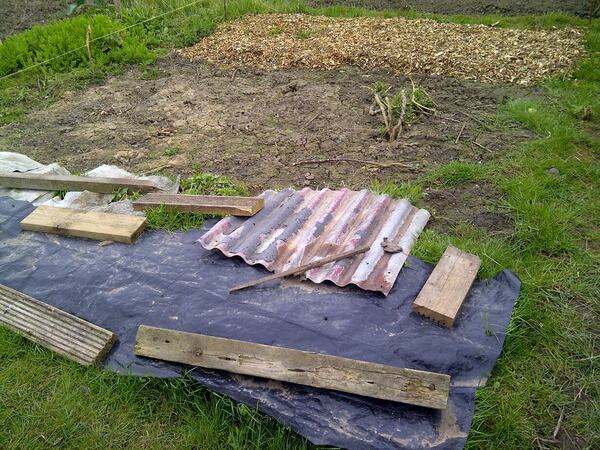
The patch I have set aside for a planting of really tough perennial vegetables that might be resilient to climate change in all directions (i.e. drought, excessive rain, flooding, extreme heat and extreme cold!) has, despite the urgency, been put on hold for a year. I don’t expect to find time to incorporate the required sand and grit into the bed in bulk until next winter. For now I’m covering it with woodchip.
In the shady backyard of the house I am still growing the Elastostema umbellatum, the ‘sansai’ or mountain vegetable from Japan, and it is doing well in its pot. But I have moved the Bergenia crassiflora (for chigir tea) to a lighter spot in the track verge beside Plot 71 where it is growing alongside Mahonia aquifolium and Trachystemon orientalis.
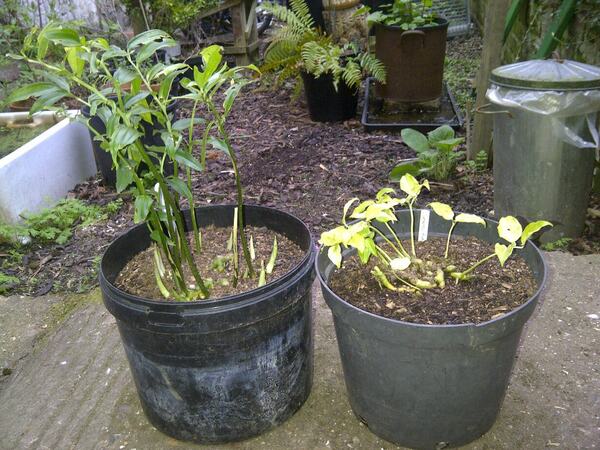
Two new potential perennial vegetables I’ve bought are Disporopsis pernyi (on the left in the photo below) and Disporopsis aspersa (looking a bit yellow on the right). I’ve read that the aspersa at least is eaten as a vegetable (young leaves, tender stems and flower buds) in Yunnan in China.
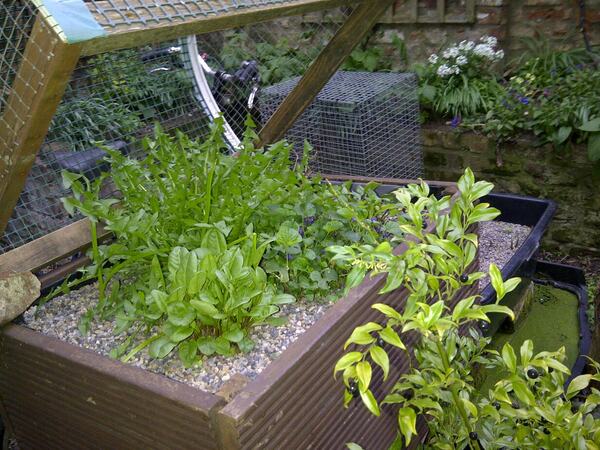
Lastly, I finally got the mesh lid on my dash-to-get-something-fresh-to-eat-on-the-most-foul-winter-days planter. There is dandelion, garden sorrel, wild rocket, three-cornered leek, Siberian purslane and sweet violet planted in here – they all seem to cope with the shade in the garden. The lid keeps the birds off (especially pigeons who like the dandelion) and can be covered with clear plastic for added insulation in winter.