Tree Mallow Salad and Soup
This stout bush is tree or sea mallow, Malva arborea (previously Lavatera ardborea), grown from seed I collected one foggy September day on the Norfolk coast. I think this one is a couple of years old now, maybe more. It should flower before long, with lovely blousy mauve blossoms, but may not live long after that – I believe they can be either annuals, biennials or short-lived perennials.
 Despite its probable short life I like this plant for its sturdiness and similarity to the tree kales, collards and cabbages which supply us with such a plentiful supply of large, tasty and nutritious leaves. Could tree mallow do the same?
All Malva species are edible but some are more pleasant to eat than others. Tree mallow leaves are thicker than those of common mallow and have quite a velvety texture but I thought they might be more palatable when cooked. I have made delicious warm mallow salad, khoubiza from common mallow (Malva sylvestris) before so I thought I’d try it with tree mallow.
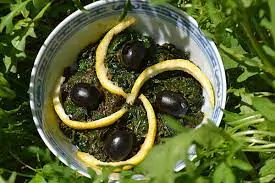
Khoubiza made with common mallow
My first attempt retained too much of the ‘furriness’ of the leaves but I realised afterwards that I hadn’t steamed the leaves for long enough. I tried again giving the leaves longer than the 15-20 minutes recommended in the recipe linked to above for common mallow.

This was much better. I think I should have chopped the leaves more finely as the texture was still a little rough. So a further attempt might be worthwhile. I liked this, but it is probably a bit of an acquired taste and not as delicious as the original dish.
How about soup? Molokhia is a name given to an Egyptian mallow soup made from jute mallow, Corchorus olitorius, (also known as molokhia), which is sometimes made using common mallow instead.

I set off with the intention of closely following a given recipe for molokhia except with tree mallow leaves but that wasn’t really possible. I wanted a vegan version, one using fresh leaves not dried leaves and one which recommended getting the leaves down to a pureed texture. And I wanted to use quite a bit of lemon juice too as it was said to offset the mucilaginous texture of the leaves (although it turned out that tree mallow leaves are not very slimy compared with other mallows). These recipe demands were not easy to find in combination so I improvised.

I fried chopped onion in oil until soft, added a mixture of garlic cloves, coriander seeds, salt and pepper which had been crushed in a pestle and mortar plus some vegetable stock and lemon juice and then I added finely chopped raw mallow leaves which I’d pureed in the blender with some water. I simmered it all gently for a while but it still didn’t seem fine enough so I pureed it again.

Then we tried a bowl each. Yes, good, I relished mine! So that’s one use for tree mallow anyway (but Stew wasn’t keen, possibly too much lemon flavour).