Sweet Eryngoes
In Self-Sufficiency by John and Sally Seymour, John writes,
Sea Holly (Eryngium maritimum). Eat the flowering shoots like asparagus, and roast the roots. (I’ve never tried it.)
Neither have I. It’s something I want to try next year if possible. Sea holly has been cultivated in gardens in the past for use as a vegetable. I’d like to find out more about this but it’s going to take some doing simply because most writers have been more taken with its famed Elizabethan use as an aphrodisiac in the form of candied eryngoes (crystallized sea holly roots) and its mention by Falstaff in the same context in the Merry Wives of Windsor.
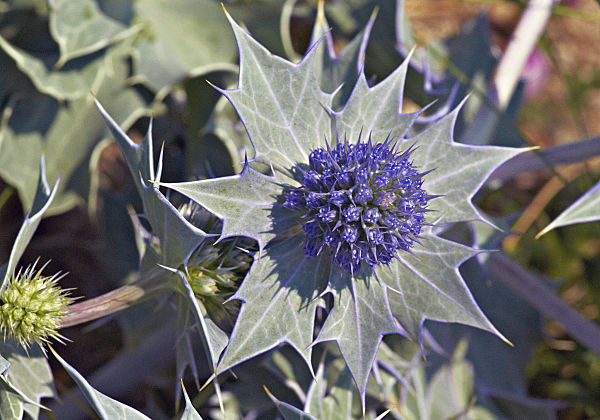 |
| Sea Holly by Peter G W Jones cbd |
This was a use I’d heard about too, and as I’ve long been curious about just what ‘eryngoes’ were and what they might look like, I decided to first have a go at making some. I found a handful of recipes on the net, both ancient and modern, including a copy of a magazine article by Fergus Drennan Candid about Candy where you can find instructions for candying lots of wild foods including alexanders, blackberries, chestnuts and rosehips.
I noticed Eryngium planum was mentioned in Fergus’ text, which is the Eryngium species I had growing, so, pleased that this species could be used, I went ahead and dug up a plant and candied the roots. Only later did I realise that this was probably a mislabelling of Eryngium maritimum which is pictured in the article. I believe it’s safe to eat Eryngium planum but its usual use is just as a medicinal. It doesn’t really matter anyway as it was curiosity, not a sweet tooth, that was motivating me and I’m unlikely to try more than one! (The one I did try tasted of sugar and the rose water I added as flavouring, alongside a slight bitterness. I suspect the roots of E. maritimum when I get to eat them may be sweeter.)
The candies were easy to make; it was just a matter of boiling the roots to cook them until tender, peeling them, and then boiling them again in a thick sugar syrup (flavoured if you wish with rose water). Some instructions would have you do this multiple times. I did it twice which seemed enough. And some instructions refer to the roots, or strips of root, being braided or twisted, before being sugared. This seemed to me to be impossible to do at this stage but quite easy when they had already been boiled in syrup for a while.
 |
| Eryngoes |
Here are my ‘not quite authentic’ Eryngoes. Happy Christmas/Yuletide!
Hazel
I saw lots of sea holly when I stayed near the coast in October and was intrigued to read about candying the roots. It's on my list of things to try once my (new) garden gets established.
Happy Christmas!
Alison
Hi Hazel, If you try them I hope you come back here and say how they turned out! The true sea holly is especially attractive isn't it? – hope to grow it at the allotment next year.
IanBo
If you check the Botanic Atlas of the British Isles, you will plainly see that, at one time, this plant followed the entire coastline.
Later, because of its reputation as an aphrodisiac – it disappeared, apart from some remote areas.
May I suggest that, if you want to try it (and I do) that you grow some at home and not pilfer the wild stuff.
Alison Tindale
Hi Ian, Hoping that that is addressed to all potential readers and not just to me and that you did read actually the article. I’ll give you the benefit of the doubt! I’m in agreement with you, and the law I believe, that wild plants should not be dug up.