Kaldirik dolmasi
Today has been fun. I’ve been finding out about how to cook oriental borage, Trachystemon orientalis. I first heard of this perennial vegetable when Emma Cooper mentioned it on her website leading me to an article by Susanne Masters. I was interested. Discovering that I could buy it online from The Beth Chatto Gardens I added it to my wish list but then forgot about it for a while.
About a year later our son sent us a link to some photos he’d taken in Bangor in Wales, mostly of birds, but including the shot below. I had to check but yes, those were the flowers of Trachystemon orientalis and I came home with a cutting after our next trip to visit him in Bangor.
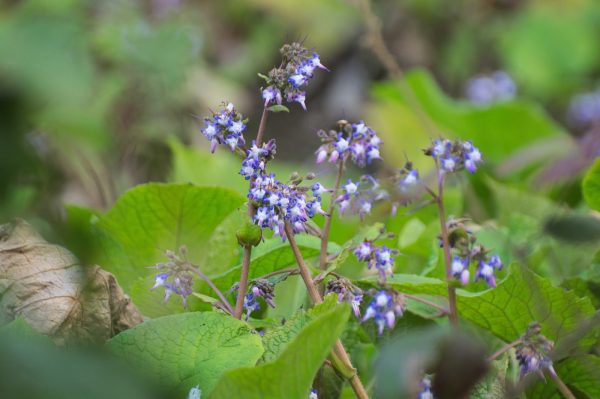
So ‘Abraham, Isaac and Jacob’ (a common name for the plant) is now growing in a pot in a shady spot in the garden and this month I started to find out how to cook with it.
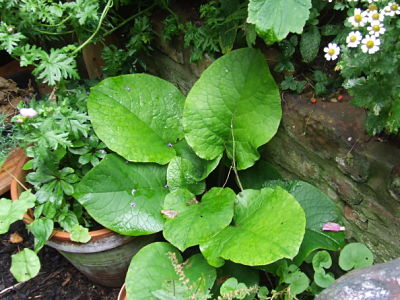
From a comment from GreatScot from Ankara on davesgarden.com I’ve learnt that Trachystemon is….
“highly edible and grows in the Black Sea mountains in Turkey. Much like spinach it needs a very good soak and rinsing several times because of the bristles, it is a lovely food, stem and flowers included, when chopped and added to sautéed chopped onions, then whisked eggs stirred in and allowed to cook through. Salt and pepper to taste. It is a seasonal plant and not available except by foraging for it, so when I finally learned its Latin name and then found my favorite ‘Kaldirik’ on the internet, I felt like a discoverer.”
and from Bob Beer, commenting on the entry for oriental borage on Plants for a Future website,
“This is a common plant in the Black Sea area where it is known by a bewildering number of names: Hodan, Bodan, Bodana, Aci Hodan, Ispýt, Ýspit, Salut, Tomara, Tomare, Kaldirik/Kaldirik/Kaldýrýk/Kaldýryak, Doðuhodaný, Zýlbýt and there are probably more. It’s a great plant, good to eat and as a tough garden plant that provides both attractive flowers and a tough groundcover that can stand up to fairly harsh conditions. It also tastes good. :)”
Bob Beer is an American musician and plant-lover who has lived in Istanbul for many years and has an interesting blog Bahçe Hastas? – Garden Freak in Istanbul where I found out more:
“..the rhizomes are cooked in various dishes (but I find them slimy); the petioles are gathered and pickled and are one of the most popular pickles in the Eastern Black Sea region.”
N.B. Despite these endorsements of Trachystemon orientalis as an edible some caution is advised as members of the Boraginaceae family, to which this plant belongs, contain varying quantities of pyrrolizidine alkaloids which can cause liver damage.
I got the impression that kaldirik is usually gathered earlier in the year than this but one recipe I came across, kaldirik dolmasi (stuffed kaldirik) seemed to be using older leaves so I thought I’d try that one. Several online recipes written in Turkish were put through Google Translate (with some quirky results, ‘go ahead with our internal mortar’!) and this video was enjoyed (very much enjoyed – worth a watch) before I felt able to piece the following recipe together.
500g kaldirik leaves
- Bring a large pan of water to the boil, add the juice of the lemon and boil the kaldirik leaves for three minutes. Drain and rinse in cold water.
- Chop the onions finely and mix half of the chopped onion with the cornflour, chopped garlic cloves, beaten egg and enough water to make a sauce with the consistency of a thin custard. Season quite generously with salt and pepper.
- Taking each boiled kaldirik leaf in turn, place a tablespoon of the filling on the leaf a small distance from the lower edge, fold the lower edge and then the sides of the leaf over the filling and roll it up. Place all the rolls in a single layer in a saucepan.
- Fry the rest of the chopped onion in the butter until softened and golden and add the tomato puree and sufficient water to pour over and cover the rolls.
- Simmer the rolls with a lid on for 15 minutes on the oven top.Transfer the rolls to a serving dish and spoon yoghurt over them before serving.
I hope that is roughly right at least – if you are Turkish and/or familiar with cooking kaldirik dolmasi and I’ve got the wrong idea please leave a comment below and correct me. But it seemed to work and here is the result:
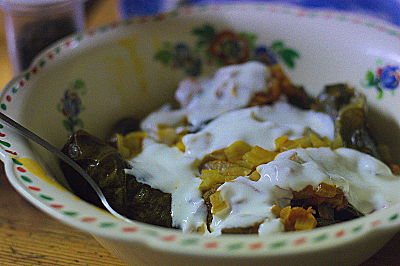
With their flavoured, floury filling the dolma were rather like dumplings and the tomato and onion sauce that they were cooked in was especially tasty. It was comforting food. (I also gleaned from my researches that the dolma can be made from dried leaves so you could enjoy them in the depths of winter.)
cin
Thanks fot this recipe and sharing your research ! I have a rather abundant patch of oriental borage in my garden and i only found out recently what it was and that it was edible, but had not tried it yet because I couldn't find anything else then "is cooked like spinach". So far any green " cooked like spinach I prepared was not really appreciated by my tree men. But I have a feeling they will love this!
Alison
Do please come back and let me know if it went down well 🙂
cin
Well, I've tried out the recipe and the taste was fine but wasn't entirely what I expected. The texture of the leaves was still a bit hairy, I think your impression that the leaves should be gathered when young is correct. Mine are much bigger then the ones in the video an most of them had brown spots. Although it wasn't the success I hoped for, my men are rather picky when it comes to unusual food, I am going to try it again next year. It is a great plant though, a beautiful ground cover in shadow area's and as it blooms so early ( end of February here in Belgium) it attracts tons of big fat bumble bees.
Alison
Thanks cin for reporting back! I wonder if soaking and boiling for a bit longer would work for older leaves. Anyway I hope you have more success with spring recipes. Good to know it attracts the early bumblebees.
Sazji
Back again (though it doesn't look as if my previous comment has appeared – moderated perhaps?). I looked up the Kaldirik Dolmas? recipe. There were several, some with meat and some meatless. The only thing that stood out was the translation of "misir unu". As far as I'm aware, "corn flour" in England refers to the white fine powder we. call "corn starch" in the U.S. But in Turkish it means ground corn (corn meal), which seems much more typical for Black Sea Turkish cooking! 🙂
Alison
Hi Sazji, For some reason your first comment never got to me – I've got no idea why, but sorry about that. Thank you, your help is really useful. I wondered about the cornflour because it made a rather dense filling – corn meal makes more sense and I'll use that next time. Have you heard of other uses for the leaves? (I'm also curious about the translation of kaldirik as 'pavement' or 'sidewalk')
Alison
Hi again, Sazji. Now I have realised who you are – so thank you for your earlier information about oriental borage too!
Cin
Hi Allison, Ive tried the young leaves again but this time covered in pancakebatter ( in fact a recepie i found for comfrey). I found it had a sort of fleshlike texture, but my son and husband didn't like it at all. They had itchy throats afterwards. Not a succes.
Alison
Sorry it wasn't a success Cin but useful I think that you tried it again with young leaves – so that you know! Was that with cooked leaves by the way?
Elke Schwarzer
That sounds like a great recipe.
I love this recipe with Trachystemon-leaves:
http://guenstiggaertnern.blogspot.de/2015/04/kulinarischer-karriereknick.html
Unfortunately only in German, but this is how it is made: Stir goat's cheese with milk to make it softer. Throw in cut leaves of Glechoma hederacea. Take one Trachystemon-leave and spread the cheese on its underside. Take another leave and stick it on the cheese, like a sandwich. Then bread and fry them.
Alison
Elke, Thank you so much for that recipe. It looks very tasty and quite different too! I like the use of ground ivy.
Nic Wilson
Interesting post – thanks. Another one to add to my ‘want to try’ list! ?
Senur
Hi!I am a Turk and we are piking up this leaves from almost all black sea regions’ forest. But we have more than 1 resipe. We are cooking these leaves like grapes leaves but instate of rice. We are using broken wheat,in Turkish mean bulgur. And this recipe so delicious and we say we prefer to this meal than the other all meal.
Alison Tindale
That sounds really good Senur, thanks so much for leaving a comment. What might go in with the bulgur?
Nazan
I love your enthusiasm regarding kaldirik. I’m Turk but from the southern regions so had never tried this before marrying into a family from the northern parts. They love kaldirik (which they call kaldirak)! I think they only pick the youngest shoots and leaves for cooking. In the video, the lady mentions that they go out once (during spring?) to pick the leaves and dry them for later consumption. Those are probably the freshest leaves.
My family-in-law uses the stalks. They either ferment them to eat like a salad together with other foods, or cut and pre-boil them for the freezer. The frozen kaldirik is prepared like so: they sautee lots of onions in olive oil and butter, add the thawed kaldirik and fry it up, before adding eggs. It’s delicious eaten with bread and maybe some yoghurt!
Btw, kaldirim in Turkish means pavement. Maybe that’s why the translators confused the two. Especially as kaldirik seems to be a highly local plant which most dictionaries wouldn’t recognize.
Alison Tindale
And I love your comments – full of interest for me. I’d like to try fermenting some stalks. Thanks Nazan.
Johan
Hi guys,
As a Bostonian who is advised to try this local taste, I found your page. I want to find some of these on Amazon or anywhere convenient. If anyone finds, I would like to give it a try.