November Plant Profile: Skirret
The eighth in a monthly series of perennial vegetable profiles. Practical aspects of growing and harvesting the plant are outlined first, with further relevant information following on. Please let me know in the comments if there are more details you would like me to include.

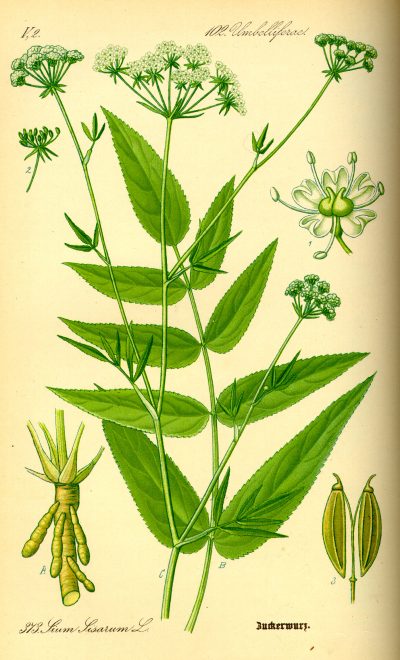
Skirret (Sium sisarum) is a perennial member of the Apiaceae (carrot) family which bears a clump of long, thin, white, and quite sweet roots. It has been cultivated, probably since antiquity, for these – but has fallen out of favour in modern times. It grows wild in eastern Europe and central and northern Asia, and Iran, and has been introduced to parts of central and southern Europe.
Hardiness
Hardy to about -20°C
Soil conditions and location and cultivation
For the longest, straightest and whitest roots skirret needs to be grown in a moist, fertile and light soil in sun or part-shade. Moisture is especially important for succulent roots. Moist conditions also help to minimise the presence of the fine woody core which occurs in some roots (although this seems to be partly a genetic trait: it is worth collecting seed from plants with little or no core to combat the trait).

Height
4 – 5ft. 1.2 – 1.5m.
Spacing
1 ft. 30cm. (The spacing in old manuals is sometimes as close as 15cm between plants and 30cm between rows, which may be worth trying).
Pests and diseases
Few pests and diseases are reported for skirret. Voles may eat the roots and root knot nematodes may damage them. The flowering stems have been observed to develop a weakness at a point and keel over, but I haven’t yet been able to identify the cause.
Harvesting and yield
For a large clump of long roots, harvest plants in their third year. One large clump will probably furnish enough roots for one or two meals for a family of four. The leaves of young plants can also be eaten. Roots are fully hardy in the UK and can be stored in the ground until required if rodent numbers are low.

How to propagate
Sow seeds in late winter to early spring in a cold frame and prick out into individual pots for growing on and planting out in summer. Germination is erratic over several weeks and the compost must be kept moist at all times. Alternatively sow in the open ground where they are to grow in April, thinning out to 30cm between plants.
Skirret offsets can also be planted in spring by digging a mature skirret clump and separating out individual plants (no cutting required). When harvesting clumps of roots, the roots can be cut off the plant and the remaining crown replanted and left to grow for a further three years.

Photo by Malte (CC BY 3.0)
Wildlife value
Attractive to flies, beetles, bees and butterflies.
Botanical name
Sium sisarum Linnaeus 1753

Common names
Skirret, suikerwortel (Netherlands), crummock – corruption of Gaelic crumag (Scotland), zuckewurzel (Germany), sukkerrod (Denmark), chervis (France), sisaro (Italy)
History
The earliest mention of skirret may be in a 5th century BC comedy called ‘The Rustic‘ by the Greek playright Epicharmus of Kos (from a report by Athenaeus of Naucratis in his The Dinner Sophists that the Greek word sisaron is mentioned in that play. However the word may refer to the parsnip).
Pliny the Elder (AD 23-79) refers to a plant called siser in his Natural History (Book 19 Chapter 28) which seems likely (but not certainly) to have been skirret.
The siser [skirret], too, [i.e. in addition to the parsnip discussed in the previous chapter] has had its reputation established by the Emperor Tiberius, who demanded a supply of it every year from Germany. It is at Gelduba, a fortress situated on the banks of the Rhine, that the finest are grown; from which it would appear that they thrive best in a cold climate. There is a string running through the whole length of the skirret, and which is drawn out after it is boiled; but still, for all this, a considerable proportion of its natural pungency is retained; indeed, when modified by the addition of honeyed wine, this is even thought to impart to dishes an additional relish. The larger parsnip has also a similar string inside, but only when it is a year old. The proper time for sowing the skirret is in the months of February, March, April, August, September, and October.
In the following book Pliny also discusses the medicinal virtues of wild skirret.
Skirret is mentioned by Hildegard de Bingen (12th century German Benedictine abbess and polymath) in her Physica for its medicinal qualities but when it entered Britain is unclear. The first record of it seems to be in a 14th century list of seeds bought by the Archbishop of Canterbury’s gardener for the Lambeth House garden in London. It did not become commonly eaten until the 15th century but then became very popular in the Tudor period and there are numerous recipes for it from this time, especially for skirret pies. However it began to lose favour in 17th century possibly because the popularity of the recently introduced potato (which has a similar texture but is is less fiddly to prepare) began to rise.
Fortunately it was not lost to cultivation. However skirret grown from seed available today is sometimes poor and the plant needs restoring to its former quality by selective breeding. Some attempts are being made to do this (see The Free Skirreteers Facebook group).