December Plant Profile: Scorzonera
The ninth in a monthly series of perennial vegetable profiles. Practical aspects of growing and harvesting the plant are outlined first, with further relevant information following on. Please let me know in the comments if there are more details you would like me to include.

Scorzonera (Scorzonera hispanica) is a herbaceous, perennial plant native to Southern Europe and Western Asia. It has long black, edible roots which have good nutritional value and a mild but slightly sweet flavour. The roots contain inulin which can cause flatulence in some people although usually to a lesser degree than Jerusalem artichokes. They are easily cooked by boiling sections of clean, unpeeled roots for 5-10 minutes after which time the black skin is easily peeled off. The boiled roots are often served with a sauce. The leaves, young flower stems, unopened flower buds and flower petals are all also edible.
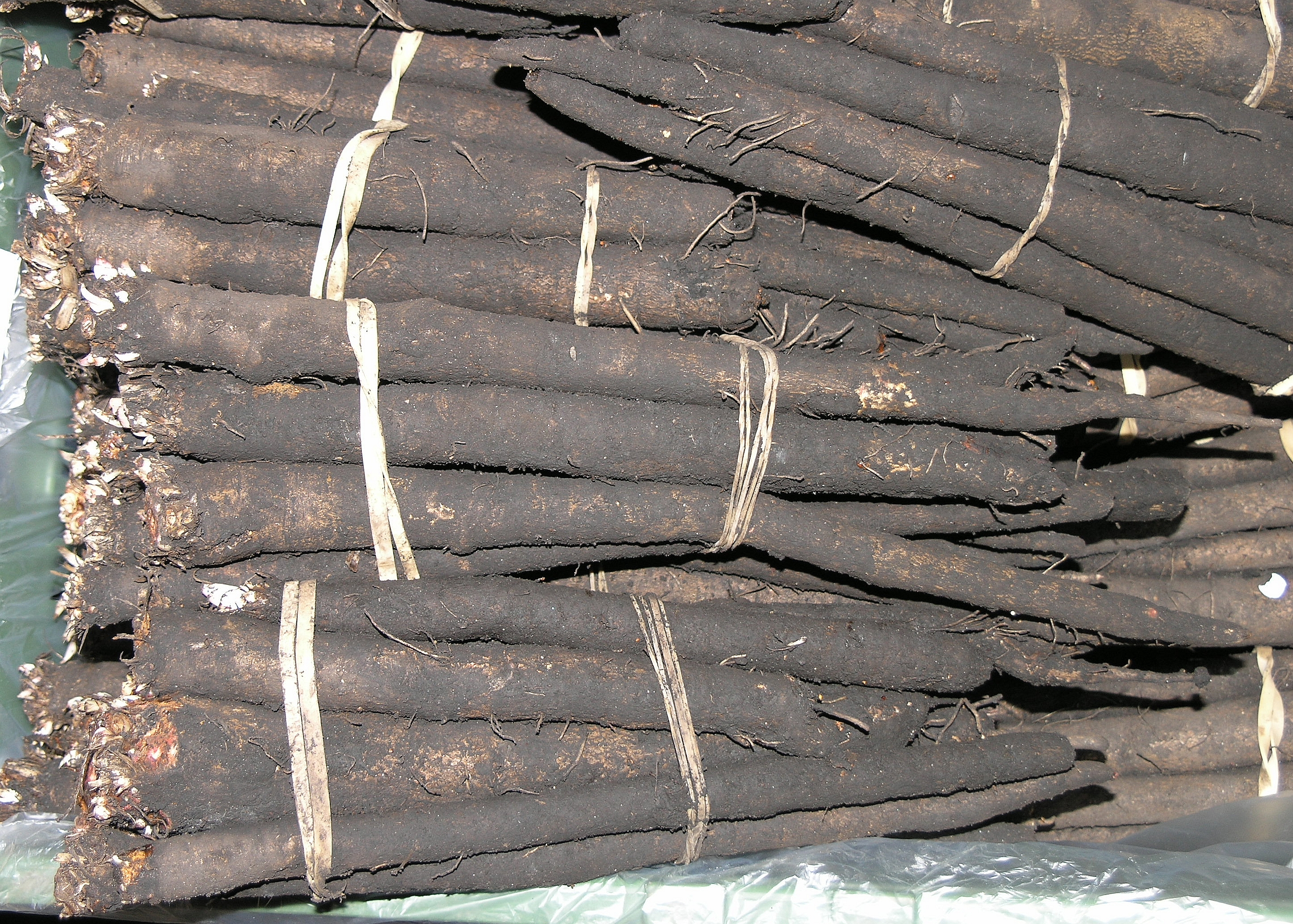
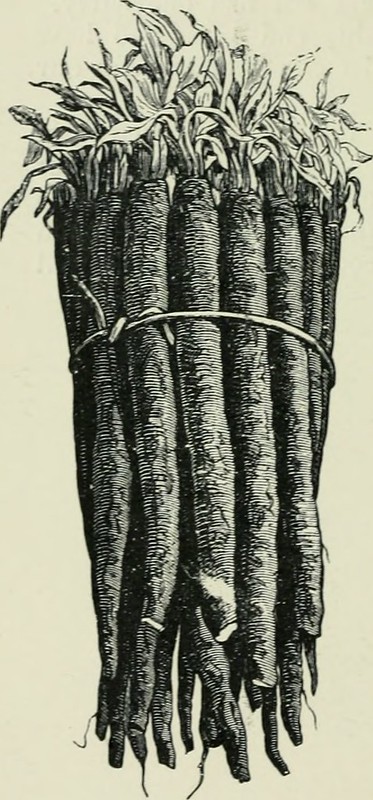
Scorzonera bundles by Goldlocki
CC BY-SA 3.0


Hardiness
Hardy to about -20°C
Soil conditions and location and cultivation
Ideal conditions for long root production are a sunny spot in moist but well-drained sandy or loamy soil. However it will still produce useable shorter roots in a clay soil and will tolerate a partly shady location too.
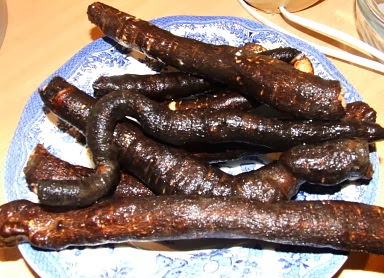
Scorzonera roots grown in a clay soil
Height
3ft – 4ft. 90 – 120cm.
Spacing
6 – 12 inches. 15 – 30 cm.
Pests and diseases
Besides slugs sometimes eating young plants I haven’t had any pest or disease problems with scorzonera. However the RHS mentions that, ‘White blister is the most important disease of salsify and scorzonera’.
Harvesting and yield
Two or three one year old plants will furnish enough roots for a meal. Older replanted plants often have branched roots and one plant will suffice. Dig deeply and carefully as the roots snap easily.
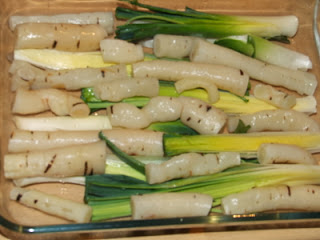
Leeks and scorzonera prepared for a gratin dish
How to propagate
Easily raised from seed sown in situ either in autumn or spring. Use the freshest seed possible. Can also be raised in pots and planted out in spring. Divide older plants in autumn. When plants are being dug to be harvested it is possible to remove most of the root leaving a 5cm stub and replant the crown to grow on for future harvests in following years.
Wildlife value
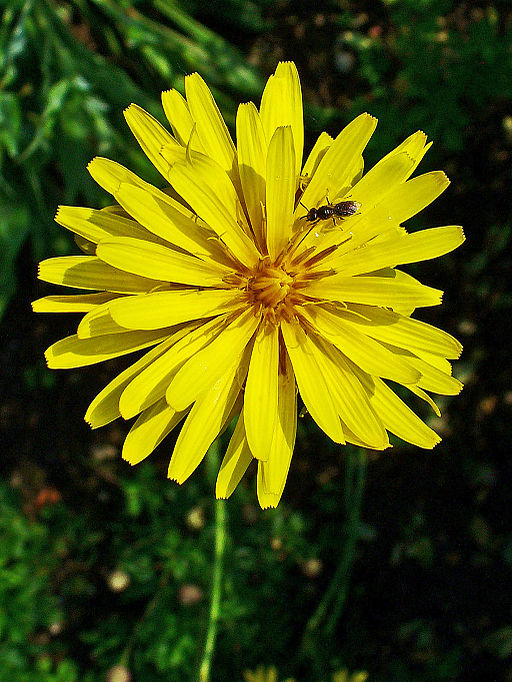
H. Zell CC BY-SA 3.0

The Database of Insects and their Food Plants lists Scorzonera hispanica as a host plant for aphids and Aphis fabae. Its flowers attract many insects although I have yet to make careful observations of its visitors.
Botanical name
Scorzonera hispanica Linnaeus 1753
Common names
Black salsify, Spanish salsify, black oyster plant, serpent root, viper’s herb, viper’s grass, scorzonera.
History
The first mention of the plant in botanical literature seems to be in 1561 in a letter from Odoricus Melchiorius, physician to the queen of Bohemia sent to the Italian botanist and physician, Pietro Andrea Matthioli. The letter passes on a detailed description of the plant sent to Melchiorius by Petrus Canizerus, head doctor to Ferdinand 1. Canizerus also sent an illustration and a dried specimen of the plant.
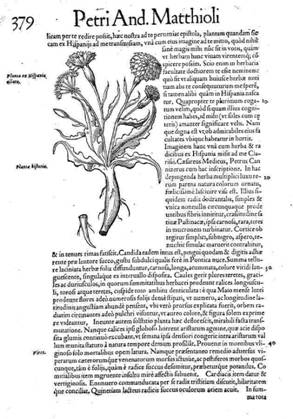
Matthioli’s Scorzonera page
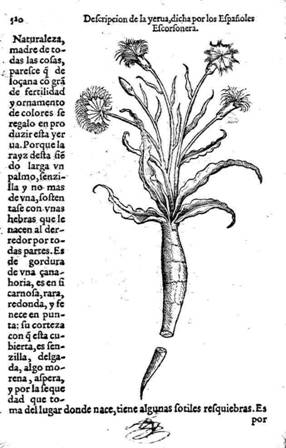
But there is also a description and illustration of the plant as an addition by Juan de Jarava to his translation into Castilian of a version of ‘De Historia Stirpium’ by Leonhart Fuchs. This may have preceded Matthioli’s publication by a few years. Juan de Jarava seems to have drawn on the same or a similar source.
Melchiorius’s letter and Matthioli’s reply to it are not easy to translate for non-Latin scholars but a rough translation of one delightful sentence reads, ‘Those who ate from their roots will end their sadness, and regain laughter.’ Melchiorius suggests that the plant’s description was verbatim from the pen of Canizerus. The letter also includes the story of an African slave who knew the plant from North Africa and cured a group of harvesters of snake bites by giving them scorzonera juice to drink. The details of the plant and the story of the cure reappear in 1574 in a book written by Nicolás Bautista Monardes and translated into Latin from Spanish by Carolus Clusius, ‘De lapide bezaar et scorzonera herba: duobus præstantissimus adversus venena remediis’ (Bezoar Stone and Scorzonera Herb: Two excellent poison remedies).
(It is however worth noting that some authorities consider that the references to the ‘Spanish Scorpion’ in these publications refer to Scorzonera humilis, also found in Spain, rather than Scorzonera hispanica).
Perhaps surprisingly it is as soon as 1576 that scorzonera is recorded by Matthias l’Obel as being grown from Spanish seed in France, England and Belgium. It becomes increasingly common in cultivation from then on for use as a vegetable as well as a medicine, less popular in England than on the Continent, but recorded by Evelyn in 1699,
‘…best of all stewed with marrow, spice and wine etc as artichoke, skirret etc, diced or whole. They likewise may bake, fry, or boil them, a more excellent root there is hardly growing’,
by Charles Aston in 1770,
‘It is of an agreeable, sweetish taste, subviscid, and a little rough: I have eaten of it plentifully when a child; and known it served up at the table fried, as a delicate as well as wholesome dish.’
by John Claudius Loudon in 1849,
‘…a native of the South of Europe, in culture in British gardens since the middle of the sixteenth century. The root is straight, conical, and about the thickness of a middle-sized carrot, with a black rind. It is used boiled or stewed, in the manner of carrots or parsnips.’
and by Jane Grigson in 1997,
‘Salsify and scorzonera have much in common. They both provide us with long carrot shaped roots of a succulence unusual in root vegetables. They have the same delicious flavour, though people in a position to know say that scorzonera has a slight edge over salsify.’
Salsify (which is not very closely related to scorzonera but bears similarities to it) is perhaps more commonly grown than scorzonera now in conventional vegetable gardens, (but this of course is relative, both crops being rare). Salsify however is a biennial plant, and scorzonera is slowly becoming more popular as the interest in perennial vegetables grows.
Ray Brown
I have just discovered your blog through my interest in field beans! Thank you, lots of interesting stuff.
I grow scorzonera as a leaf plant providing lots of “spinach” type greenery. Very useful from November onwards.
Alison Tindale
Glad you like the blog Ray. I like your idea of using scorzonera as a leafy winter vegetable. I actually lost my own mature stock although I have had young plants in the shop this year. I’ll try that when my young plants get bigger. Do you find it is evergreen for you?
Ray Brown
Is it evergreen for me? The answer is I haven’t been growing it as a perennial for long enough. We haven’t had hard winters for the past couple of years so we will need to wait and see. Ray
Ray Brown
Further to my last reply to your question, we have now had a couple of weeks of sub-zero temperatures and several nights with -9C. The scorzonera leaves are still green and we have used them in a mix with kale and sprout tops as our greens. Happy New Year Ray
Alison Tindale
Good to hear. Thanks Ray.
Deborah Pratt
My veggie plot was completely neglected last year due to illness, I am now hacking back the nettles (I can’t eat them all!) and have found a row of scorz sown the year BEFORE last, can you eat the roots that old or should I stick to trying the green leaves cooked?
Alison Tindale
In my experience they should be fine to eat.