Alexanders – Parsley of Macedon
I discovered recently that Alexanders (Smyrnium olusatrum) was called Petroselinum alexandrium (Parsley of Alexandria) by apothecaries in medieval times, or Petroselinum macedonicum (Parsley of Macedon). The latter name may have been more accurate as it is more likely to be found growing wild in Greece (where Macedon was located) than in Alexandria in Egypt – but perhaps it was cultivated and naturalised there. It has certainly been cultivated from ancient times and appears to have been a very popular pot-herb in the past for many centuries, losing favour in time as celery cultivation became common.

Anyway it grows on my allotment after I sowed it there a few years ago. It is best described as a biennial plant, but has sneaked onto this blog on account of: also qualifying as monocarpic perennial as it may sometimes take three years or more to flower and then die, rather than just two; reseeding itself easily and so becoming a perennial feature of the perennial vegetable garden and, thirdly, being a green edible available in winter along with perennial kale, alliums, saltbush and sea beet. So worth a mention basically!
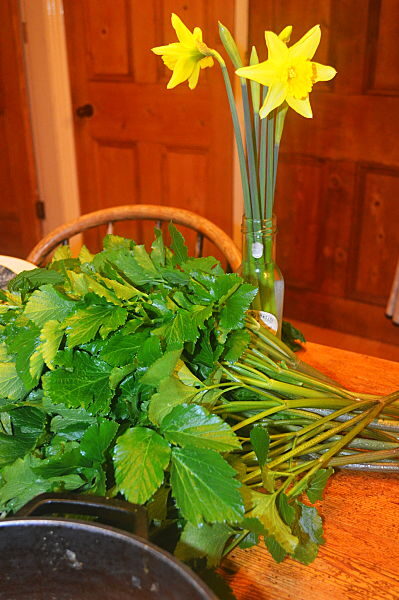
Yesterday I picked a big bunch of alexanders and divided it into slender leaf stalks, thicker leaf stalks and freshest youngest leaf shoots…..
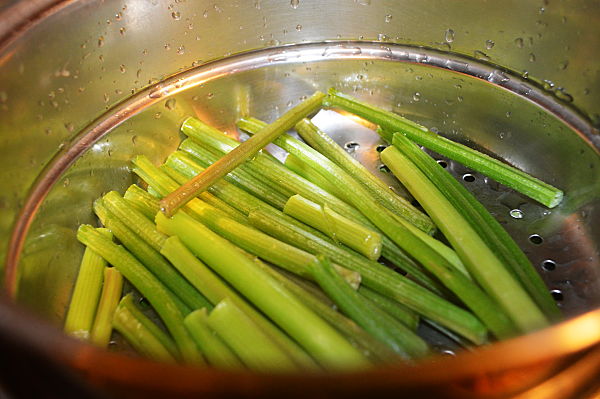

….and steamed them all, serving them drizzled with oil, black pepper and salt.
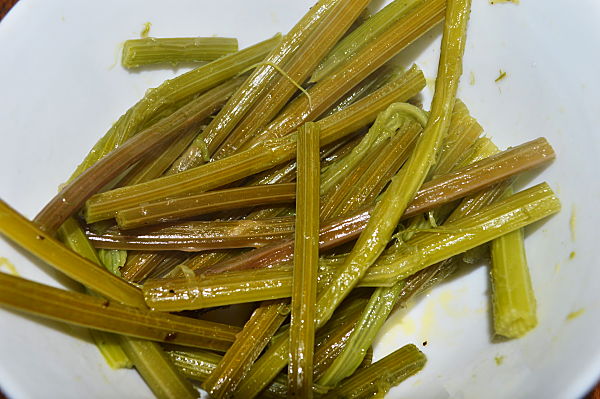
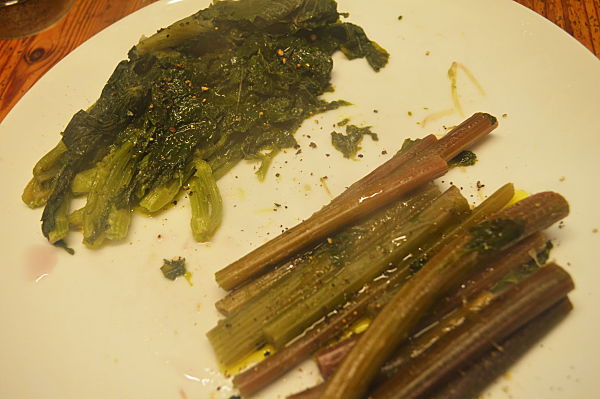
Only the shorter, paler green stalks even of the ‘slender’ pile were tender enough to eat – and they were succulent and satisfying. Perhaps I could have steamed the others for longer? I’ve read of people peeling off fibres before cooking but that is too fiddly for me.
The leaves had an odd, musky taste. That doesn’t sound very inviting but I did like them and look forward to having more. It was rather like the taste of broad bean tops. If you like those you might like these. (Important to check the identification of your plant carefully as there are closely related plants that are very poisonous.)
You might also want to try the young leaves and flower buds raw in a salad, collect the seeds as a spice or bake or boil the roots. All in all a very useful use-all plant!
Joshua Christian
Is it possible that it originally meant “parsley of Alexander the Great (from Macedon I believe)” thus preserving the Macedonian link and explaining the Alexander part of the name? I should say I’ve done zero research to support this but just wondered. I’ve never managed to get the seeds going and am not brave enough to try foraging them so recently bought some plants and hoping to try them soon
Alison Tindale
Hi Joshua, I wondered about that but most Latin dictionaries gave ‘alexandrinum’ as meaning ‘of Alexandria’ rather than relating to Alexander. Maybe the spice trade routes of the time and how they worked are relevant? Anyway, hope you like the taste. I’ll try to remember to try the seeds later in the year.