Can you beat Sea Beet?
Sea beet, Beta vulgaris maritima, is a rather well-studied plant as wild plants go. I believe this is largely because, being the wild relative of sugar beet (and also of beetroot, chard, and perpetual spinach), agricultural scientists consider it to be an important source of genetic material for sugar beet breeding.
 |
| Sea beet |
I found a study online which interested me, with my perennial vegetable obsession, because it looked into how long sea beet lives. It was carried out at the University of Lille in 2002. Sea beet seed was gathered from 104 wild populations of the plant in France, Belgium, Great Britain and the Netherlands and sown in the glasshouses at Lille. The average life-span of the sown plants was about 2 years in the case of the plants grown from the seed from inland habitats in south-western France to 11 years or more for north Brittany, before decreasing to about 5 years for the most northerly populations in Britain and Germany. I’m not sure anyone knows why sea beet from northern Brittany has a particularly long life-span but it’s obviously a good place to collect some seed!
Sea beet seems to be variable in its vigour and eagerness to flower too. This photo is of my sea beet patch.
 |
| Sea beet patch |
These plants were all sown at the same time but the bigger one has been leafier and thrown up far fewer flower stems than the others. It has been heavily harvested too giving us lots of leaves for eating as a plain steamed vegetable or for including in stews and curries. (N.B. I gradually realised that I had bought mis-labelled seed for these plants and they are actually perpetual spinach a.k.a. leaf beet – or possibly a sea beet/leaf beet cross. I’ve since raised plants from sea beet seed I’ve collected myself and the leaves are noticeably thicker.)
I’ll be adding some more compost and clover mulches to the bed and I think the plants could do with a bit more space; these are about 30cm apart, but if the smaller plants don’t improve I’ll replace them. Sea beet is wind-pollinated and crosses easily with any other plant within the Beta vulgaris species – but perhaps it might still be worth growing out some seed from the bigger plant and seeing if I can spot some stronger individuals.
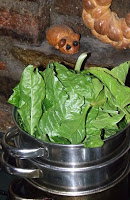
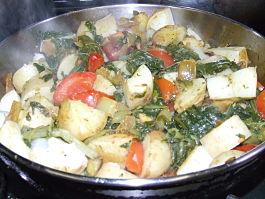
Having said that, I’ve been considering whether perennial sea beet is generally worth growing given that the two domesticated relatives that it most closely resembles, perpetual spinach and chard, are particularly easy ‘annuals’ to grow.
Perpetual spinach and chard are often compared in terms of flavour in gardening books, with chard coming out on top. Now I have to admit that I don’t have the most discriminating palate (this may be one reason why I’m not a talented cook despite aspiring to be one) but I think I agree that chard has a better flavour. I would also say (for whatever it’s now worth!) that sea beet tastes pretty much identical to perpetual spinach. Chard and perpetual spinach will often overwinter (and of course sea beet does so pretty reliably), but chard is a bit less hardy than perpetual spinach so it’s possible that if I just grew that I might not have leaves available during the hungry gap.
So I think I’d go for growing sea beet rather than perpetual spinach on the basis that one can keep the same plants going for years. But I’d maybe also grow an annual crop of chard for when I feel the need for that special chard flavour.
I might grow some annual spinach too, although we’ve been greatly enjoying leaves from the perennial Lincolnshire spinach a.k.a Good King Henry. We’ve been gathering them in quantity for steaming and they haven’t become too bitter even after the plants have flowered.
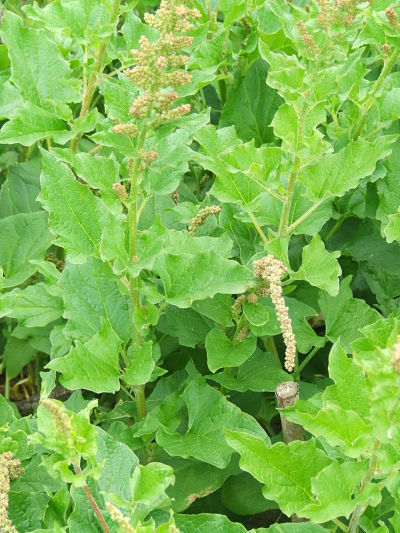 |
| Good King Henry |
I’d like to say we’ve also picked lots of leaves from the Caucasian spinach, Hablitzia tamnoides (a plant which is not only perennial but is a climber and a shade-lover to boot!) and that I’m familiar with its taste now. But, alas, my oldest Hablitzia which I hoped would be nice and bushy this year has been poorly, as you may be able to see in the photo below on the left. Its leaves have been small and curled down and in on themselves.
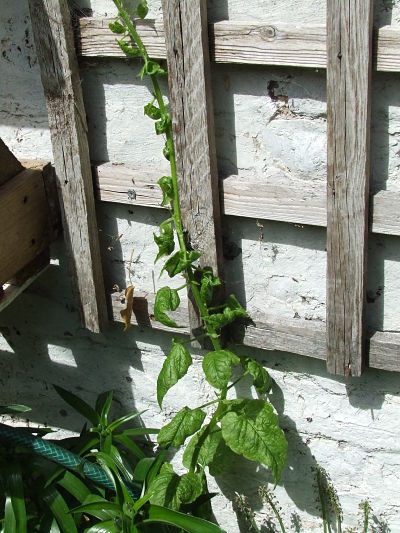 |
| Hablitzia – not thriving |
 |
| Hablitzia – recovering a bit |
I’m not sure if drought, cold or a virus is the problem but I’ve given it extra water and a comfrey feed for a tonic – it does seem to be picking up a little bit now but I’ll have to wait a while longer to really get to know its eating qualities.
See here for a photo of a bushy, healthy Hablitzia tamnoides belonging to Stephen Barstow who has helped to bring this useful edible plant out of obscurity.
Emma
I like perpetual spinach. People treat it like chard's poor cousin, poor thing, but it's endlessly productive and easy to cook.
Anonymous
Hi, how long did your sea beet live for, is it still alive?
Alison
Yes still alive but I pulled out the plants in the picture above when I realised they were not true sea beet. I probably planted the ones I have now in the autumn of 2013 but I'm not quite sure!
Regan Ludwig
It would be pretty neat to get a hold of some of this seed. I am in Canada. Does anyone know where I could get a few different types?
Alison Tindale
You could ask Aster Lane Edibles in Canada Regan. Or Pennard Plants UK will ship to you I think.
Mike
How do and where are the seeds harvested on tge sea beet..csn I replant the whole plant?
Alison Tindale
Hi Mike, When the seeds come free from the flowering stem when you run your hands up it they are ready to harvest. It might be possible to replant the whole plant. I have done this successfully once, but in winter when the plant was not in active growth.