Portuguese Kale
A couple of years back a friend gave me some seed labelled Portuguese cabbage.
I grew some seedlings and planted one out at the allotment alongside some other heritage brassicas such as Sutherland kale, Madeley kale and Delaway cabbage. At first I grouped it with these others in my mind also; broadly similar leafy brassicas which nonetheless offer up interesting individual characteristics in leaf form and colour, flavour, heat and cold tolerance, disease and pest resistance.
Meanwhile I was trying to lay my hand on some cuttings of tree collards from the United States, having heard that they are ‘true’ perennials, like Daubenton kale, in that they rarely flower and keep growing for several years. (Many brassicas will keep growing after their second year flowering, especially if you remove the flowers as they appear. But I have found that this can be a lot of work – they are often really keen to flower, managing to replenish their flowers just a few days after the last lot have been removed – and that during this enthusiastic flowering phase they produce fewer and smaller leaves.) I couldn’t find anyone who would send tree collard cuttings to England but in searching the web I found a comment that Portuguese kale/cabbage was the European equivalent of the tree collard.
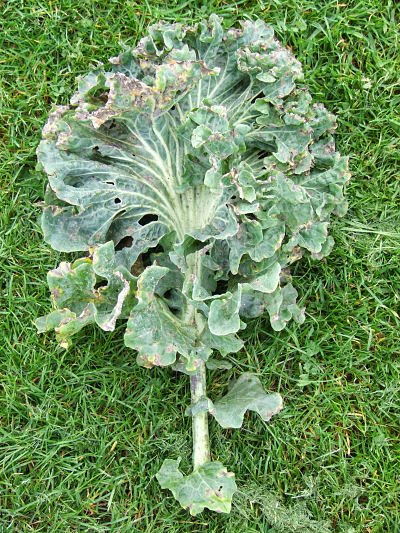
I inspected the one Portuguese kale I’d grown with renewed interest. It was impressive! It was growing fast and had very frilly, large, thick, grey-green leaves of mild flavour with prominent white midribs and veins, growing from the top of a two foot stem. It looked very distinctive – and very distinguished – amongst the heritage kales.
 |
| Portuguese kale |
It is not easy to say for certain but comparing this kale to photographs on the internet it looks similar to those described as ‘couve galega’. Frillier than some, admittedly, but I understand couve galega to be the name for a landrace plant, a genetically diverse variety of a domesticated species that is adapted to local conditions. So frilly and non-frilly may be all in the mix, or frilly types may come from a particular part of Portugal.
 |
| Older Portuguese kale leaf |
 |
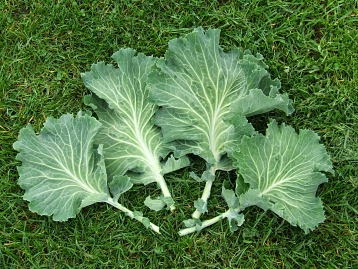
| Younger leaves |
As for flowering, well it obviously does, or I would not have been given seed, but this plant didn’t flower this year, its second year, when most of the other kales were flowering their heads off (including the walking stick kale, also known as Jersey kale). Another one that didn’t flower very much however, was one that came to me as seed, via the Heritage Seed Library, labelled as ‘tall kale’. It shares some characteristics with the Portuguese cabbage having large leaves with white midribs and veins and a similar height. But it is more tree-like than the Portuguese kale with heads of leaves arising from separate branches.
 |
| ‘Tall’ kale |
 |
| ‘Tall’ kale leaves |
At present at least, the leaves of the Portuguese kale all arise from about the same place at the top of the stout stem. As the plant grows from the crown it drops its lower leaves and so the bare portion of the stem gets longer.
 |
| Portuguese kale about to lose a lower leaf |
I don’t yet know how hardy this kale is. It survived last winter with ease but it was a mild winter. Some sources I’ve read suggest that it is not only very cold-hardy but more likely to be perennial in cold climates, whilst others suggest the opposite on both counts. Luckily it is easily propagated from cuttings (scroll halfway down this forum page to find some great photos of the kale growing in Portugal and how to propagate it). It occurs to me that even if it isn’t reliably hardy in the UK, taking cuttings like this is a very easy way to have a perpetual supply of kale.
Portuguese kale is used to make a delicious soup, beloved of many Portuguese people, called caldo verde and described very lovingly in this delightful blog post by Joy Albright-Souzaby. I based my attempt on the recipe given there but, as we are vegetarians, I used vegetable stock and, instead of Portuguese linguiça (smoked pork sausage), a vegetarian ‘sausage’ made from lentils flavoured with lots of smoked paprika and garlic.
 |
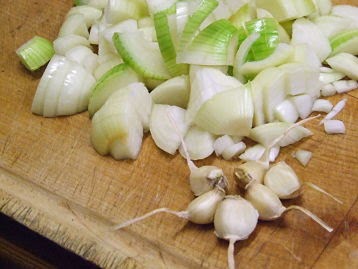 |
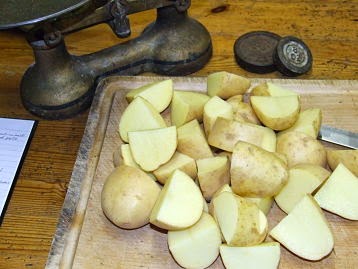
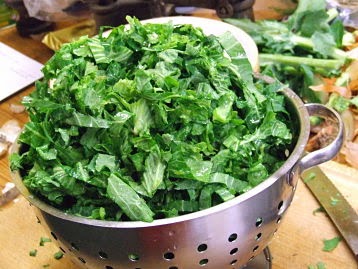
Refer to the recipe in the link above for exact instructions (to make about six portions I think) but basically I boiled the potatoes in the stock until they were almost tender and then added the sautéed onion and garlic with the (ideally!) very finely shredded cabbage and more water. The soup was seasoned and simmered for about half an hour.
 |
 |
I made the vegetarian ‘sausage’ by mixing cooked lentils with sautéed onion and garlic, breadcrumbs, egg, olive oil, smoked paprika, salt and pepper and forming patties with the mixture, coating them in flour and baking them at 180°C for about thirty minutes, turning them over halfway through the baking time. In the recipe the linguiça is cooked alongside the onions and garlic for a while and simmered with the soup but I thought the lentil patties might disintegrate in the soup and so added them to it just after it was put in the bowls.
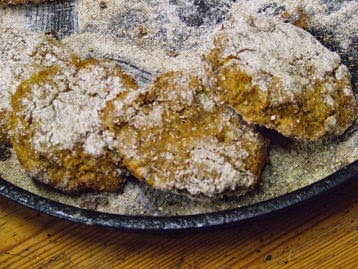 |
| Smoked paprika and lentil patties |
The soup is often served with freshly grated Parmesan cheese to sprinkle over – I meant to serve some grated cheddar instead for the sake of economy but then forgot about serving cheese altogether.
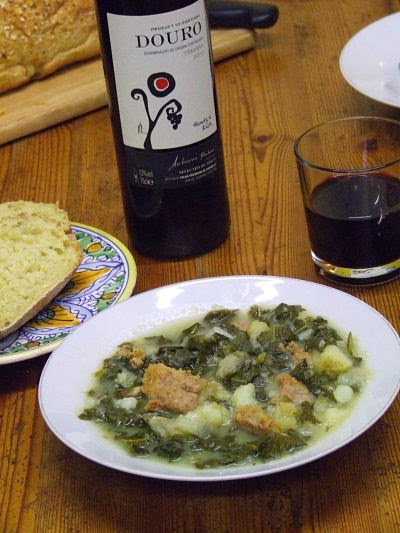
The recipe said to eat the soup with crusty bread and glasses of red wine – so we did!
It was good.
Billy Bluntz
Hi ,were in europe can i oder this kale seed ?
Alison
Hi Billy, I think Ebay is your best bet.
Paul Gutches
Thanks for the article Alison! I can't seem to find a source for buying the perennial plant or seeds. Is this the same as the Tronchuda Beira? All the places that sell it don't mention if it's perennial. And all the portuguese kale site don't seem to sell it! Can you provide any useful tips for a lost soul? Thank you!
Alison
Hi Paul, Did you try Ebay? I think that is where the seed I was given was bought and there seem to be several sellers offering it at the moment. I think it will probably go by the name of couve galega also (although mine does seem to be frillier than this usually appears to be in photos I have seen – this may just be variation in landrace seed). I think Tronchuda Beira is similar in leaf but not tall-growing. As for perenniality, I wouldn't expect every plant to be reliably perennial but its quite likely that they will keep going (this may be true of the Tronchuda Beira too). I've still got the plant in the photo in the post above.
Salvador Palma
Hey man, no disrespect but your soup looks nothing like caldo verde. I'm portuguese. First, the cabbage needs to be cut much more tinner, like 1mm or 2mm. Second, the potato needs to be proceced after boiling and before you add the cabbage. This creates a thicker soup. And third, there is no such thing as parmesan or any other cheese in caldo verde, EVER!
Just use onions and potatos and olive oil (fair ammount), boil them, process them, add the cabbage and voila. You really dont need any kind of meat. Yes, traditionally in contains (chouriço), but is not mandatory. I am also vegetarian, never use chouriço.
I know it is time consuming to cut the cabbage this thin, but you will see its worth it.
Hope you enjoy your next caldo verde better.
Salvador Palma
Salvador Palma
if you need help finding couve galega seeds or tronchuda or any kind of portuguese/spanich cabbage/kale send me an email to:
salvador.palma@hotmail.com
Alison
Hi Salvador, very pleased to hear how the soup should be made. I can see that what Joy said in the blog I linked to above is very true, "this beloved simple soup inspires a number of strong opinions as to its proper method of preparation."! I'll certainly be slicing the leaves very fine in future and mashing the potato, just not sure everyone in my family will forgo the cheese!
What do you think to the way the plant looks with its rather frilly leaves. Would you call that couve galega?
Many thanks indeed for the offer of help to find seeds – I will be in touch!
Duarte Frade
Since Salvador didn’t reply, as another Portuguese I’ll give you some notes on Portuguese brassicas. Portuguese speakers will often confuse cabbage, kale (or collard greens) and Portuguese cabbage when speaking in English because all follow under the term “couve” in Portuguese, but Portuguese cabbage and Portuguese kale are not the same. Portuguese kale (“couve-galega”) is a variety of kale. It has both frilly and smooth forms, and people don’t really distinguish between the two – in some places you often see the growing side by side in the same field, and both can come in the same batch of seed. This is the one you have there, and the one usually used for “caldo verde”. Regular cabbages are called “couve-repolho” (smooth leaves), “couve-lombarda” (frilled leaves) and “couve-roxa” (red cabbage), but were traditionally less cultivated. Portuguese cabbage (“couve-portuguesa”, “couve-penca” and “couve-tronchuda”) falls in between cabbage and kale, and is considered a distinct cultivar from either of the two. It remains short, and sometimes form a small sprout on top, but never form a big, round cabbage. “Couve-portuguesa” or “couve-tronchuda” is a particular landrace of the cultivar (the one traditionally eaten with boiled codfish and potatos on Christmas eve), and includes Tronchuda Beirã. Other varieties include “Penca de Chaves”, “Penca de Mirandela”, and a few other.
Lisa Warmoth
Found seeds at an online seed shop in the UK called Portuguese Kale (Brassica Pekinens) , Brassica oleracea var tronchuda. I can’t find them anywhere in the United States. Can you give me any information on this particular Kale?
Alison Tindale
Portuguese Kale, Brassica oleracea var tronchuda is shorter than the couve-galega described in my post (see Duarte’s comments above). I haven’t grown it but I suspect it is quite perennial too. I think the Brassica Pekinens part of the listing is an error because Brassica rapa pekinensis is the name for Chinese cabbage which is an annual, related more closely to turnip, forming a tight head of leaves (was originally named by a Portuguese botanist, Joao de Loureiro).
Ana
Hi Lisa
I’m portuguese, maybe I can help a little. I live in Central Portugal and don’t grow them in the summer because they bolt fast with the hot weather and don’t grow as well as I would like it. But provided the weather allows it you can. They’re usually sown late August, early September for a Christmas harvest since this is the type of kale we use for the traditional Christmas dinner with cod fish. The info on seed packets show you can sow from August through March, which gives you pretty much an year round harvest. Like Duarte said there are other varieties, you can find Tronchuda seeds on westcoast seeds I believe. I reckon I could try and send you a few packets, but I’m not sure if they’d get stuck in customs.
Alison Tindale
Thanks for this Duarte. It is so useful to have these names explained and great to have my plant identified as couve galega and to know that this comes in a frilly as well as a smooth form. And to know that Portuguese cabbage is neither simply cabbage nor kale but special in its own right.
beesandtrees
what fun
Wade Souza
Interesting to read all this. My Avo’ aka grandmother used to grow this in our backyard here in Hawaii. It was just called cabbage and was used in soups and stews. As a kid I didnt know it was maybe kale…there were other plants called Kale which she also grew. The kale was cut removing the center stem then sauteed in olive oil with garlic and raisins. As an adult, I started getting interested in this stuff when I moved to New England and encountered lots of Portuguese with similar names but different upbringing and backgrounds all curious about a Hawaiian Portuguese. I discovered their versions of foods I knew from HI were different as well as others I didnt know. Thx for this article, it is educating me further.
Alison Tindale
Thank you so much for your comment Wade. Fascinating that there is Hawaiian Portuguese kale – and the central stem being cooked like that with garlic and raisins. I’ve learnt a lot from the responses to this post!
Sue Hunter
Hi, going back to your search for collards, I have had seed of Collard ‘Teddie’ from Chiltern Seeds. It has proved to be a short lived perennial surviving in our polytunnel in southern England for 3 winters so far. We like the fairly mild taste and discovered that the recipes online from southern USA which give lengthy cooking with a bacon hock are disappointing. Boiling or steaming work best for us.
Last year to make room for summer crops I cut it back almost to the ground when it sprouted half a dozen new stems. It did flower this spring and the sprouts were delicious so I have cut it down again ready for tomatoes. I can’t say what it would do in the open as pigeons got in and destroyed the main part of the crop.