Ali’s Alliums
It’s been all change at my perennial vegetable allotment recently. I’ve been relocating plants to make room for two ‘sand beds’ for plants which haven’t been doing so well in the clay soil, but also to establish a bed with larger colonies of the perennial leeks and onions we most like to cook with. Here is the new bed….
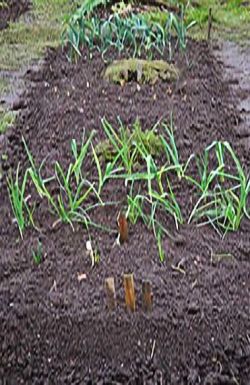
The first few plants at the near end of the bed are young Welsh onions. Behind those are Minogue onions (a leek!) Potato onions are planted in the next section and a perennial leek, St.Victor x Oerprei, occupies the far end of the bed.
The bed is about 3.6m long. The potato onions and the perennial leek cross are intended to fill a third of it each, and the Welsh onions and Minogue onions a sixth each. All the plants will clump up in time and I intend to harvest big onion bulbs/leek shanks/bunches of leaves as we need them (and replant offsets and bulbs in gaps as they appear to keep the colonies going). A bit of thinning out will be needed from time to time too. I’ve planted some creeping thyme in there as well, hoping it will spread and provide ground cover without detracting from the growth of the alliums.

My other edible alliums are intermingled with other plants on the allotment. There are Babington leeks and wild leeks with the sea kale and sea beat, and tree onions and Elephant garlic in with the asparagus. The rest are mostly growing in the herb garden.

My collection
Counting up I have quite a number now. Not the huge collection I could have, as all alliums are edible and there are hundreds of species! (You can see over 700 pictures of Stephen Barstow’s allium collection here). However some are much better eating than others; I’ve been aiming to grow the tastiest, and most convenient for cooking and to have something oniony to harvest all year around. The following list just about covers the ones I have growing so far.
Perennial leek – Allium ampeloprasum St.Victor x Oerprei – cross made by Aster Lane Edibles. Produces seeds.
Wild perennial leek – Allium ampeloprasum – produces seeds.
Babington’s leek – Allium ampeloprasum var. babingtonii – a sub-species of A. ampeloprasum which produces top-setting bulbils and sterile flowers. Pronounced garlic flavour.
Elephant garlic – Allium ampeloprasum var. ampeloprasum – a sub-species of A. ampeloprasum with very large bulbs. Produces seeds.
True pearl onion – Allium ampeloprasum var. sectivum – produces many small, white, mild, sweet onions in the ground. Often pickled or roasted.
Minogue onion – Allium ampeloprasum var. sectivum ‘Minogue’? – Not absolutely sure of the species for this one but there are suggestions that it is a form of pearl onion. I have found it to be vigorous, growing and clumping up very quickly.
Welsh or Japanese bunching onion – Allium fistulosum – produces clumps of hollow leaves, many varieties in existence, of various heights and some with red coloration. White conical flowers.
Tree, Egyptian or walking onion – Allium × proliferum – a hybrid of Allium cepa, the common onion, and Allium fistulosum. Produces small (1-3cm) top-setting bulbs in multiple tiers and a medium-sized round bulb in the ground. Several varieties in existence.
Chives – Allium schoenoprasum – there are many varieties of various heights, shades of white, pink and purple flower colour and shades of green foliage colour.
Giant chives – Allium schoenoprasum sibiricum and Allium ledebourianum both sometimes go under the name of giant chives and I would like a large chive. Neither have achieved very large stature yet but may do so in time.
Rakkyo – Allium chinense – produces an evergreen clump of tubular leaves with small, rose pink flowers.
Garlic or Chinese chives – Allium tuberosum – clumps of flat leaves, garlic flavour, pretty white flowers in late summer or autumn.
French grey shallot, true shallot, griselle – Allium oschaninii – smaller than a regular shallot (and a different species) these have a grey skin and pinkish flesh and said to have a particularly fine flavour – I haven’t yet tasted mine.
Three-cornered leek – Allium triquetrum – leaves have a v-shape in cross-section. Leaves available in winter. Pretty white drooping flowers with green stripes. Can be invasive.
Daffodil garlic – Allium neapolitanum – attractive star-like white flowers, garlic flavour.
Wild garlic – Allium ursinum – broad leaves with a strong garlic smell but milder flavour. Leaves only available in spring. Pretty flowers. Invasive.
Everlasting onion – Allium cepa perutile – Short, clump forming, usually non-flowering. Leaves available all year.
Golden garlic – Allium moly – short variety with yellow flowers and a mild garlic flavour.
I’ll try to improve this list in time, with more details of the season of each type and whether they are drought or shade tolerant and so on. And more photographs!
N.B. I lost the photos for some 2018 posts recently and have had to replace them as best I could from other sources (e.g. from posts on Facebook and Twitter) – sorry if they don’t look quite right! 17.02.2021
Hazel
I’m intrigued by the elephant garlic in with the asparagus. I want to prepare an asparagus bed this year and want to plant it with something else though that’s not traditionally recommended. I don’t mind not maximising the crop if I can harvest something else too. I have seen strawberries suggested and a combination of the 3 might work? How do you grow the two together?
Alison Tindale
Hi Hazel, I’ve only just moved it there so I’m not sure how it will work out yet. The asparagus is probably spaced with about 60cm between each plant in a single row down the middle of a 105cm wide bed and I’ve planted the Elephant garlic in 3 rows (I think) across the bed between the plants. I’m not sure about the strawberries – my perennial leeks seemed to rather swamped by them and seemed to be growing less vigorously than ‘free’ plants. I have some lambs lettuce in with the asparagus, the small plants are fine, but I will be pulling out bigger ones as mature plants have fine but very extensive moisture sapping root systems. Plant combinations are tricky aren’t they? I imagine plants that root in just one place but spread far and wide would be good – but which? We should discuss this further 🙂
Hazel
Hmmm. Back to the drawing board then. It’s hard to think of something that’s not overly competitive but I don’t want to be constantly weeding the asparagus. Anything else low growing like nasturtiums tend to be fairly rampant. Will keep thinking!
Vicky
Last year I planted New Zealand spinach at the back of my (2 year old) asparagus bed. The roots didn’t compete as they were a bout 18 inches away: the sprawling nature of the New Zealand spinach provided brilliant ground cover and reduced competition from weeds later in the year (it’s dies in frost so needs reseeding: I’m not sure yet if it will self seed or not). Strawberries planted at the front of the bed have yet to prove their worth: time will tell! I wish someone could provide a solution to asparagus beetle: having to net it as I had so much trouble with it last year…any ideas?
Alison Tindale
Hi Vicky,
Good to hear that New Zealand spinach (Warrigal greens) was a good non-competing and edible ground cover. Yes I’m interested to see if my patch has self-seeded too.
I haven’t experienced asparagus beetle yet (but then I haven’t experienced much asparagus either through various cultivation problems!) But if I pick up any tips I will pass them on.
Alison Tindale
Might still be worth trying the strawberry and asparagus combination. Also might glean some ideas here…
https://permies.com/t/62923/Super-short-perennial-ground-covers. Many not edible though. There are a couple of links in there to further lists too. It is for America but still useful as a starting point.
glynna muin
could you tell me where you got your Allium ampeloprasum var. sectivum seeds?
Alison Tindale
Hi Glynna,
I bought a plant from Deaflora in Germany. They didn’t seem to be listing it last time I looked. I don’t know of any other source I’m sorry to say, although I do hope to supply plants myself in time.
B
Is the elephant garlic a perennial as well?
Alison Tindale
It is. The bulbs will form cloves which will each form a bulb and so on…. My patch is only recently planted but I understand the plants will need thinning annually so that they don’t become congested and small.
This makes an interesting read…..
https://onestrawrevolution.net/garlic-you-only-plant-once/
B
Many thanks for the reply and the link Alison, that’s really interesting. Perennials just get more and more exciting!
B
Is there any growing advantages of Allium oschaninii over standard shallots, or is it just a taste thing?
Alison Tindale
Sorry B, I missed this comment last month. I’ve found Allium oschaninii a bit trickier to grow than standard shallots (but then I’m not a very experienced shallot grower) and they are also smaller – so no, I think the taste is the thing!
Ali Clark
Hello Alison, Have you been affected by allium leaf miner in your neck of the woods? I am wondering if there are any perennial alliums that cope well with it, or perhaps are in their dormant period when the leaf miner fly is on the move ( march/april and sept/oct/nov). I have it my garden for the first year in 2020 in the east midlands. Ali Clark
Alison Tindale
Hi Ali,
I haven’t seen that pest here (although I do have problems with some allium disease which I can’t identify but which just seems to go for the onions not the leeks). I don’t think that helps you much though because it may be that it just isn’t too bad in this area yet rather than that the perennial alliums escape it.
Pam Dawling
A great resource! Thank you Alison.
Ray Brown
I agree, a great resource. A couple of allium comments.
1. Allium triquetum, the three cornered leek is a fabulous, if invasive, plant providing garlicy leaves, stems, small bulbs and even edible flowers. I make lots of wild garlic pesto from them. This freezes well.
2. I normally harvest my babbington leeks by cutting about 2.5cm below ground. I tried this with elephant garlic but the bulbs rotted. Any thoughts?
Ray Brown
Alison, concerning allium leaf miner. I lost almost all my annual leeks and many of my onions to this pest in 2020 and 2021. I now grow them under a fine netting. Interestingly, my garlic was relatively unaffected and the perennial alliums not at all! I am in the West Midlands.
Alison Tindale
On the question of the rotting elephant garlic bulbs, I wonder if this is a question of whether or not the elephant garlic has split into cloves at the time you cut the leek. If it is still a monobulb perhaps this will rot before the bulb starts to initiate cloves each with their own growing point. Did you plant your elephant garlic in the autumn or spring? Perhaps a ‘perennial’ elephant garlic bed is best for leek harvest so that you are harvesting leeks from the older clumps that arise from a nest of cloves. You could still dig up some bulbs as well during periodic thinning of the bed.
Ray Brown
Alison, good thought about the monobulb. Both my babbington leeks and elephant garlic are managed in permaculture beds. perhaps I will keep the elephant garlic for the bulbs and use the babbingtons as leeks. Ray