Good King Henry Grain
Good King Henry is closely related to quinoa – they are both members of the ‘goosefoot’ (from the shape of their leaves) or Chenopodioideae sub-family. So I was interested in using Good King Henry as a pseudocereal just as quinoa is used (a pseudocereal is a non-grass plant whose seed is used as a grain in a similar way to the seed of grasses like wheat, oats and barley i.e. for cooking or for grinding into flour).
I harvested 130g (uncleaned) seed from my six Good King Henry plants. (This is a low yield compared to the masses of seed you get from quinoa but Good King Henry is basically a wild, unimproved plant and higher yielding plants could be bred. The advantage over quinoa would be its perennial nature and easy cultivation. These plants have been looking after themselves for years, I just tidy them up and weed them a bit once a year. I should probably feed them occasionally too but haven’t yet.)

There is more seed still to ripen on younger stems.
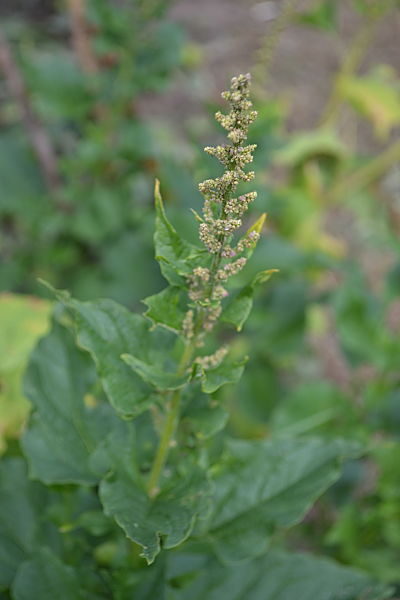
To loosen the seed from the stem I just had to run each stem through my fingers. There were lots of translucent seed husks and bit of stem in the seed but it cleaned up without much effort simply by pouring it from one plastic tub to another on a breezy afternoon on the allotment. I found I could get rid of the chaff more quickly by pouring the seed from a greater height – with the added excitement of the risk of losing the lot onto the grass if the wind changed speed mid-pour! Doing the whole operation over a larger bin would have been wiser.
Back home I measured out some seed to make some rosemary crackers following this recipe from Wishful Chef as a guide. I decided to use half Good King Henry flour and half plain white wheat flour.
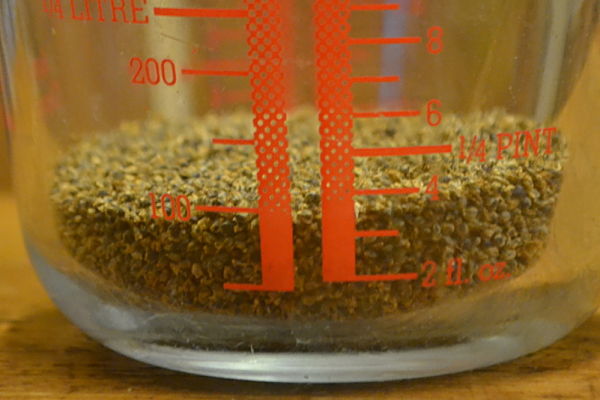
I ground the seed in a Vitamix blender. We have an old model of this blender which manages to grind grains into reasonably fine flour – the resulting flour was still very slightly gritty to the touch.
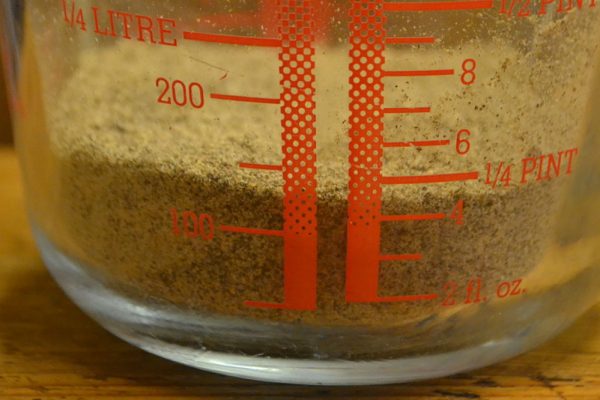
The dough came together well…
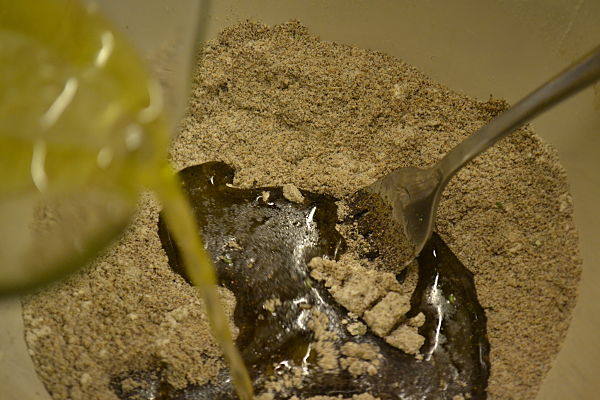
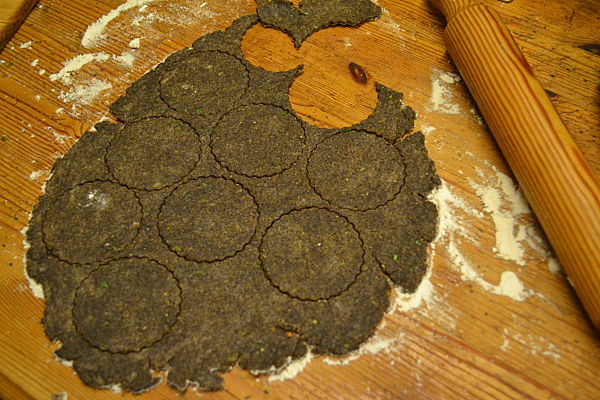
and was easy to roll out and cut into rounds…
Baked in a hot oven for ten minutes they gave these….
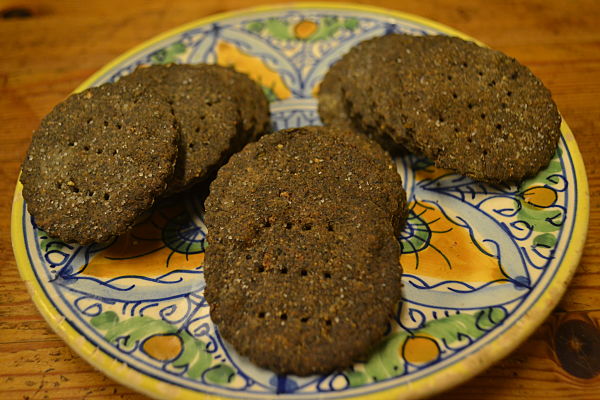
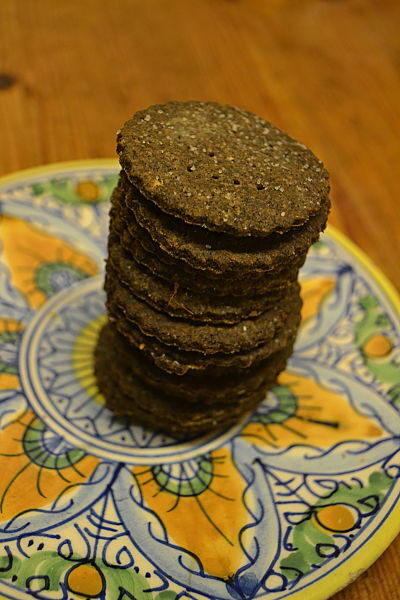
Odd little dark crackers! (But could catch on – we went into a ‘bistro’ a few days ago and Stew ordered a quinoa burger which was served in a black bread bun. They are probably trendy – but new to us!) To me the crackers were rather strong tasting. I think I’d try a third or a quarter Good King Henry flour next time. But my family helped themselves from the plate quite happily!
The strong taste may have been due to saponins and other unwanted substances in the grain. Reading up on the processing on quinoa flour, I should probably have soaked and rinsed and dried the seed before grinding it, and then roasted the resulting flour too, to give a finer, tastier and healthier grain.
Having said that, when I went on to rinse the remaining seed several times for cooking I found the water ran clear every time. I could be wrong on this but I think it would have been cloudy and soapy if the seed was rich in saponins.
I cooked the seed following instructions on a quinoa packet but found it absorbed at least double the water and needed at least double the cooking time. Then it was great! Nutty and very slightly crunchy – and delicious mixed with some leftover fried mushrooms and greens we had in the kitchen.

I’m going to have the rest with fresh tomatoes and salad leaves for lunch.
Here is a great video on Good King Henry grain from Tycho of Myrrhis Permakulturhaven.
Stewart
These were delicious!
BRT
Great info Stewart, and cheers for appreciating and utilizing such a great resource. I’m wondering if sprouting would be an improvement on the flavor and in making more of the nutrients available.
https://nourishedkitchen.com/how-to-make-sprouted-grain-flour/
Good King Henry Grain — Blog – The Backyard Larder | Anni's perennial veggies
[…] via Good King Henry Grain — Blog – The Backyard Larder […]
Alison Tindale
Thanks for the mention on your site Anni, (and also thanks that I am now no longer vaguely wondering quite what a ‘ping back’ is!) Good luck with the grain experiments.
Nancy Bell
I must find out what’s happening to your notifications Alison. I suspect my spam filter is junking them – sorry! However since I follow Anni’s ‘blog, I’ve found this delightful post of yours! This looks very interesting: Good King Henry seems to love it here – seeding around for me happily and forming a ground cover. I quite like the flower sprouts, but using the seeds would also be interesting.
Alison Tindale
Glad you liked the post Nancy. Let me know how you get on with the seed. And also if you spot extra high-yielding plants!
Nadya King
Delightful – I’ll have to try this! I love quinoa, and often cook some brown rice for 20 minutes, then add the quinoa for the last 20, so could add the GKH seed earlier!
Years ago, a flat mate was a chef at the retreat centre where we worked, and he’d freeze veggie trimmings for stock, so o often start by simmering a pot of those first. Current bag has leek and carrot tops, garlic skin, and fava bean pods. I usually add a bay leaf, fresh herbs and some lovage.
Lady Marisha
Thanks for the information and recipe. I planted these seeds in a large planter about 3 years ago and forgot to label. When early Spring came it began to grow, VERY LARGE LEAVES!! It scared the bejesus out of me! I didn’t pull it out, after all, I was a Show Stopper and planted in a favorite planter. It just re-grows every year. Large leaves and all. Now that I have a plant identifier I am good. Plus because of your article I now have a recipe. Who knew?
Alison Tindale
That’s good Lady Marisha. How wide are the leaves in inches or cm? From your description I’m wondering if you have an individual with unusually large leaves.