February Plant Profile: Sea Beet
The eleventh in a monthly series of perennial vegetable profiles. Practical aspects of growing and harvesting the plant are outlined first, with further relevant information following on. Please let me know in the comments if there are more details you would like me to include.
Sea beet, Beta vulgaris maritima, is the wild relative of sugar beet (and also of beetroot, chard, and perpetual spinach). It is native to Europe along the Atlantic coasts and the Mediterranean Sea and the coasts of North Africa and Western Asia, and has naturalised on other continents. In Britain it is generally, but not exclusively, found growing on the coast, on shingly and sandy beaches, cliffs and sea-walls, and in saltmarshes. Being a perennial leafy vegetable with a strong but appetising spinach-like taste it is popular with foragers of wild food but can also be successfully grown on garden soils.

It is more perennial than its cultivated relatives which are generally biennial, but its lifespan varies between individuals in a population, and between populations from different regions: only about two years in the case of plants from south-western France to 11 years or more for north Brittany, before decreasing to about 5 years for the most northerly populations in Britain and Germany.
Hardiness
Hardy down to about -20°C
Soil conditions and location and cultivation
Whilst sea beet is tolerant of a wide range of soil conditions, it will do better in a deep, open, well-drained soil with plenty of organic matter and does significantly less well on clay. A sunny location is needed. It will tolerate a saline soil (and there is some evidence that it does better if the soil is moderately saline soil) and it will also tolerate a moderate degree of soil alkalinity. Leaves can become bitter in late summer but the plant can be chopped down in mid-July to give a flush of fresh new leaves.

Height
4ft. 1.2 m.
Spacing
3ft. 90cm.
Pests and diseases
Sea beet suffers from few pests and diseases. It is used as a source of genetic material conferring resistance to beet necrotic yellow vein virus, the cause of rhizomania, an important disease of commercial sugar beet, beetroot and spinach. Some damage from beet leaf miner may be seen but this is not usually extensive. Some control may be achieved by removing clusters of white eggs from the underside of leaves or crushing the maggots in the tunnels they mine in the leaves. Pigeons sometimes eat sea beet leaves during the winter so a protective net may be useful.
Harvesting and yield
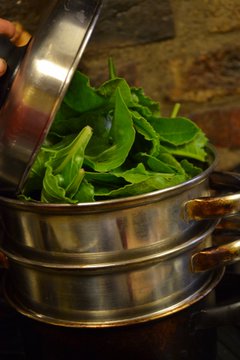
Leaves can be picked all the year around. On well-grown plants there are usually plenty of sizeable leaves even when the plant is in flowering mode (flowering stems can be removed to divert nutrients to foliage although this is not strictly necessary). When plants are mature one or two plants will be sufficient for one person even in winter when leaves will be smaller.
How to propagate
Propagation is most easily achieved by sowing seed. This can be hard to find to buy but sea beet grows wild around the coasts of British Isles and it is legal to collect seed from the wild (ideally just a small amount). Variable plants will result from sowings of wild seed and individuals with the best characteristics and vigour can be grown on. Cuttings are harder to achieve but layering is the most successful method.
Wildlife value
Sea beet is a host plant to several beetles and moths, some of which are nationally rare such as the rosy wave moth and the sea wormwood weevil (below).


Botanical name
The species was described in 1753 by Carl Linnaeus as Beta vulgaris and as Beta vulgaris maritima in 1882 by Giovanni Arcangeli.
Common names
Sea spinach, wild beet, wild spinach.
History
Sea beet seems to have been part of the diet of hunter-gatherers in Mesolithic times as fragments of dried seed stalks, carbonised seeds and root fragments have been found at archaeological sites in Denmark. Domestication and the development of cultivated types is judged to have begun around 8000BC, perhaps in Mesopotamia or Asia Minor, spreading from there to the Mediterranean. Analyses of mitochondrial DNA suggests this was probably from a wild ancestor rather different than the plants known today. But wild sea beet continued to be frequently used after domestication and continues to be so today, especially in Mediterranean and Caucasian regions. It is mentioned by multiple classical and medieval scholars but it takes a detailed study to try and elucidate whether the wild sea beet is being referred to or one of the many domesticated forms. Beta maritima: The Origin of Beets by Leonard W. Panella is one such detailed study.
A mention of gathering sea beet and other wild vegetables is made in the charming Old English Wild Flowers: To be Found by the Wayside, Fields, Hedgerows, Rivers, Moorlands, Meadows and Seashore by Joseph Tom Burgess (1868)

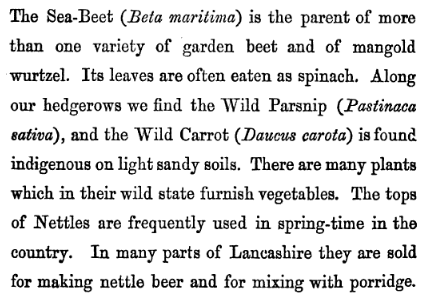
Generally garden writers have not mentioned introducing sea beet into the garden but Claudius Louden did so:
“A perennial spinach, however, whether from the Beta maritima, or Chenopodium Bonus Henricus, is very desirable in every garden, as a resource in case of neglect or accident, and because the plants being in perpetual maturity, and abundantly furnished with proper sap, are, as it were, ever on the alert to take advantage of any circumstances favourable to vegetation.”
The Gardener’s Magazine, Volume 2 1827
Helen Butt
I tried to grow sea beet from seed but it didn’t germinate, although as I direct sowed, this could have been an issue. I’ll look the seeds out and see if they might still grow in a pot. (Spinach and beetroot don’t grow in my soil, either).
Ceri
Only a very few of my sea beet seeds germinated…but the few I have, have gone on to become sturdy vigorous plants. Just about to put them in a stirfry!
Ms S Warren
Hello
Thank you for posting all this really useful information. I wonder if you can help me. I have foraged and eaten sea beet in Essex in the past. I am currently working and living in the Channel Islands and have found a variegated variety growing here. Is this also edible?
Many thanks
Sue
Alison Tindale
Hi Sue,
I’ve never seen a variegated sea beet – but would love to see a photo if you ever get one! I can see mention online of variegated Swiss chards (which developed from sea beet) planted as ornamentals – maybe they mean the ones with colourful leaf ribs and veins. Yes no reason for it not to be edible if it is definitely sea beet – so long as the variegation isn’t a result of herbicide damage or other nearby chemical pollution.