Elephant garlic – a puzzling history
It is tricky to trace the origins of any onion, leek or garlic because this group of vegetables has been cultivated from the earliest times. But elephant garlic is especially puzzling because a) it is not always clear whether elephant garlic is being referred to or a large form of true garlic (Allium sativum) and b) there are rival claims about its ‘discovery’.
Elephant garlic (Allium ampeloprasum var. ampeloprasum), also known as great-headed garlic, is part of the Allium ampeloprasum ‘species-complex’. The large size of its bulb is probably due to the plant having additional sets of chromosomes compared to other members of the complex. Allium ampeloprasum is believed to have originated in the Mediterranean region possibly extending into Asia, but it is cultivated in many countries of the world and become naturalised in some of them.
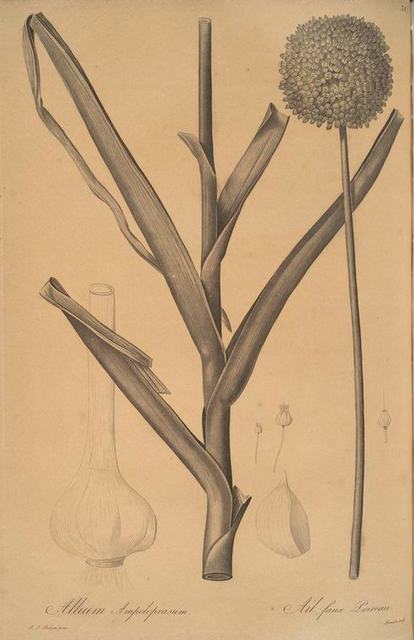
There are some indications that great-headed garlic may have been in cultivation in the Classical era. Pliny refers to a garlic called ‘ulpicum’. He writes,
‘Another distinction, too, is formed by the relative size of the heads. Ulpicum, also, generally known to the Greeks as “Cyprian garlic,” belongs to this class; by some persons it is called “antiscorodon,” and in Africa more particularly it holds a high rank among the dishes of the rural population; it is of a larger size than ordinary garlic.’
Pliny the Elder, The Natural History (AD 77-79), Book 19 Chapter 34.
He is drawing on an even earlier reference by Theothrastus to Cyprian garlic….
‘There is one kind which excels in size, especially that variety which is called Cyprian, which is not cooked but used for salads, and, when it is pounded up, it increases wondrously in bulk, making a foaming dressing.’
Theothrastus c. 371 – c. 287 BC, An Enquiry into Plants, Book 7, Chapter 4, 10-12
And ‘ulpicum’ is also mentioned by Columella….
Ulpicum, which some people call Carthaginian garlic, but which the Greeks call 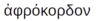 , is of far greater growth than ordinary garlic, and around October 1st, before it is planted, it must be divided from one head into several; for, like common garlick, it has several cloves sticking together;…
Columella 4-70AD, Of Husbandry, Book 11, Chapter 3
Classical scholar, Margaret R. Mezzabotta, in her paper, ‘What was Ulpicum’, published in The Classical Quarterly, came to the conclusion that ‘ulpicum’ was indeed great-headed garlic .
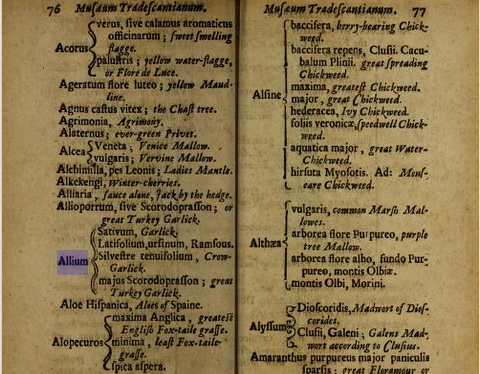
In more recent times, John Tradescant the Younger is said (by Martyn Rix in ‘Vegetables’ I think, although I don’t have a copy to check) to have grown elephant garlic in the ‘Ark’ garden at South Lambeth in 1656. I’m guessing that Rix must be equating the entry shown below for ‘Great Turkey Garlick’ with elephant garlic. This appears in the catalogue for the museum and garden, ‘A Collection of Rarities preserved at South-Lambeth neer London’ by John Tradescant.
On to even more recent times and the story is still hard to unravel. Nicholls Garden Nursery in Oregon produce a sheet explaining how Mr Nicholls first saw this massive garlic in 1941 growing in a backyard in Scio, in the Willamette Valley in Oregon, an area originally settled by people from the former Czechoslovakia or Northern Yugoslavia. The Nicholls believe that the settlers probably brought the garlic with them and explain that it was called Giant garlic at the time. They bought 12 pounds of the cloves and started to work on improving the strain further, selecting for size, hardiness and disease resistance, selling it to the public and finally giving it the name Elephant garlic in 1953.
They are adamant that they were the first breeders of elephant garlic in America and that the claim that Luther Burbank, a famous American plant breeder, developed elephant garlic, is entirely wrong. But in 1922 Henry Finck had predicted that ‘there is ‘big money’ coming to those wise enough to grow Burbank’s Elephant garlic and Giant chives’. And in his work, ‘Luther Burbank: His Methods and Discoveries and Their Practical Application’ (1914), Burbank recounted…
‘I am now cultivating a wild garlic from the mountains of Chile which is a wholly distinct species from the common cultivated garlic, having much larger bulbs and a taller stalk similar to that of the leek.’
This is curious – although rare in the southern hemisphere, there are a few wild alliums that occur in Chile, but I haven’t read of any there that have large bulbs. But elephant garlic is cultivated on Chiloe, off the coast of Chile, possibly brought there by immigrants from Europe. Certainly the garlic that Burbank went on to develop and name ‘Elephant garlic’ and which appeared in his 1920 catalogue, ‘Burbank’s 1920 New Creations and Special New Selections in Seeds‘, does look very much like the elephant garlic we know today.

Lots of puzzles: what was ulpicum?, what was John Tradescant growing in his garden?, what was Burbanks’ wild garlic from Chile?, who first developed elephant garlic for the American market, who brought elephant garlic to Chiloe? Luckily growing and eating it is a much simpler affair.
Ghulam Murtza
we have a similar variety with the name NARC G1 in pakistan.
I wish if any research is being conducted on the ingredient DNA of the elephant garlic with the traditional garlic to highlight the difference for the consumers.
Tammy Hamilton
Are Elephant Garlic Forms edible ??
Alison Tindale
They are.