Triteleia Try-out
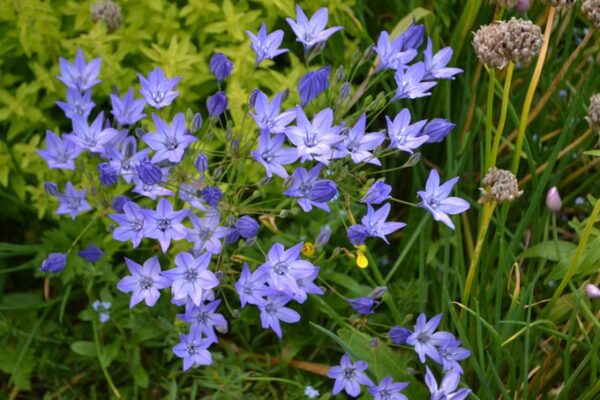
Triteleia laxa ‘Queen Fabiola’ flowers
Last week I cleared a bed at my ‘annual’ allotment (although the name no longer really applies because I seem to be growing more and more perennial vegetables there). This was a bed of potato onions which I’d already harvested but not replanted yet as the bed had become weedy with dandelions. Half-way through the digging I came to a part of the bed where I’d planted a few rows of Triteleia laxa, or grassnut, púuchu or triplet lily.

This is a plant with delightful blue starry blooms and small edible corms. It is another one I’d learnt about from a post on Radix – Root Crop Research and Ruminations. I’ve been growing it in the herb garden for several years on my other allotment (the commonly available variety, ‘Queen Fabiola’). But I’d never tasted the corms – it is such a riot of plants in there and I wanted to be sure I knew what I was eating! Hence the more orderly rows I dug up last week. Here is the pile of corms that emerged…
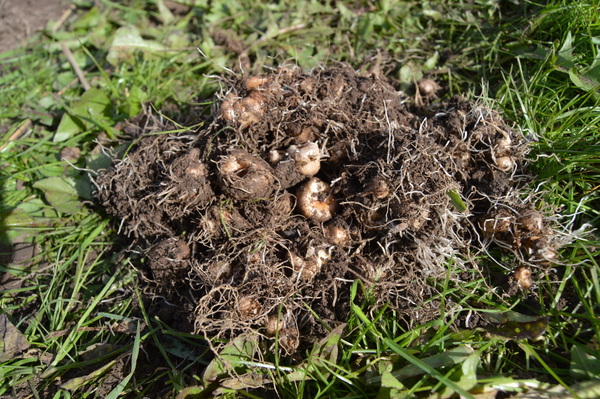
A muddy little pile. A bit easier to see once washed…..
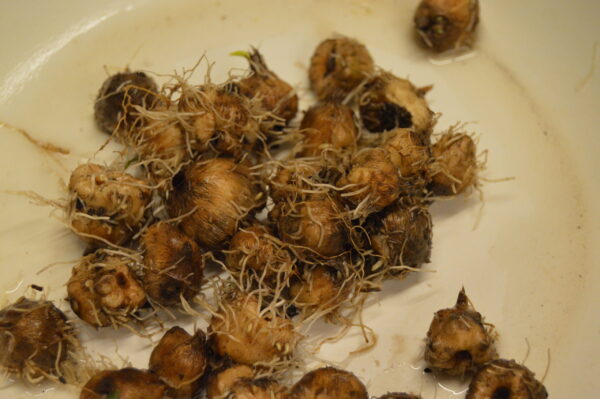
and then peeled…. (A bit of a fiddle – I wonder if I needed to do this but they were a bit hairy!)
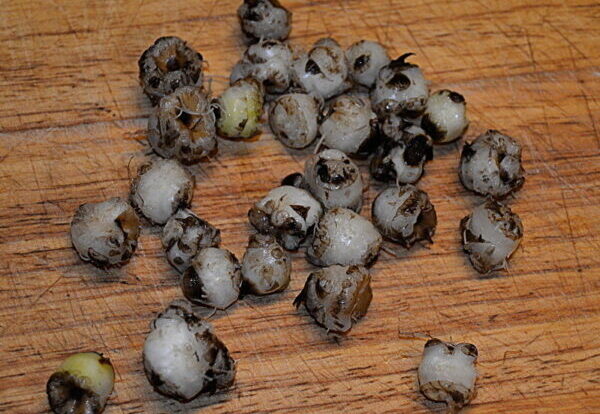
I ate a few during this process as they can be eaten raw. Sweet and crunchy – very nice!
Then I boiled the rest (for about 10-15 minutes I think – not quite sure, forgot to time it.) And mashed them (adding some salt, pepper and sunflower oil spread).
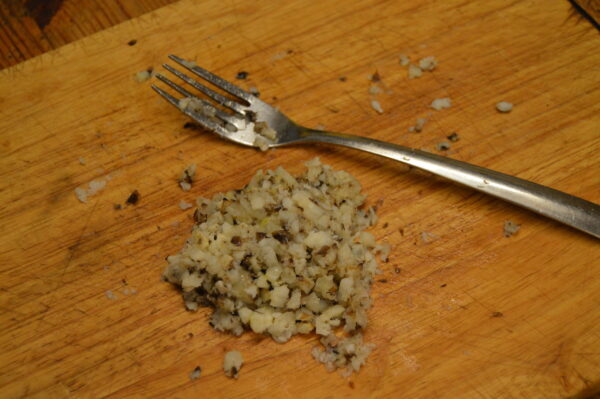
A bit grainy as you can see (maybe needed a bit more boiling) but a satisfying, flavoursome mash. Just needed more!
Bigger corms are really required for it to be easy to harvest enough for a meal. I think I need to find ‘Humboldt Star’, a form with big corms and few offsets, selected by Jim Robinett from seeds collected in Humboldt County in California. Or maybe I could sow púuchu in every nook and cranny on the plots and hope a similar form appears amongst the stars.

Karen Potterton
Brilliant practical research, and so informative, many thanks! These bulbs are sold by companies in the UK as ornamental with an extensive and varied selection of dire warnings not to eat, or even touch without gloves in some cases. I can only conclude from your post and others that the companies selling are not confident about the identity of the bulbs in their packets.
Alison Tindale
Thank you! I suppose the ‘not edible’ warnings might be due to chemicals, such as fungicides, sprayed onto ornamental bulbs to extend storage times.