Plant Profile – Siberian Purslane
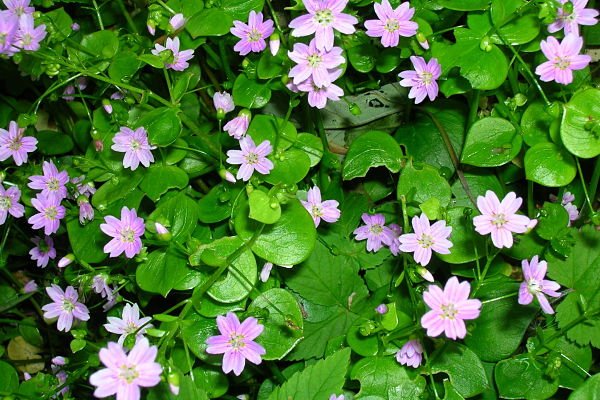
Siberian purslane (Claytonia sibirica) is an evergreen, usually perennial, low-growing herb with pretty pink flowers. Its evergreen nature makes it a useful winter salad leaf (with a mild beet flavour). And the fact that it will grow in deep shade (as well as sunnier spots) gives it value as edible ground-cover for darker spots in the garden. It is native to the Komandorski Islands (off the eastern Siberian coast) and western North America. It has been growing in the wild in the United Kingdom since the early nineteenth century and is now very common especially in western counties.
Flower colour can vary from white to pink-striped or pink. In 1934 a white-flowering form growing on Amchitka Island was named Claytonia sibirica var. albiflora by Misao Tatewaki and Yosia Kobayasi, and in Scotland a white-flowered form, the Stewarton flower, predominates in North Ayrshire.
Hardiness
Hardy to about -40°C (or F!)
Soil conditions and location and cultivation
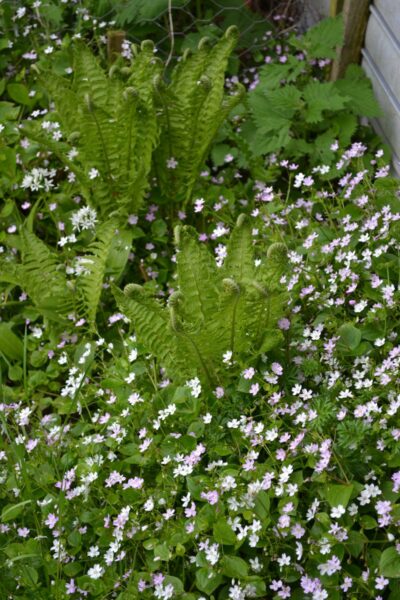
Not at all fussy about soil pH (except very alkaline ones) or soil type and can grow in sun, semi-shade or deep shade. Tolerates dry soils. Can be used as a ground cover around fruit bushes and trees or taller strong-growing perennial vegetables. It should not be allowed to spread in a wild setting as it can out-compete native vegetation to a serious extent.
Height
8in. 20cm.
Spacing
1ft. 30cm.
Pests and diseases
Young plants often need protection from slugs and snails. No other serious pests or diseases.
Harvesting and yield
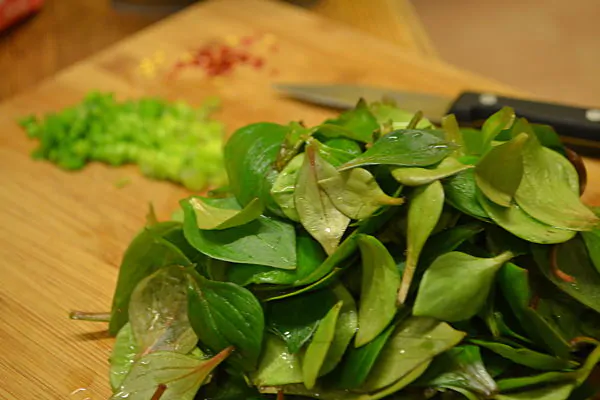
A small patch of about a square metre will give plenty of leaves to add to mixed salads or harvest for occasional use as a cooked vegetable (steam for just a minute or two).
How to propagate
Extremely easy from seed and self-seeded seedlings are also easy to find and pot up or transfer to new places in the garden. Large clumps are usually comprised of a number of offset rosettes around the original rosette (asexually produced) and can be dug up and divided.
Wildlife value
Does not appear to have significant value to wildlife.
Botanical name
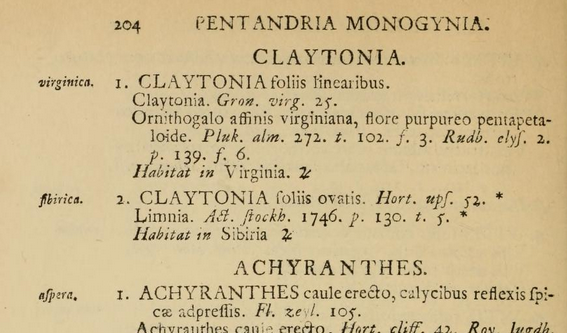
Claytonia sibirica Linnaeus 1746.

Common names
Siberian purslane, Siberian lettuce, Siberian spring beauty, Siberian miner’s lettuce, pink purslane, candy flower.
History
There are many records of winter purslane (Claytonia perfoliata) being used as a vegetable by indigenous peoples in North America but it is medical rather than food uses which are more common in reports for Siberian purslane. However the Native American Ethnobotany Database does list food uses for the Yurok and Alaska Native tribes.
The name Siberian ‘miner’s lettuce’ is due to the plant being related to winter purslane, commonly called miner’s lettuce, and widely claimed to have been gathered by miners in the California Gold Rush of 1848 to ward off scurvy (although the only contemporary accounts of this that I could uncover is an account by a doctor in San Francisco advising scurvy patients to gather a ‘kind of wild lettuce’ that grew on sand hills at the back of the city). There is no evidence of Siberian purslane being used in a similar way despite it also being high in Vitamin C and growing in regions where scurvy was once a serious problem to sailors and miners.
According to Hortus Kewensis (1814) Claytonia sibirica was first cultivated in England in 1768 by Philip Miller. (However Miller’s description seems to be of a smaller plant with a tuberous root, as found in several similar Claytonia species, whereas C. sibirica is usually described as having a fibrous root – this is the case in all the specimens I have seen). The Online Atlas of the British and Irish Flora notes that it was first recorded in the wild in 1838 but did not start to spread widely until 1930. It it now very widespread especially in western counties and sometimes pushes out native flora.