2023 Review
The Backyard Larder’s tenth annual review!
We finally got the greenhouse glass in last June. (All except in the louvre window low down at the back – could have sworn we brought the narrow panes home with us but couldn’t find them anywhere. Still not done – it has a spare large pane propped against the gap!)
Such a pleasure to have the greenhouse up and in use.

It soon filled up with plants. And was soon surrounded by pots too.

Over the months homes have gradually been found for much of this plant collection. I made a circular bed between the greenhouse and the shed in the shade of an old elderberry tree…..

…..and planted it up with shade-tolerant edibles; Oriental borage (Trachystemon orientalis), a Mahonia I grew from seeds from some tasty fruit I used to snack on on the way to our previous growing site, apple mint, another lower growing Mahonia donated by a friend (M. aquifolium), butcher’s broom (Ruscus aculeatus) to give potentially asparagus-like edible shoots (potentially very bitter!), Caucasian penny-cress (Pachyphragma macrophyllum), creeping bellflower (Campanula ranunculoides), pokeweed, Siberian purslane, honewort and mitsuba.
And also a witch hazel and early spring bulbs (just for colour in the cold months). You will also spot some self-introduced plants like those two big cotton thistles. I suppose I ought to remove at least one of those before they are ten feet tall! A lot in a small bed and several of them are of the type that try to take over – but they are at least isolated here from the rest of the plot. I was going to plant udo (Aralia cordata) here too but was advised that it could easily fill the whole bed. It has found a home in the herb garden at the front of the plot.
I also had several potentially large trees and shrubs in pots; Japanese silverberry (Eleagnus umbellata), beef and onion plant (Toona sinensis), sea buckthorn, and mulberry. Edible things I wanted to grow but really scratched my head wondering where I could plant them. The mini forest garden is only about 12 square metres but it has taken them alongside the Szechuan pepper – as a short hedge to be pruned quite hard. This will be interesting!
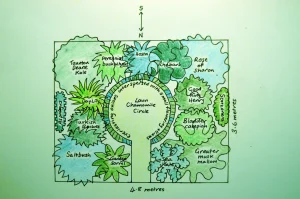
‘The Backyard Larder’ name is inspired by the thought that, across the country, there are thousands of homes that could have edible but care-free (i.e. perennial) plants growing in their gardens, with something always ready and at hand to feed the occupants. Our own backyard is very shady and only a restricted range of edible perennials will grow there, whilst on the plot I try to grow every edible perennial plant that takes my fancy, whether it is very space-worthy or not. So, with the sunny but smallish garden in mind, I was curious to plant up a selection of the most productive plants and see how things works out. I may change the choice of plants a bit but this is the basic plan which I made last August (click it for more details).
And here is the patch of land on one of my allotments which I finished digging over and raking this afternoon.

The idea is to do regular updates as the year progresses.
In other news we were pleased with how well cotton scrim did as an alternative-to-plastic cabbage white butterfly excluder on the sales plants beds. It is a delicate fabric and won’t last forever but it can go on the compost heap once discarded. (At the time we got a discounted roll from Ebay. No longer available but the price here, which appears to be for the 50m roll, seems fairly reasonable.)
