Tasting Chinese Yam
I was weeding around a 20 litre pot containing Chinese yam (Dioscorea polystachya, synonym Dioscorea batatas) at the allotment yesterday. The yam was just beginning to sprout, visible, if you look very closely, as a pinkish shoot in the centre of this photo.
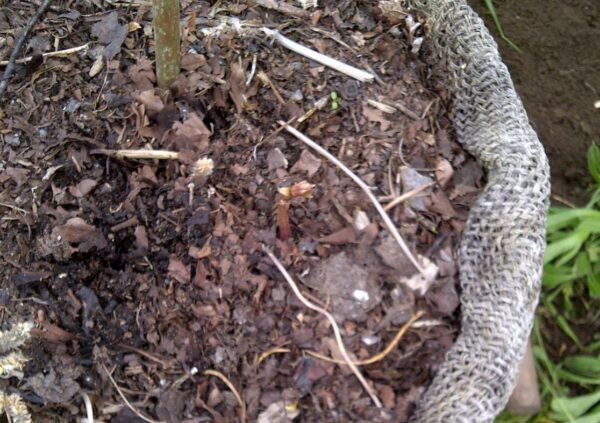
(They are quite hardy. This one was mulched with leaf mould and the pot was wrapped in jute sacking for a bit of added protection.) It was in that pot for easy harvest as the roots of the yam are long and go deep: it is difficult to uproot their whole length when they are grown in open ground. But I have been reluctant to harvest the root yet. Another name for the plant is cinnamon vine from the smell of its flowers – and I’m still hoping that my plant will flower so I can experience wafts of cinnamon scent one summer day as I walk through its arch.

The bulbils that form in the leaf axils (shown below on a hungry plant) are a bonus harvest. They have a pleasantly crisp texture. Not much flavour but they can be spiced and seasoned in the kitchen for an enjoyable snack.

I decided to shift the pot to remove any couch grass or bindweed roots from the soil beneath it and I heard something snap.

The yam root had grown through 40cm of pot, out through a hole in the base and into the soil. Digging it up I heard another snap and the portion shown below came up with the spade.
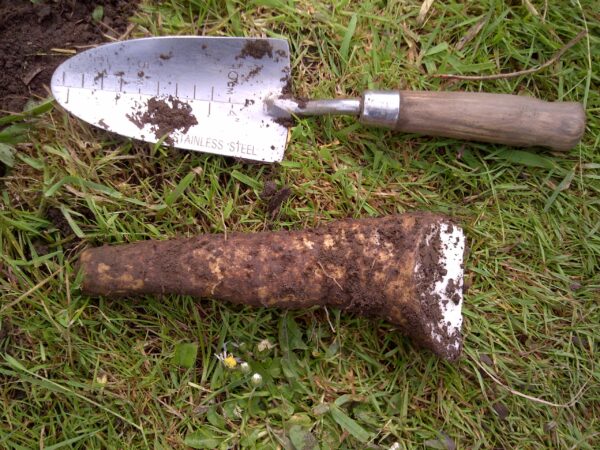
I dug a bit more but only brought up a few fragments and I think the root probably rounded off just below the fatter portion into a bulbous base. The pot was returned to its place and the root came home to be cooked.
From the Wikipedia entry for Chinese yam I learn that this long cylindrical type of D. polystachya is known as nagaimo (long yam) in Japan and that there are also palmate ‘ginkgo-leaf’ yams and round ‘meatball’ types. It also says that this species of yam is unique in that it can be eaten raw as well as cooked. I didn’t try it raw as it is quite slimy uncooked – but curiosity makes me wish I had now! Next time.
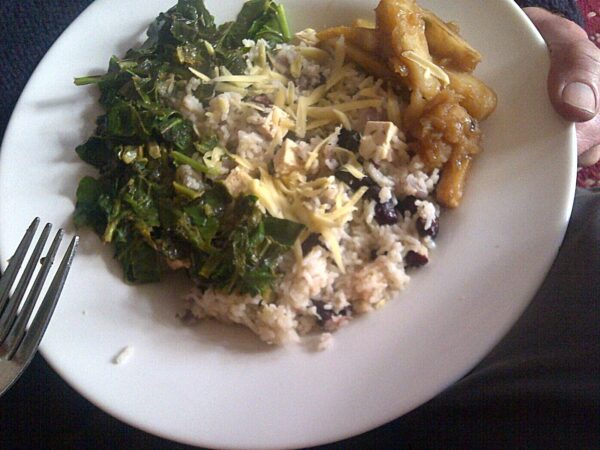
How to cook it? I found an entry on Reddit by ‘starbombed’ explaining that in Korea the yam is cut into matchsticks, par-boiled and then boiled a little more in a mixture of soy sauce and syrup, allowing the moisture to infuse into the yam and for the moisture to evaporate. I tried that, using soy sauce and some maple syrup we had in the cupboard.


The texture of the yam was soft and potato like. Satisfying food and nutritious too. It was appetising cooked like this but I’d use less syrup next time – to our tastes a bit too sweet to accompany a savoury dish.
Hazel
thanks for this information. I found this plant growing in my mixed hedge yesterday! There’s no way I’d be able to access the root but I’d love to try propagating it and growing in a pot as you suggest.
Alison Tindale
Which plant have you got Hazel? Because there is a native Dioscorea (black bryony) in the UK which is highly poisonous.