Stupid Skirret Suppositions
What is the best time to harvest skirret?
After initially harvesting small bundles of roots in the autumn after planting in spring, I adopted the practice of digging them up in their third year and was delighted with the large clump of roots that emerged from the ground. I decided this was a better practice. So I’ve been replanting a third of the skirret bed each year and harvesting each third in its third year.
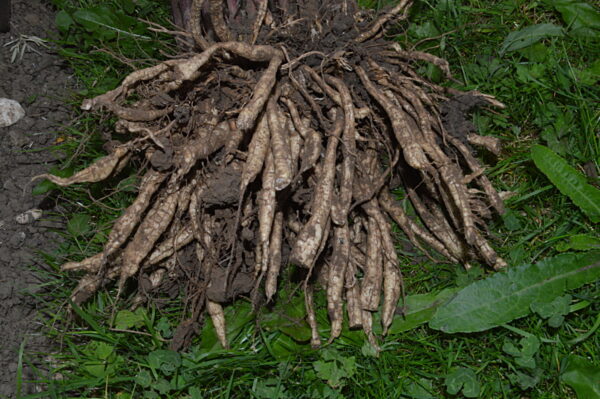
(Actually I think this might be a photo of one of the clumps that got left for four years!)
They didn’t seem to have become woody in three years of growing. Someone asked me about when to harvest recently and I shared this experience. I also suggested that, as the roots had been growing for more than a year, they could therefore be dug up at any time of year.
But I’d never actually tried harvesting in spring or summer – and so dug some up yesterday. Which has led to a rethink…..
A large clump of rather short, thin roots emerged – which separated out easily into individual bundles.

And in the mix were three or four dead stalks with roots attached.
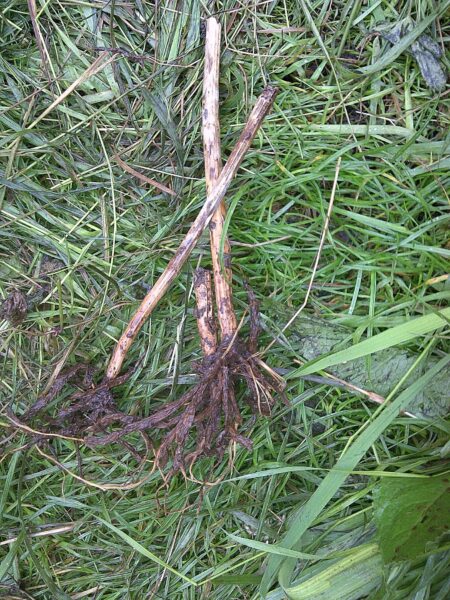
I’ve seen the initial division of the roots before in winter harvests and have often sold the young offsets (which become the new bundles) so that people can start their own skirret plants. But I’d been really quite slow and continued thinking that the original roots persisted and got bigger over time. Now I’ve realised that each year the original root dies off as the offsets the plant has produced develop into new plants. No wonder they weren’t woody! In my three-year clump I’m guessing the first year stalk and root has rotted away altogether and I can only see the remains of the year 2 roots along with the living year 3 ones.
Harvesting in summer like this just gives very young small roots. They were tender and tasted good, we had some last night, but would have got longer and fatter left in the ground.
What of the three-year cycle idea? Well I have been digging up a satisfyingly large clump of roots in autumn, lots of roots in one heft of the spade – but they have taken up garden space for three years to produce the crop. On the other hand, I think the individual roots on the three-year cycle have been longer and fatter than the ones I was previously harvesting in their first year. It could be that offsets develop into bigger plants when they have the resources of the dying root to start them off. Or the whole clump, being undisturbed for three years, sets up better mycorrhizal connections. Or perhaps more moisture is retained around the growing roots in a multi-plant clump. Or …… perhaps one season’s growing would simply have given a third (or even more) of the three-year crop? I’m not sure. Comparison trials and careful measurements clearly need to be made.
Another observation is that the plants have grown rather well in a very tight clump. So perhaps they might be sown or planted more closely (for harvesting either in the first or in later autumns). I do remember hearing a suggestion a few years ago that they do well at closer-than-would-be-expected spacings.
All is subject to rhythm and change in the perennial vegetable garden! Comments from other skirret growers on their various experiences are welcome.
Bobby Watson
Well, you can also harvest “on demand”, take the roots to eat, and replant the buds in the soil (is it the right word?). In my experience they regrow in the spring, and that way you don’t absolutely have to resow each year… Harvest might be less large than with your method though, I haven’t compared.
Neil
I grew skirret last year for the first time. I’d read about leaving them to grow bigger roots but couldn’t resist trying some in the winter time (delicious!). After digging up the clump I also moved it but didn’t split it and this year have a much bigger clump. I will split this one when I harvest roots in the winter. However, both last year and this year all the stems flopped over completely when they reached about 4ft tall. Does this always happen? If so I will need to give them some support as they are covering half the bed where they’ve flopped over!
Alison Tindale
Hi Neil, I haven’t known that happen. Maybe to a stem or two but not wholesale like that. I’ve seen sections of stems collapse much higher on the plant, possibly due to some stem boring insect although I’ve never seen any insect life at the collapsed spot. I have seen the same symptoms on wild umbellifers locally. Do you have a free-draining soil? They are quite thirsty plants but I guess that’s not it as you don’t mention wilted foliage. Anyway glad to hear you like the taste!
Neil
It’s quite a heavy clay soil, but very fertile with lots of added compost. Maybe that’s the problem – too much vegetative growth, although still only about 4-5 ft tall. Still flowering profusely from its prone position but it has caused the fennel to bolt and swamped the celeriac underneath it.
Alison Tindale
Yes that is a possibility. I think of it as quite a ‘hungry’ crop needing rich soil for a decent harvest, but perhaps the nitrogen needs to be high but not too high. Or maybe grow it like that (if the harvest proves to be good) but with support, as you say.
Dominic
Just stumbled across this post and slightly surprised, having worked for one of the large seed companies for quite a few years, that there are still things to grow which I’ve yet to discover. I’d never heard of skirret until now. Just had to Google to learn more and found it described as “somewhere between a Parsnip and a carrot with a hint of pepper”. Having read that, I’d love to give it a go – but, sadly, may be about to move and not sure yet whether an allotment is a viable option after the move. If it is, I’ll probably join the experimentation.
Sally
My skirret has produced huge quantities of seed ( which seems to be a thing for them), I’m wondering if the seed is edible – does anyone know? Also, does this mean that skirret will self-sow if left to its own devices, or does it need some heat/protection to germinate?
Neil, mine’s fallen over too…
Alison Tindale
I don’t know but Damien at living-mudflower.blogspot.com believes they are. I see carrot seed is used for medicine and as a spice in India. Not that it is the same thing! Mine never resows and I planted out very young seedlings one autumn and they didn’t survive the winter (not that I know what befell them – could have been eaten by something rather than succumbed to cold or wet.)
Pauline Webb
I am very happy with my 2 skirret plants in their 1st year – spring to autumn so far, 1m high, flowering. They flopped weeks ago and they are now staked. I’m excitedly waiting to try them when they die back but will transplant some.
Alison Tindale
I’m sure you will love them!