2024 Review
The Backyard Larder’s eleventh annual review!
I garden on two allotments. They are referred to between ourselves as ‘old’ and ‘new’, ridiculously now as ‘new’ was taken up in 2010 and ‘old’ in 2003.
I’ve had another year of greenhouse love on ‘old’. Such a pleasure to be in there on a cold day with seeds germinating around me, the radio to listen to and birds flitting onto the feeders hanging on a nearby silver birch tree.

Here is a birch sap collector I’ve just attached to a slender branch of the tree. This works and is less damaging to the tree than a spout in the trunk. Birch sap is refreshing to drink – and faintly sweet!

Work to be done this year – urgent cleaning of greenhouse glass!

Less urgent planting of a fig tree. There is no warm sunny wall for a fig tree on the plot so I figured (after watching online videos etcetera) that I could plant it against the greenhouse glass – but keep it very low, trained horizontally along wires. The fig will produce vertical shoots from the branches – hopefully this will just be the right degree of shade for the greenhouse over the summer. A cold frame or two is planned for placing beside the fig, to be made with the wood, presently stacked in the shed, that we received as part of our £50 greenhouse bargain in 2021.
Grapes and figs. Figs and grapes. My son helped me erect two of these grape supports over the perennial vegetable beds.
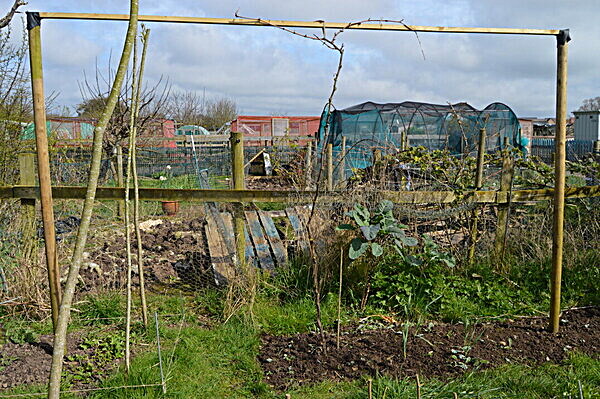
This one is over the Good King Henry in one bed and the asparagus and silverweed in the other. Part of my attempted thickening up of food production from the plot by finding plant combinations and arrangements that work. Here is another.
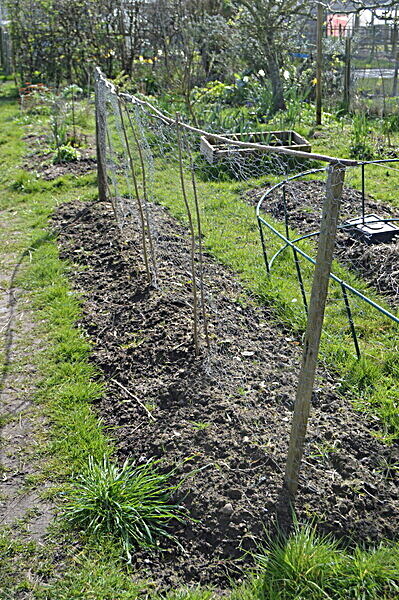
This bed has the ‘Dwarf’ Jerusalem artichokes planted in it and a support for aardaker (Lathyrus tuberosus) down the middle. This wouldn’t be possible with the average height Jerusalem artichoke but ‘Dwarf’ is diminutive, growing only a couple of feet high. And the tubers can all be harvested at the same time.
On ‘new’ big changes are underway. This extra plot started life as the ‘allotment farm’. We were very busy with children at the time, so I planted it up with just four low-care annual vegetables: potatoes, leeks, onions and beans. As ‘old’ was gradually turned over to perennial vegetables, ‘new’ became the home for all the annual vegetables. Then Stew got his allotment and began to grow most of the annual vegetables alongside his wildflowers and so space on ‘new’ allotment was freed up for new projects. Hence the experimental perennial vegetable garden reviewed in the previous post.
I have been also been combining the original narrow beds into three bigger plots. The first is for perennial grain plants: perennial oats, perennial rye, perennial wheat and some other rarer perennial grasses which may prove useful for grain production. The space soon gets used up but if I can sneak some cornflower weeds in here too, such as poppies and corn marigolds, it will be give me great pleasure!
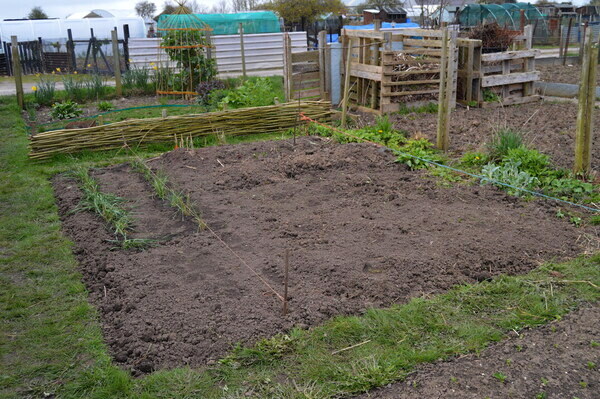
The next plot will hold a climate resistant perennial vegetable collection. I have a few plant candidates in mind for this one but not the whole picture yet. The soil is going to need a bulk import of sand and grit to improve drainage. Most heat and drought resistant plants that are sufficiently hardy for winter here just won’t survive the winter wet and flooding without good drainage.
The third bed is to take popcorn, squash, beans, peas, talet, lupins, yacon, oca, sunflowers and my sunflower/Jerusalem artichoke hybrids. With all these plants from the Americas perhaps it will be a touch reminiscent of the Mesoamerican ‘milpa’ which Rhizowen told me about.
‘A milpa is a field, usually but not always recently cleared, in which farmers plant a dozen crops at once including maize, avocados, multiple varieties of squash and bean, melon, tomatoes, chilis, sweet potato, jícama, amaranth, and mucuna … Milpa crops are nutritionally and environmentally complementary. Maize lacks the amino acids lysine and tryptophan, which the body needs to make proteins and niacin; … Beans have both lysine and tryptophan … Squashes, for their part, provide an array of vitamins; avocados, fats. The milpa, in the estimation of H. Garrison Wilkes, a maize researcher at the University of Massachusetts in Boston, “is one of the most successful human inventions ever created.” ‘ Charles C. Mann, 1491: New Revelations of the Americas Before Columbus.
Discussion of milpa and a Cherokee/Appalachian version of the same concept can be found here.
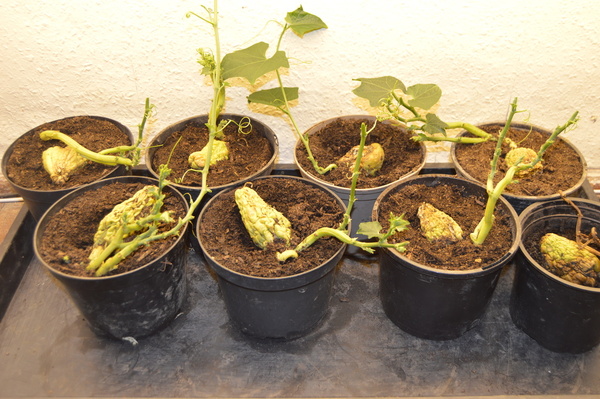
I also intend to try chayotes (Sechium edule) along a fence in the Americas bed. Since writing a post on this new venture I have received news of someone growing chayotes successfully in Pontefract which is very encouraging. Chokos are coming north! Here are the chokos under a growlight in the top floor room of our house.
Down the bottom of the plot is the perennial brassica mesh cage we put up last year.
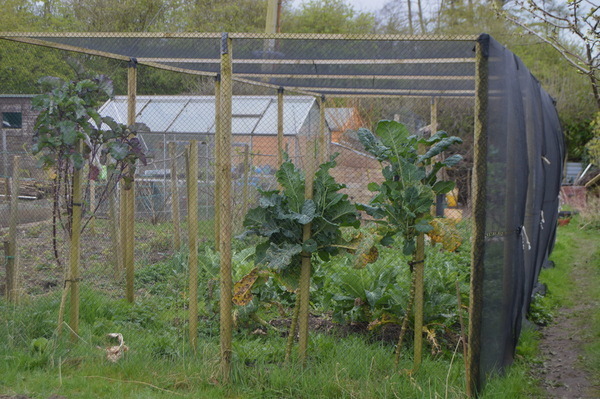
The pigeons finally made me do it! (People have told me they effectively keep pigeons off their brassicas by growing them amongst other tall plants to camouflage them. I’ve wondered how that works in the winter when the other plants have died back although I can imagine it working with evergreen rosemary plants.) Despite the present weediness, the plants in here are revelling in their new protection. The new cage won’t keep out all the butterflies but caterpillar destruction is greatly reduced these days, I think due to the wildflower border down one side of the plot full of plants favoured by parasitic wasps.
Now for a brief mention of old and new perennial vegetable plants (and one fruit plant). The California goosefoot has done well over winter outside.
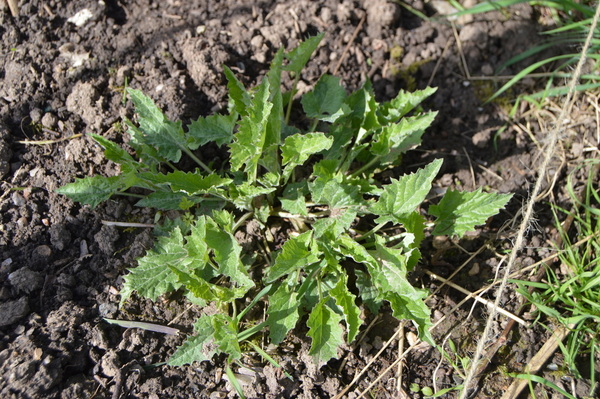
The poppy mallow (Callirhoe involucrata) flowered.
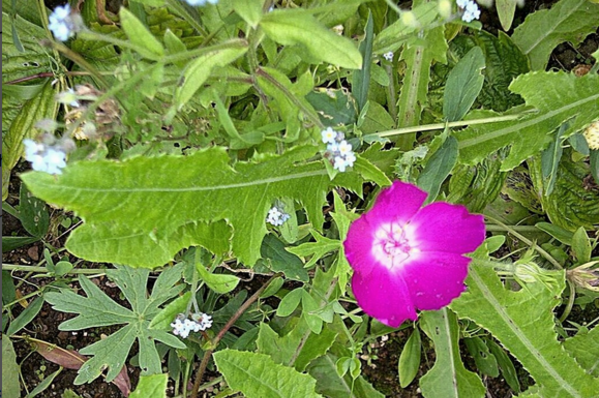
‘True’ earth chestnut Bunium bulbocastanum seedlings are still alive in their pot, but dying everytime I attempt to plant some into the garden.

The same, for some reason, is true for Claytonia virginica (‘fairy spuds’) and Alpine bistort (Bistorta viviparum).
Bergenia crassifolia, the well known Elephant’s Ears, has earned a place in a pot by the backdoor, since I read Martin Crawford’s post on it as a source of leaves for chigir tea. The leaves are gathered after they have died, darkened and fermented on the plant – and the tea is great, a fine and refreshing brew. Recommended! Elastostema umbellatum is in a pot next to it, growing well there after being rescued from the too deep shade in the backyard border. It is a ‘sansai’ or mountain vegetable from Japan.
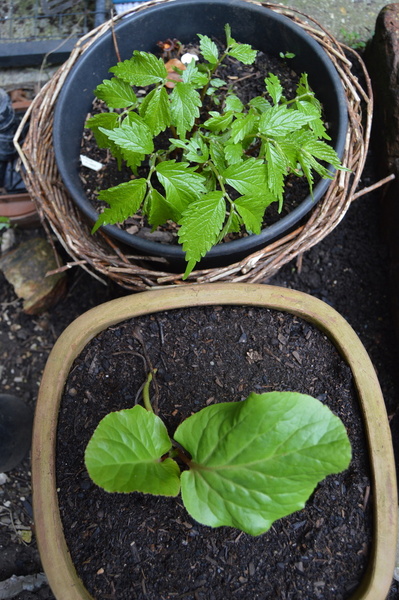
Elatostema umbellatum (top), Bergenia crassifolia (bottom).
I grew green Jaltomato tlaxacala (or procumbens?) in the greenhouse last year after receiving seeds from Small Island Seeds. Richard Kuernel who runs this nursery writes…
Green Jaltomato – Jaltomata Tlaxcala – Rare, Delicious, and Perennial. Jaltomata Tlaxcala is a fruit bearing plant in the nightshade family, Solanaceae. Jaltomatas originates in South America, and are relatively unknown outside of their native region. The berries taste absolutely delicious. They can be eaten and enjoyed raw, in salads, cooked in dishes, or made into a salsa. The flavour is unique, but could be described as a combination of ground cherry, tomatillo, and other flavours that are unique to the jaltomata genus. The ripe fruits can be quite sweet. The plants can grow tall and bushy, so some sort of support or a cage is recommended. Jaltomata Tlaxcala is very prolific, and will provide many fruits from mid summer until frost. The plants are perennial down to zone 8, but can be grown as an annual everywhere else.
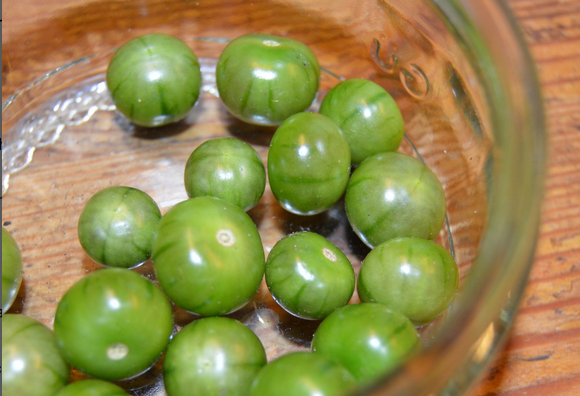
The fruits were produced in quantity and had a unique taste, maybe appley-banana flavoured? But I’m not sure if my plant has survived winter in the greenhouse, let alone outside. Time will tell…. I have the purple form to try this year.
I never realised there would be so many perennial vegetables. So many plants, so little time! I must make a proper inventory one day of all the ones we have growing now.