Time for Hablitzia tamnoides
I’ve asked Stew to cook us a Caucasian spinach omelette tonight.
 |
| Hablitzia tamnoides |
Caucasian spinach is a common name for Hablitzia tamnoides, an extremely useful, shade-tolerant, climbing, edible plant that has been brought to the notice of the unusual-edible-eating public by Stephen Barstow, author of “Around the World in 80 Plants“. (I’ve been feasting on this book ever since Stew gave it to me for Christmas – not that it is at all heavy going but there is a lot in there! I’ll finish reading it and review it properly when I have – but it is excellent. Travel broadens the mind; letting Stephen take me around the world in eighty plants is both broadening and deepening my understanding of perennial vegetables.)
Hablitzia has been growing in our backyard for a few years now, climbing up a trellis to a height of about seven feet. At first I left it alone to grow in peace and then it started to grow a little strangely and didn’t look so appetising. (I thought it might have a virus. I don’t think this is common for Hablitzia – I’ve never heard anyone else mention any problems with it at all. But to be on the safe side I replanted with fresh stock this year and the new plants have been growing well so far.)
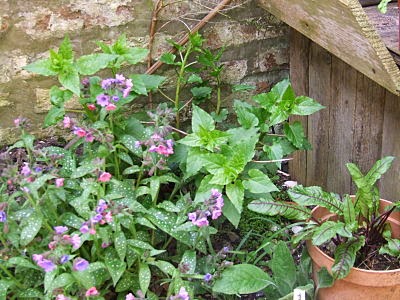
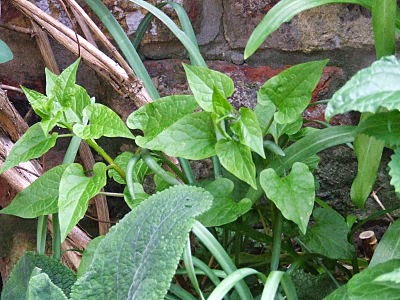
I have had a few leaves in salads and steamed a few too but I still don’t feel very familiar with its taste. Stephen seems to favour the very young shoots as in the photo below – I’ve missed the moment for those but the leaves stay edible and mild in flavour all year.
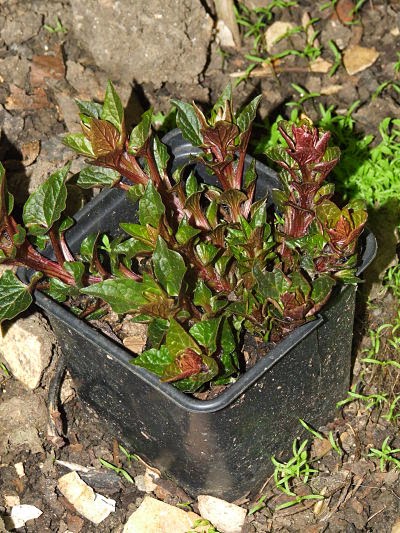
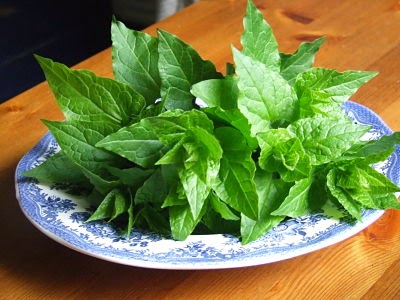
So tonight we’ll have these not quite so young shoots in our omelette.
~:~:~:~:~:~:~:~:~:~~:~:~:~:~:~:~:~:~:~:~:~:~:~:~:~:~:~:~:~:~:~
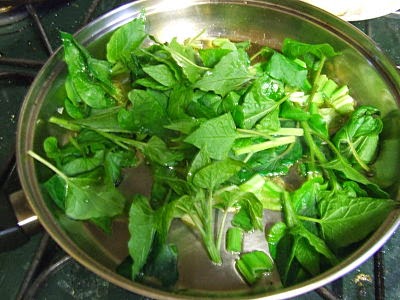
I wasn’t very sure of the best way to cook Hablitzia but I’d read that softening the shoots in oil worked well. Stew is cooking them here with some Babington leek.
Then he went on to do the usual omelettey thing.
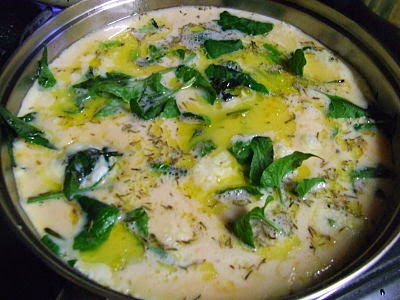
Done!
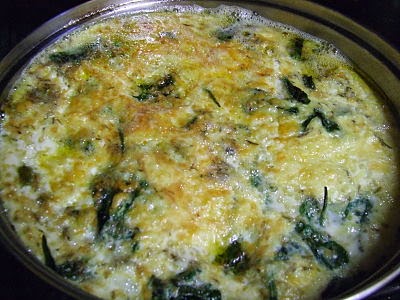
The verdict? Well it was a lovely omelette but it was hard to really taste the individual flavour of the Hablitzia with the other ingredients. I’d thought it might be so I’d made a salad with some of the raw leaves along with other perennial salad leaves.
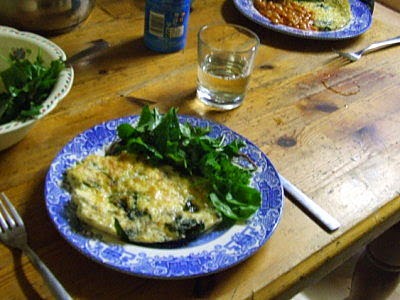
We picked out Hablitzia leaves and decided that whilst their flavour isn’t very distinctive it is pleasant and mild. And this I think is one of Hablitzia’s several virtues. Many other perennial vegetable leaves are on the bitter side but here is a plant which will give you plentiful mild shoots and leaves from very early in the year (Stephen has harvested shoots in the middle of winter in his garden in Norway and has a mature plant which produces some 250 shoots) and which will clad the walls even in a shady situation. I feel it earns its place in the perennial vegetable garden several times over and I’m sure we’re going to be using a lot of it in the years to come.
Ottawa Gardener
I do believe you are my favourite perennial vegetable blog. Thanks for another great post. This is a plant that I sell out of almost immediately each time I offer it.
Alison
Thank you indeed! A very likeable plant I think, bushy and cheery in their pots and fun to watch them shoot up their supports in the spring!
JL Norwich, VT
Really enjoying reading your blog. It's so hard to find information on what these plants really taste like. I am in search of a perennial spinach substitute that produces abundant tasty leaves that work well in a quick sauté and are cold hardy to zone 4b. Can you make a recommendation? I love GKH but only after blanching the leaves in boiling water. Would you recommend Caucasian spinach? Patience dock? I cannot find patience dock seeds in the U.S. thanks for any advice.
Alison
Yes I think I would recommend Caucasian spinach, although I still don't feel I can really say how it compares with spinach yet. I think we'll be cooking a lot of the leaves this summer so I should be very familiar with it by the autumn! And the same goes for patience dock, but more so – haven't tasted mine yet – sorry!
Anonymous
Hi Aliso,
I'm trying Hablitzia Tamnoides this year for the first time. It's getting off to a slow but sure start. It's been in the cold frame since Easter weekend and is still only 4-5cm tall but the leaves seem to be thickening up nicely. I planted a few in the ground yesterday – maybe the extra root space will help them put a spurt on. I'm hoping to grow one up a lilac tree in the garden, to take advantage of a bit of verticality.
Does HT build up a root system under the ground, year on year? If so then a slow start in the first year is no problem. I find with many perennials that they invest quite a lot in their roots first and only later do they put on some serious above-ground growth.
Have a good season
Cheers,
Paul R
Alison
Hi Paul, I'm sure it will get going once it can get its roots down – they do build up a big root system. I had reason to dig up a plant and the roots certainly went down more than a spade's depth and were several centimetres thick in places. Here is a picture: http://ow.ly/N63zw
startingwithrufus
Hello,
Absolutely love your blog! I'm trying to track down some Hablitzia at the moment, but am having very little luck. I don't suppose you have one going spare do you? I'd be more then happy to pay.
Hope you're well.
GG x
Alison
Hi Rufus, Yes I have some. Follow the Buy Plants link at the top of the page and we can make email contact and I can send you details.
Owen
Hello Alison- could I ask how do you rate it now after having Hablitza for a few years- is it still considered a valuable addition to your garden? Would you recommend it? Or perhaps just unusual rather than must have? Many thanks!
Alison Tindale
Hi Owen,
It is certainly one of my ‘must haves’ now. I think its shade loving qualities puts it especially high in my ratings because I have a very shady yard next to my house and it grows well even in the corner that gets no direct sun throughout the year. Add to that the fact that it climbs to about 10ft so you get a lot of leaves for the space it takes. It is a pleasantly mild flavour, nothing outstanding, but useful, nutritious and gives a plentiful harvest of leaves from spring to the end of summer (and earlier leaf shoots and flower shoots are good eating too). Once you get it going, it is undemanding, very early into leaf and very hardy and long-lived. As you can see, I quite like it!
Melinda Hawthorne
Fantastic to see the update. I have started some from seed from Incredible Veg and they are now a few inches high and am trying to decide whether I can put them in the ground or not. Am going to start introducing them to the outside either way so that they are ready next weekend. Great blog, thanks.
Alison Tindale
Thanks Melinda. They do like to get into the ground I find. Just watch out for snails!
Tom H
A year and a month on from the previous post; I have 50 tiny seedling H.tamnoides popping up in a plastic takeway tub here in North Wiltshire following directions supplied with seeds from Incredible Vegetables – great!
We have a pretty shady tightly-planted and mature orchard so we’ll find out how some of these Hablitzias grow when combined with hops (yes I’m boasting now but they are home-grown seedling hop plants personally collected from wild plants in the mountains of Central Asia) – I planted the hops on the sunniest side of each apple trunk so the Habs can sit on the shady side.
Ferric phosphate slug pellets – read the label carefully – are the only ones we should be using for slug and snail control, if any.