Consider the Lilies
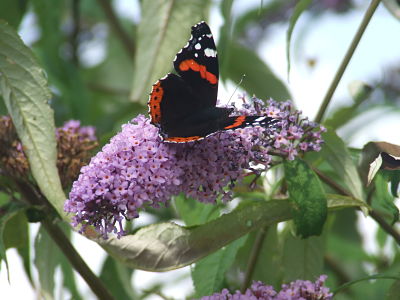
It was glorious summer at the allotment yesterday and the insects were loving it.
But summer is a sort of hungry gap for me where perennial vegetables are concerned. There’s still plenty of the almost-all year-around crops like kale, rocket, watercress and sorrel. And there would be plenty of fresh green growth on other leafy vegetables such as Good King Henry and bladder campion if I was already in the habit of chopping them down in early summer when they start to throw up flowering shoots. (I’ve realised that this is important seasonal work – yes work! – in the perennial vegetable gardener’s annual round).
But exciting vegetable fruits like the tomatoes, beans and summer squashes which are being harvested from the annual garden are lacking in the perennial vegetable garden. There are possibilities: less well known fruits like those of the snowbell tree or the clammy ground cherry, and also attempts by breeders to develop hardier versions of tender perennial vegetables or perennial versions of annual ones. But no fruits yet which really satisfy the desire for juicy summer veg.
There are plenty of edible flowers. Firstly lots of bright and beautiful petals to incorporate in salads. I don’t really count these as vegetables, being less substantial and used in small quantities. But fat flower buds like those of the globe artichoke and daylily are another matter.
 |
| Globe artichoke |
 |
| Daylily |
Globe artichokes are one of the few perennial vegetables that appear in conventional gardening books so there is plenty of information on how to grow and cook them. Daylilies are uncommon fare here but popular in China (see my daylily post from July 2013).
I cooked our last globe artichoke yesterday but being in experimental mood thought I’d try the buds of the related cardoon too. Usually it is the leaf stalks and leaf midribs of the cardoon which are eaten after being bundled up in cardboard to blanch them. If you’ve grown your cardoons from seed and planted them out in spring they will be about 3 feet high and ready to blanch in autumn. See Au Potager, a wonderful French gardening website, for details. But I’m growing my cardoon as a perennial and it attained this height in April after being planted last year.
 |
| Cardoon in April |
 |
| Cardoon in August |
I mean to try blanching and harvesting the leaves next spring (and then I should follow Martin Crawford’s advice to do this every other year so the plant can regain its strength).
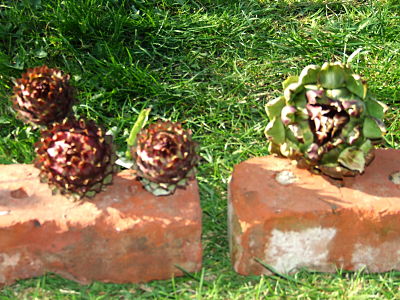
Here are the cardoon and globe artichoke buds I picked and cooked and ate:
 |
 |
There are several ways to enjoy globe artichokes but the very simplest is to steam the heads whole until the scales pull away easily from the rest of the bud (which takes anything from twenty-five to fifty minutes) and then taking each scale in turn, dip its base into melted butter and scrape away the fleshy portion of the scale with your teeth. And when you’ve eaten all the scales, remove the fibrous choke with a spoon and enjoy the succulent artichoke heart which lies hidden beneath it. (This video from Brandi Milloy is great for the extra details.)
 |
| Artichoke bud scale |
 |
| Revealing the artichoke’s heart |
 |
| Much tinier cardoon scales |
 |
| Cardoon heart in centre of picture |
The cardoon bud scales were as tasty as the globe artichokes but less fleshy and too small and fiddly to bother with again. The heart was perhaps two-thirds the size of the globe artichokes and again equally delicious. I’m not sure if I’d bother with the hearts again either though, especially as the bees adore the open flowers, but, just in case, it’s good to know they are there!
Another plump summer flower bud that is recommended for eating is that of scorzonera. If you know of more please do leave a comment below!
cin
Over here the daylillys are done for this year as are the scorzonera flowers. I do have a hosta that is flowering. The flowers have the same crunchiness as daylillys. I have two varieties of hosta and as they flower at different moments I can enjoy the flowers over a longer period.
Alison
Thank you cin! I've never tried hosta flowers. Do you cook them? I have just Hosta sielboldiana Elegans but I hope to add to my collection in time.
cin
Hi Alison, no I eat them raw in a salad or as a little snack when I walk along them. But I guess they would make good fritters. Unfortunately I have no clue which varieties they are.
Alison
Thanks cin. Following your lead I've since read that H. fortunei and H. plantaginea are especially prized for their edible flowers.