Wild Cabbage Update 2
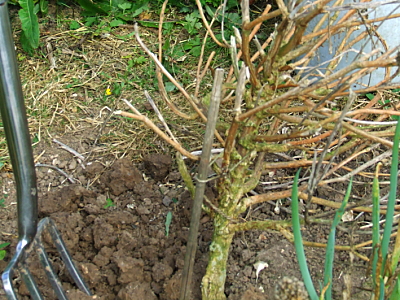
This is the last of the five wild cabbage plants I planted in the spring of 2013. Dead. And its fellow survivors (see last update) died earlier this year too.
To give them credit, as this was their third season they had made it to the rank of perennial (living for more than two years). Only just – but the possibility of perenniality is in there. My plans now are to grow more plants from seed and keep a look out for longer-lived specimens to then propagate by cuttings.
Since first writing about wild cabbage I’ve learnt that many botanists consider that some or possibly all of the wild cabbages that grow around our shores have actually escaped from earlier cultivation and naturalised. See link for a discussion of this and support for the idea that cabbages were first cultivated from wild plants growing in the Mediterranean region. Perhaps it follows that the genetic make-up of ‘wild’ plants, having come from plants in gardens, allotments and fields whose ancestors came from diverse locations abroad, will vary between separate locations in the British Isles even more than if they were native. So I’m interested in sourcing seed from a variety of wild populations. A trip to Staithes, on the North Yorkshire coast, is planned at least. The wild cabbages that grow there are known as Silverwhips.
And looking back over that last update I’m going to try a different care plan for my next lot! I had left one of my original plants to flower freely. It appeared to die but then started to produce leaves from the base.

True it then copped it, but probably because I let it go too short of water during the summer. If it hadn’t died of thirst perhaps it would have had more vigour and gone on to have enjoyed a longer life than the plants that had to keep producing more and more flower shoots as I repeatedly pruned them to prevent them from flowering.
Incidentally, unlike that one wild cabbage that appeared to come back to life, the plant pictured at the top of the page was truly dead. I left it for a good long while to make sure!
(Wild cabbage update 3 here.)
Gwenfar’s Garden
Interesting experiment. Based on your previous post, these lot were short-term perennials. Before they died, did they continue to withstand pest attack, particularly white cabbage moth?
Alison
Hi Julieanne! Not really sure I'm afraid. I've tended to net these plants, along with various assorted perennial brassicas growing alongside them. I wouldn't say the butterflies had no access to them but I don't think they had much. My experience so far is that perennial brassicas as a group aren't safe from munching by caterpillars (hence the nets) – but some types seem to fare better than others. I've read evidence that butterflies initially detect the plants using their shape, colour and contrast against the bare earth so they might find the task harder where there is a dense mixed planting or a disguising ground cover.
cin
Inspired by the permaculture method to leave roots in the ground to decompose I left all the roots of last years cabbage patch in the ground. By spring it was clear two broccoli's and one red cabbage survived. The broccoli's had tiny buds and flowered so quick I decided to take them out, because i needed the space. The red cabbage grew very nice and seemed to be left alone by pests. It was surrounded by nasturtiums and melons, and heavily mulched with grasclippings, no bear ground to be seen. Unfortunately some kind of vole decided to eat its roots. I did make a salad out of it but I think it was still to immature because it tasted awfull. Anyway, for me this experience confirms that even with annual strains there are possibilities of perenniality. Good luck with your experiments.
Alison
Thank you cin – and with yours 🙂